Stock Analysis · Service Corporation International (SCI)
Overview
Service Corporation International is the largest funeral, cemetery, and cremation services company in North America. It operates funeral service locations and cemeteries across the United States and Canada under a portfolio of local brands as well as the Dignity Memorial network. In simple terms, the company helps families with funeral arrangements, burial and cremation services, cemetery property, memorial products, and advance planning.
The business is built around two main segments. Funeral operations generate revenue from services performed at the time of need, while cemetery operations combine current services with property sales and merchandise that can be delivered over time. A notable part of the model is preneed sales: customers arrange and often fund services before they are needed, which gives SCI recurring sales activity and supports future revenue visibility.
Based on recent company reporting, SCI’s revenue mix is roughly organized as follows:
- Funeral operations: about 60% to 65% of revenue. This includes traditional funerals, cremation services, related merchandise such as caskets and urns, and service fees.
- Cemetery operations: about 35% to 40% of revenue. This includes cemetery property, interment rights, lawn and mausoleum crypts, memorialization products, merchandise, and cemetery services.
Within that mix, cremation continues to represent an important industry shift. It typically carries a lower average ticket than a traditional burial funeral, but it also reflects where consumer preferences are moving. SCI’s scale allows it to participate in both traditional burial and the ongoing rise of cremation, while its cemetery portfolio adds a harder-to-replicate asset base than a pure funeral operator would have.
Over the last several years, the company’s revenue has been relatively stable in the low-$4 billion range, while profits have normalized from the unusually strong pandemic period. Even with that normalization, operating income has stayed solid, showing that the company still converts a meaningful share of sales into earnings.
The long-term picture is one of a large, steady service business with resilient demand, strong cash generation, and a meaningful base of physical assets, but also with costs and financing expenses that matter a great deal to the final profit line.
Key Figures
| Metric | Value | Sector ⓘ |
|---|---|---|
| Date | Sep 12, 2026 | |
| Context | ||
| Sector | Consumer Cyclical | |
| Industry | Personal Services | |
| Market Cap ⓘ | $11.20B | |
| Beta ⓘ | 0.81 | |
Value (Cheapness) | ||
| P/E Ratio ⓘ | 20.81 | 17.10 |
| FCF Yield ⓘ | 6.30% | 8.53% |
| EBIT / EV ⓘ | 6.15% | 6.46% |
| PEG ⓘ | 1.44 | |
Growth (Business expansion) | ||
| Revenue Growth ⓘ | 3.60% | 5.75% |
| RPS Growth (5Y CAGR) ⓘ | 5.52% | 9.14% |
| EPS Growth (5Y CAGR) ⓘ | -18.23% | -18.21% |
| Margin Growth (5Y Trend) ⓘ | -5.27% | -0.23% |
| FCF Growth (5Y CAGR) ⓘ | -2.64% | 4.91% |
Quality (Business durability) | ||
| ROIC (Latest) ⓘ | 12.65% | 12.61% |
| ROIC (5Y Median) ⓘ | 11.69% | 10.72% |
| Net Debt / EBIT (Latest) ⓘ | 5.15 | 2.10 |
| Net Debt / EBIT (5Y Median) ⓘ | 4.83 | 2.32 |
| Operating Margin (Latest) ⓘ | 22.40% | 9.25% |
| Operating Margin (5Y Median) ⓘ | 23.12% | 9.64% |
| Debt to Equity (Latest) ⓘ | 344.98% | 75.78% |
| Profit Margin (Latest) ⓘ | 12.30% | 5.33% |
| Free Cash Flow (Latest) ⓘ | $706.41M | |
Momentum (Price trend) | ||
| 3Y Return ⓘ | +41.69% | +14.53% |
| 12M Return (excl. last month) ⓘ | +6.31% | +3.08% |
| 6M Return ⓘ | +5.57% | +0.55% |
| Price vs. 200-Day MA ⓘ | +3.48% | -0.54% |
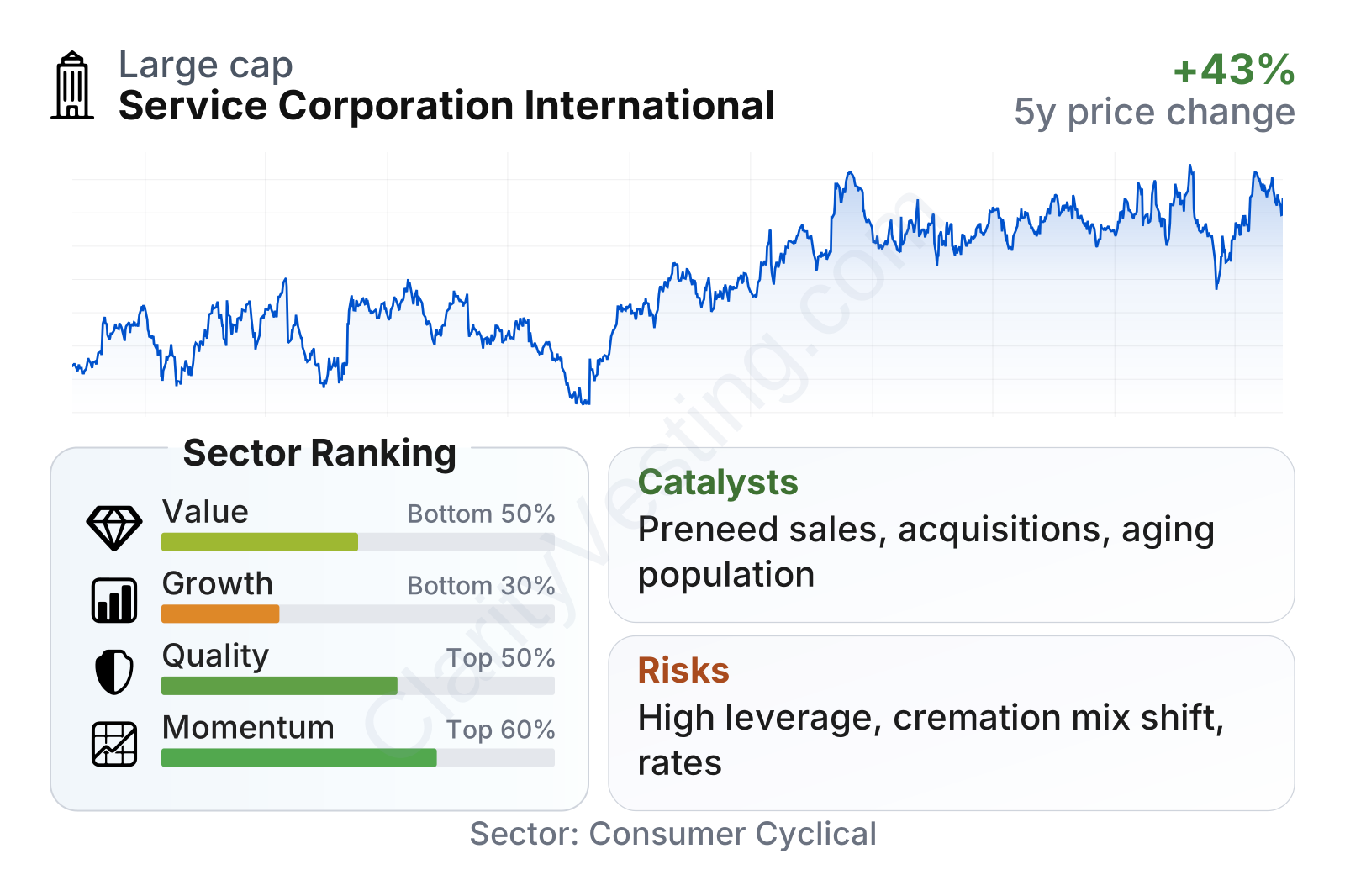
SCI sits in the large-cap range for its niche and has shown relatively low share-price volatility, with a beta below 1. The broader profile is mixed. Profitability remains better than many sector peers, especially on operating margin and net margin, and free cash flow remains substantial at around $700 million on a trailing basis. At the same time, growth metrics are weaker than the sector median, leverage is clearly elevated, and valuation is not especially cheap relative to the company’s recent growth pace.
The share price trend over the past several years has been generally upward, although not in a straight line. That pattern fits a business that is defensive and cash generative, but not one that the market is valuing as a high-growth company.
Growth
SCI operates in a sector with durable demand rather than rapid expansion. Death care is not a cyclical growth industry in the usual sense, but it does benefit from long-term demographic support, especially the aging of the population in the United States and Canada. That makes the company’s growth profile more about steady volume, pricing, market share gains, preneed sales, and acquisitions than about explosive industry growth.
The company’s strategy is logical for this type of market. SCI uses its national scale to support local brands, expands its cemetery and funeral footprint through acquisitions, and leans heavily on preneed arrangements. Preneed is important because it can lock in future business, improve customer relationships earlier, and create a pipeline that smaller competitors may struggle to match. SCI has also been investing in digital tools and customer experience, which matters as more families begin planning and comparing services online.
Recent revenue growth has been positive but modest, mostly in the low-single-digit range, with some weaker periods after the pandemic surge faded. That is consistent with a mature industry. The key question is not whether SCI can grow quickly, but whether it can keep compounding through disciplined pricing, stable service demand, cemetery sales, and continued consolidation of independently owned operators.
Free cash flow has remained strong despite some fluctuation, which is one of the more attractive parts of the business. A company in a slow-growth sector can still create value if it consistently turns earnings into cash and uses that cash effectively for acquisitions, debt management, dividends, and share repurchases. SCI has a long record of doing this, although the balance between returning cash and controlling leverage remains important.
A meaningful catalyst is the industry’s fragmented structure. Many funeral homes and cemeteries are still independently owned, leaving SCI room to keep buying assets and integrating them into its larger network. Another catalyst is preneed cemetery and funeral sales, which can support future recognized revenue. Demographics also remain supportive over a multi-year horizon, even if annual growth rates stay moderate.
Recent company updates have continued to emphasize comparable business growth, preneed production, and disciplined capital deployment rather than any single transformational event. That fits the company’s overall profile: SCI’s opportunity is based more on repetition and scale than on a sudden breakthrough.
Risks
This article is for informational purposes only and does not constitute financial advice. Some content is AI-generated. See Disclaimer


