Stock Analysis · Standard Chartered PLC (SCBFY)
Overview
Standard Chartered PLC is an international bank focused mainly on Asia, Africa, and the Middle East. Unlike many large Western banks that rely heavily on their home markets, Standard Chartered earns much of its business from cross-border trade, corporate banking, wealth management, and retail banking in faster-growing emerging economies. Its franchise is built around serving companies involved in international commerce, financial institutions, affluent clients, and mass retail customers across more than 50 markets.
The group reports four main business segments. Based on its recent annual reporting structure, revenue is primarily generated from the following activities:
- Corporate & Investment Banking: approximately 40% to 45% of income. This includes transaction banking, trade finance, cash management, lending to large companies, and capital markets activity.
- Wealth & Retail Banking: approximately 35% to 40% of income. This covers deposits, mortgages, cards, unsecured lending, bancassurance, priority banking, and investment products for individuals.
- Ventures and other activities: approximately 5% to 10% of income. This includes digital ventures, innovation businesses, and other smaller operations.
- Central and treasury-related items: the remainder, typically a low-to-mid single-digit percentage impact, can vary depending on funding, hedging, and accounting items.
Another useful way to understand the bank is by product mix rather than by segment. A large share of operating income comes from net interest income earned on loans and deposits, while the rest comes from fees, commissions, trading, and wealth-related income. In recent years, higher interest rates helped the interest income line, while wealth products, foreign exchange, and cross-border transaction services added diversification.
Geographically, the business is concentrated in markets such as Hong Kong, Singapore, India, mainland China, the United Arab Emirates, and several African economies. That footprint is important because it gives the bank exposure to trade corridors connecting Asia, the Gulf, and Africa rather than to one single domestic economy.
The long-term picture shows a business that has expanded revenue and profit meaningfully since 2021. Revenue and operating income have moved up steadily, and net income has improved even after absorbing higher costs and taxes. That suggests the recent earnings improvement has not come from one isolated line item alone, but from broader business momentum.
Key Figures
| Metric | Value | Sector ⓘ |
|---|---|---|
| Date | Nov 14, 2026 | |
| Context | ||
| Sector | Financial Services | |
| Industry | Banks - Diversified | |
| Market Cap ⓘ | $64.19B | |
| Beta ⓘ | 0.49 | |
Value (Cheapness) | ||
| P/E Ratio ⓘ | 12.47 | 12.38 |
| P/B Ratio ⓘ | 1.22 | 1.54 |
| FCF Yield ⓘ | 1.24% | 8.62% |
| Dividend Yield ⓘ | 2.34% | 2.91% |
| EBIT / EV ⓘ | 0.72% | 8.22% |
| PEG ⓘ | 0.80 | |
Growth (Business expansion) | ||
| Revenue Growth ⓘ | 15.60% | 7.00% |
| RPS Growth (5Y CAGR) ⓘ | 38.97% | 12.30% |
| EPS Growth (5Y CAGR) ⓘ | 28.79% | -0.81% |
| BVPS Growth (5Y CAGR) ⓘ | 3.73% | 4.87% |
| Margin Growth (5Y Trend) ⓘ | -6.46% | -4.00% |
| FCF Growth (5Y CAGR) ⓘ | N/A | 4.68% |
| DPS Growth (5Y CAGR) ⓘ | 35.33% | 8.77% |
Quality (Business durability) | ||
| ROIC (Latest) ⓘ | 3.89% | 9.69% |
| ROE (Latest) ⓘ | 10.91% | 14.05% |
| ROA (Latest) ⓘ | 0.61% | 1.58% |
| ROIC (5Y Median) ⓘ | 2.45% | 7.79% |
| ROE (5Y Median) ⓘ | 7.02% | 12.05% |
| ROA (5Y Median) ⓘ | 0.42% | 1.28% |
| Net Debt / EBIT (Latest) ⓘ | 2.23 | 0.97 |
| Net Debt / EBIT (5Y Median) ⓘ | -7.62 | 0.73 |
| Net Debt / EBITDA (Latest) ⓘ | 1.94 | 0.75 |
| Operating Margin (Latest) ⓘ | 19.61% | 23.57% |
| Operating Margin (5Y Median) ⓘ | 28.25% | 24.30% |
| Debt to Equity (Latest) ⓘ | 165.41% | 59.34% |
| Profit Margin (Latest) ⓘ | 27.22% | 26.53% |
| Free Cash Flow (Latest) ⓘ | $797.00M | |
Momentum (Price trend) | ||
| 3Y Return ⓘ | +312.87% | +85.82% |
| 12M Return (excl. last month) ⓘ | +52.55% | +16.88% |
| 6M Return ⓘ | +14.95% | +8.29% |
| Price vs. 200-Day MA ⓘ | +11.16% | +5.17% |
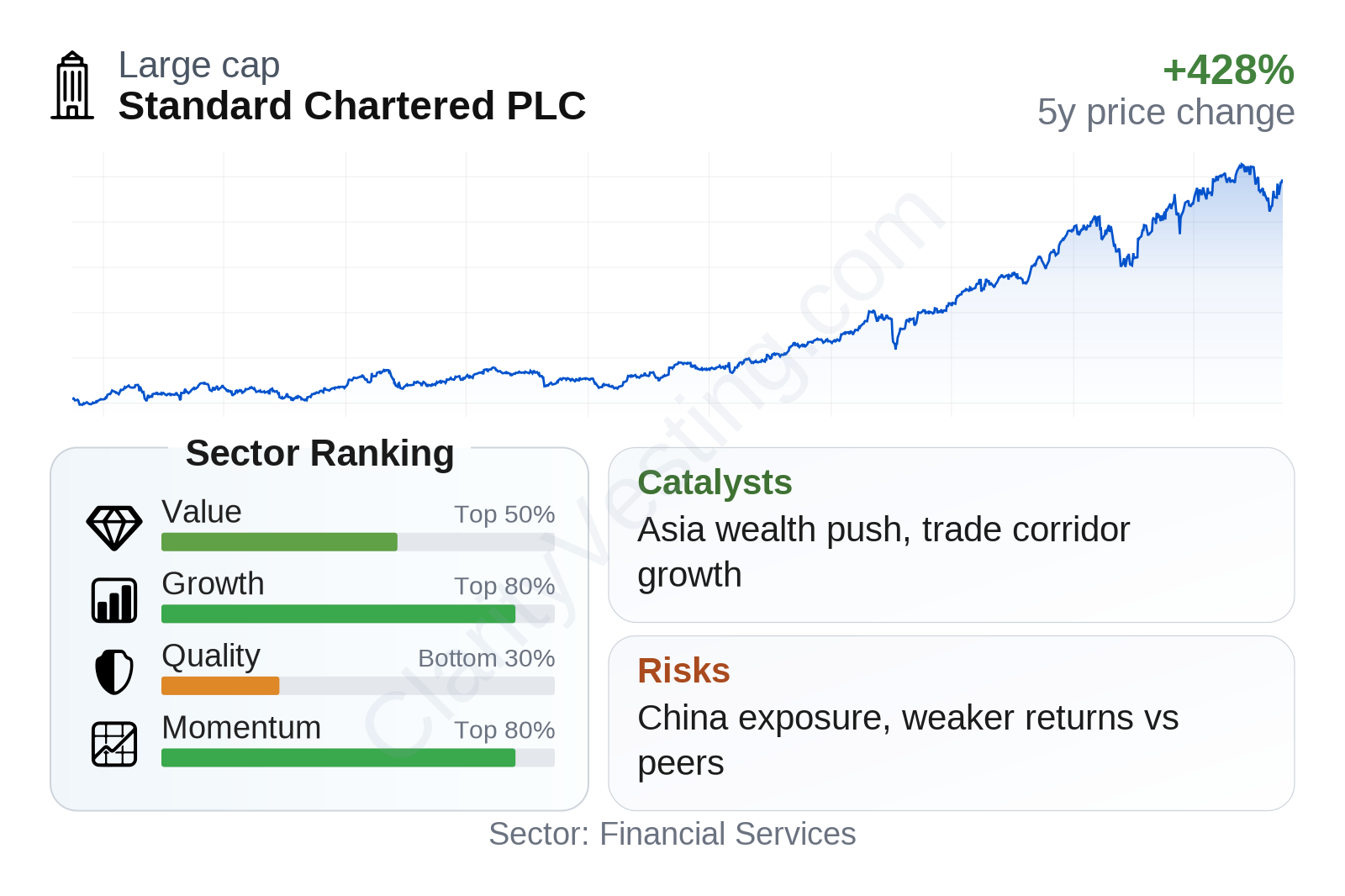
Standard Chartered is a large global bank with a market value in the tens of billions of dollars, and its share-price volatility has been lower than the broader market, as reflected by a beta below 1. On the factor breakdown, the company stands out more for growth and momentum than for traditional value or quality measures. Profit growth over several years has been strong, but profitability ratios and income efficiency still trail many peers in the diversified banking sector.
The stock’s multi-year performance has been very strong, with the share price rising several times over from late 2021 to mid-2026. That rerating means the market has already recognized a good part of the operational improvement. At the same time, the valuation multiples are no longer deeply discounted versus the sector, even though the bank still does not match stronger peers on return metrics.
Growth
Standard Chartered operates in parts of global banking that still have structural growth potential. Cross-border payments, trade finance, affluent wealth management, and financial services in emerging Asia, the Gulf, and Africa remain supported by rising incomes, growing regional trade, and ongoing digitization. Those areas are generally more attractive than mature low-growth banking markets in Europe.
The strategy also has a clear logic. Management has been focusing capital on affluent retail clients, wealth products, transaction banking, and markets where the bank already has scale. This matters because wealth and fee-based services can make earnings less dependent on pure lending spreads, while transaction banking creates sticky relationships with multinational companies and local champions.
Earnings per share have climbed sharply over the last several years, showing that the turnaround has been tangible rather than theoretical. Five-year earnings growth is well above the sector median, which signals stronger execution than many banking peers. Revenue growth in the latest year is not exceptional, but the longer-term trend remains favorable, especially given the bank’s exposure to faster-growing regions.
Book value per share has also trended upward overall, although with some pauses. For a bank, this is an important sign because it shows that capital has been building over time rather than being eroded. The pace is not as strong as the sector median, but the direction remains constructive and supports the idea of improving balance-sheet strength.
A meaningful catalyst is the bank’s continued emphasis on affluent clients and wealth management in Asia and the Middle East. These markets have been generating new financial wealth faster than many developed countries, and Standard Chartered already has established local banking licenses, brand recognition, and corporate relationships there. Another catalyst is the ongoing buildout of trade and transaction services tied to intra-Asia and Asia-Gulf commerce, where the bank’s network is more distinctive than that of many domestic competitors.
Recent company updates have also highlighted continued shareholder distributions through dividends and buybacks alongside capital discipline. While distributions do not create operating growth by themselves, they can reinforce confidence that management believes capital generation has become more reliable.
Risks
This article is for informational purposes only and does not constitute financial advice. Some content is AI-generated. See Disclaimer