Stock Analysis · Starbucks Corporation (SBUX)
Overview
Starbucks is one of the world’s largest coffeehouse companies. It sells beverages, food, packaged coffee products, and related merchandise through company-operated stores, licensed stores, and consumer packaged goods channels. The brand is built around premium coffee, convenience, customization, and a large loyalty ecosystem, with operations spanning North America, China, and many other international markets.
The business is still primarily driven by its stores. Based on recent annual reporting, revenue is concentrated in a few main streams:
- Company-operated stores: about 82% to 84% of total revenue. This includes drinks, food, and other items sold directly in Starbucks-run locations.
- Licensed stores: about 11% to 13%. These are royalties and product sales tied to stores run by partners rather than by Starbucks itself.
- Other revenue: about 4% to 6%. This includes packaged coffee, tea, ready-to-drink products through partnerships, equipment-related items, and other smaller activities.
Geographically, North America remains the core profit engine, while China is the most important international market and a major part of the company’s long-term expansion case. Recent years show that total revenue kept moving higher overall, but profits have been more volatile as labor, traffic, and operating costs have become harder to manage.
The broad financial flow shows a business that still converts a large revenue base into meaningful operating income, but with margin pressure compared with earlier peaks. Revenue has continued to edge up since 2021, yet operating income and net income have not followed at the same pace, which is a reminder that scale alone is not enough if store traffic and cost discipline weaken.
Key Figures
| Metric | Value | Sector ⓘ |
|---|---|---|
| Date | Sep 12, 2026 | |
| Context | ||
| Sector | Consumer Cyclical | |
| Industry | Restaurants | |
| Market Cap ⓘ | $112.56B | |
| Beta ⓘ | 0.96 | |
Value (Cheapness) | ||
| P/E Ratio ⓘ | 57.41 | 17.10 |
| FCF Yield ⓘ | 3.24% | 8.53% |
| EBIT / EV ⓘ | 3.25% | 6.46% |
| PEG ⓘ | 1.19 | |
Growth (Business expansion) | ||
| Revenue Growth ⓘ | -1.40% | 5.75% |
| RPS Growth (5Y CAGR) ⓘ | 7.41% | 9.14% |
| EPS Growth (5Y CAGR) ⓘ | -11.03% | -18.21% |
| Margin Growth (5Y Trend) ⓘ | -10.12% | -0.23% |
| FCF Growth (5Y CAGR) ⓘ | -14.26% | 4.91% |
Quality (Business durability) | ||
| ROIC (Latest) ⓘ | 32.02% | 12.61% |
| ROIC (5Y Median) ⓘ | 51.22% | 10.72% |
| Net Debt / EBIT (Latest) ⓘ | 4.43 | 2.10 |
| Net Debt / EBIT (5Y Median) ⓘ | 4.07 | 2.32 |
| Operating Margin (Latest) ⓘ | 11.18% | 9.25% |
| Operating Margin (5Y Median) ⓘ | 15.29% | 9.64% |
| Debt to Equity (Latest) ⓘ | -292.33% | 75.78% |
| Profit Margin (Latest) ⓘ | 5.17% | 5.33% |
| Free Cash Flow (Latest) ⓘ | $3.64B | |
Momentum (Price trend) | ||
| 3Y Return ⓘ | +10.64% | +14.53% |
| 12M Return (excl. last month) ⓘ | +19.26% | +3.08% |
| 6M Return ⓘ | -0.29% | +0.55% |
| Price vs. 200-Day MA ⓘ | +1.80% | -0.54% |
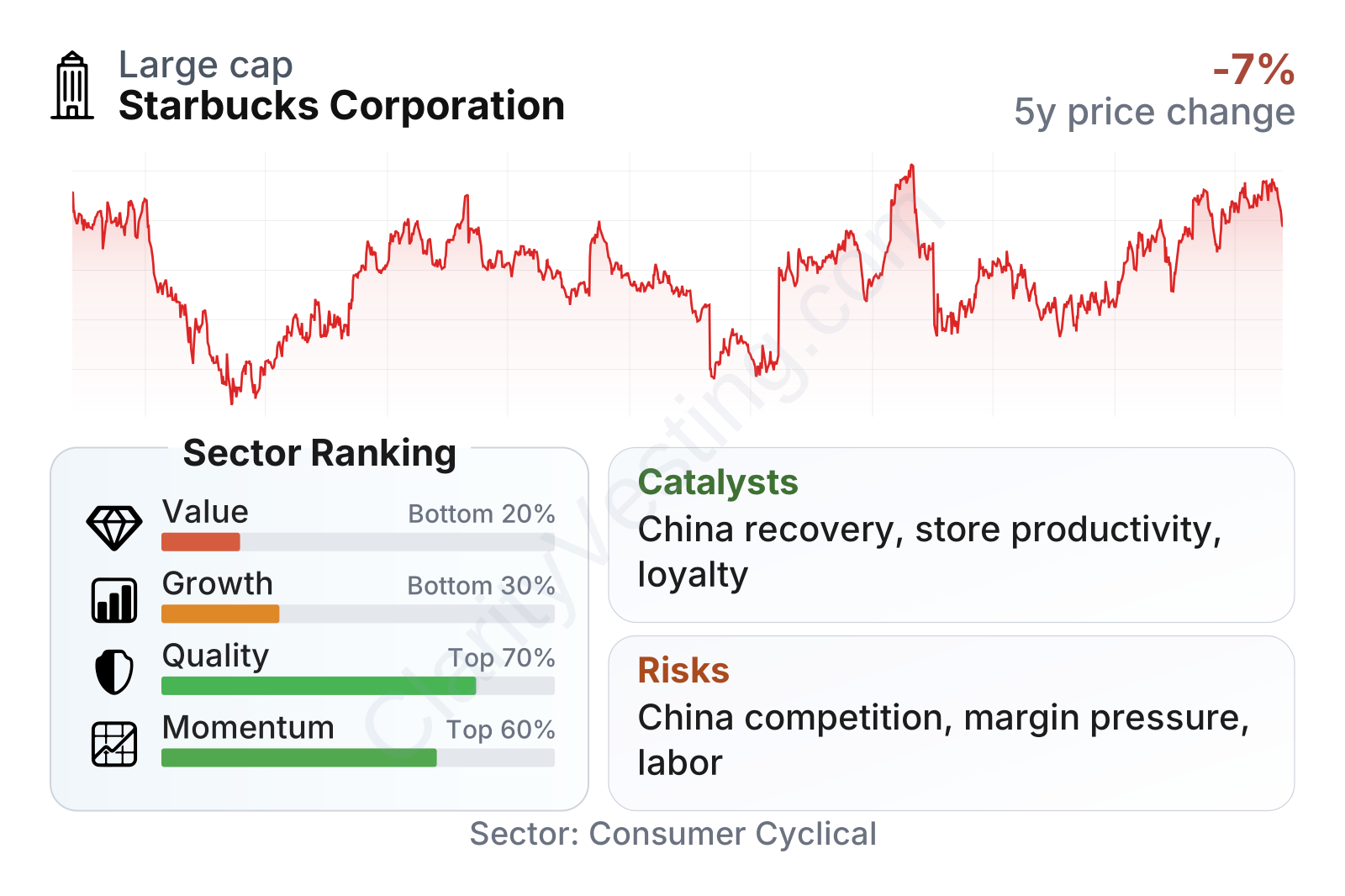
Starbucks remains a very large company with relatively moderate share-price volatility, as reflected by a beta close to 1. The quality profile is still solid overall: returns on invested capital are well above the sector median, and operating margin remains slightly above the industry midpoint despite a visible decline from its own historical levels. The weaker areas are value and growth. The stock trades at a much richer earnings multiple than the sector, while revenue growth, margin trend, and free cash flow trend have all lagged peers recently.
The market’s behavior over the past several years also shows changing expectations. After a deep reset in 2022 and another sharp drop in 2024, the stock recovered strongly into 2026. That rebound suggests investors are again assigning value to Starbucks’ brand strength and turnaround potential, but it also means expectations embedded in the share price have become more demanding.
Growth
Coffee remains an attractive long-term category. It benefits from frequent repeat purchases, pricing power in premium formats, and growing digital ordering habits. Starbucks also operates in a part of consumer spending where routine matters: many customers buy coffee several times per week, which can make demand more resilient than more discretionary restaurant occasions. On top of that, international coffee consumption still has room to grow, especially in markets where premium café culture is expanding.
That said, Starbucks’ recent growth pattern has been uneven rather than smooth. Revenue growth was strong through 2023, weakened during 2024, improved again through much of 2025, and then slipped back into a slight decline in the latest year-over-year reading. This pattern points to a company in transition rather than one enjoying uninterrupted momentum.
The company’s current strategy is centered on restoring store productivity, speeding service, improving labor execution, and re-energizing the customer experience. Management has also kept emphasizing the loyalty program, mobile ordering, premium beverages, and international store expansion. Those priorities make strategic sense because Starbucks’ economics improve meaningfully when traffic, order mix, and throughput work together. A stronger digital ecosystem can also support repeat purchasing without relying entirely on new store openings.
A major catalyst is the operational reset underway after a period of softer traffic and margin compression. If store-level execution improves, Starbucks has a large installed base that can generate better returns without needing a dramatic reinvention of the business. China is another important catalyst: it has been a volatile market, but it remains one of the biggest opportunities for unit growth and long-term brand development. New drink innovation, food attachment, and more efficient service models can also support future gains if execution improves.
Cash generation remains significant in absolute dollars, which gives the company flexibility, but the recent trend has been less impressive than its reputation might suggest. Free cash flow is still strong enough to matter, yet it has not shown a consistent upward path over the last several years. For a mature global consumer brand, this makes the next phase of operating improvement particularly important.
Risks
This article is for informational purposes only and does not constitute financial advice. Some content is AI-generated. See Disclaimer


