Stock Analysis · Sally Beauty Holdings Inc (SBH)
Overview
Sally Beauty Holdings Inc. is a specialty retailer and distributor focused on professional beauty products. The company sells hair color, hair care, styling tools, nails, and skin care products through stores, e-commerce, and distribution networks. Its customer base is split between everyday consumers and licensed salon professionals, which gives the business exposure to both do-it-yourself beauty demand and professional salon purchasing.
The company operates mainly through two business segments. Based on recent company filings, revenue is concentrated as follows:
- Sally Beauty Supply: approximately 55% to 57% of total revenue. This segment sells beauty products directly to retail consumers and also serves some salon professionals. It includes hair color, hair care, nail products, and beauty tools sold through stores and online.
- Beauty Systems Group: approximately 43% to 45% of total revenue. This segment distributes professional beauty products to salons and licensed beauty professionals, including professional hair color, care products, and salon equipment.
Geographically, the business is still centered on North America, with the United States representing the large majority of sales, while Canada, Mexico, Chile, the United Kingdom, Ireland, Belgium, France, the Netherlands, and Spain add international diversification.
The business model is relatively straightforward: buy branded and exclusive beauty products, sell them through a large store base and professional distribution network, and keep customers returning through recurring categories like hair color and maintenance products. That repeat-purchase nature is one of the more appealing parts of the company’s profile. Over the last several years, however, total revenue has been broadly flat to slightly down, while profitability has moved around more noticeably than sales. Gross profit has stayed fairly stable near the $1.9 billion range, but operating income and net income have been more pressured, showing that expense control matters a lot for this company.
The flow of the business shows a company with resilient gross profit but tighter room below that line. Sales have drifted slightly lower since 2021, while selling and administrative costs have remained high, which explains why earnings have been less stable than revenue.
Key Figures
| Metric | Value | Sector ⓘ |
|---|---|---|
| Date | Sep 12, 2026 | |
| Context | ||
| Sector | Consumer Cyclical | |
| Industry | Specialty Retail | |
| Market Cap ⓘ | $1.49B | |
| Beta ⓘ | 1.05 | |
Value (Cheapness) | ||
| P/E Ratio ⓘ | 8.23 | 17.10 |
| FCF Yield ⓘ | 16.14% | 8.53% |
| EBIT / EV ⓘ | 10.30% | 6.46% |
| PEG ⓘ | 0.70 | |
Growth (Business expansion) | ||
| Revenue Growth ⓘ | 0.20% | 5.75% |
| RPS Growth (5Y CAGR) ⓘ | 1.25% | 9.14% |
| EPS Growth (5Y CAGR) ⓘ | -9.65% | -18.21% |
| Margin Growth (5Y Trend) ⓘ | -2.18% | -0.23% |
| FCF Growth (5Y CAGR) ⓘ | -13.46% | 4.91% |
Quality (Business durability) | ||
| ROIC (Latest) ⓘ | 13.02% | 12.61% |
| ROIC (5Y Median) ⓘ | 19.75% | 10.72% |
| Net Debt / EBIT (Latest) ⓘ | 4.62 | 2.10 |
| Net Debt / EBIT (5Y Median) ⓘ | 4.31 | 2.32 |
| Operating Margin (Latest) ⓘ | 7.80% | 9.25% |
| Operating Margin (5Y Median) ⓘ | 9.08% | 9.64% |
| Debt to Equity (Latest) ⓘ | 173.89% | 75.78% |
| Profit Margin (Latest) ⓘ | 5.16% | 5.33% |
| Free Cash Flow (Latest) ⓘ | $241.21M | |
Momentum (Price trend) | ||
| 3Y Return ⓘ | +67.82% | +14.53% |
| 12M Return (excl. last month) ⓘ | +31.82% | +3.08% |
| 6M Return ⓘ | +10.83% | +0.55% |
| Price vs. 200-Day MA ⓘ | +7.63% | -0.54% |
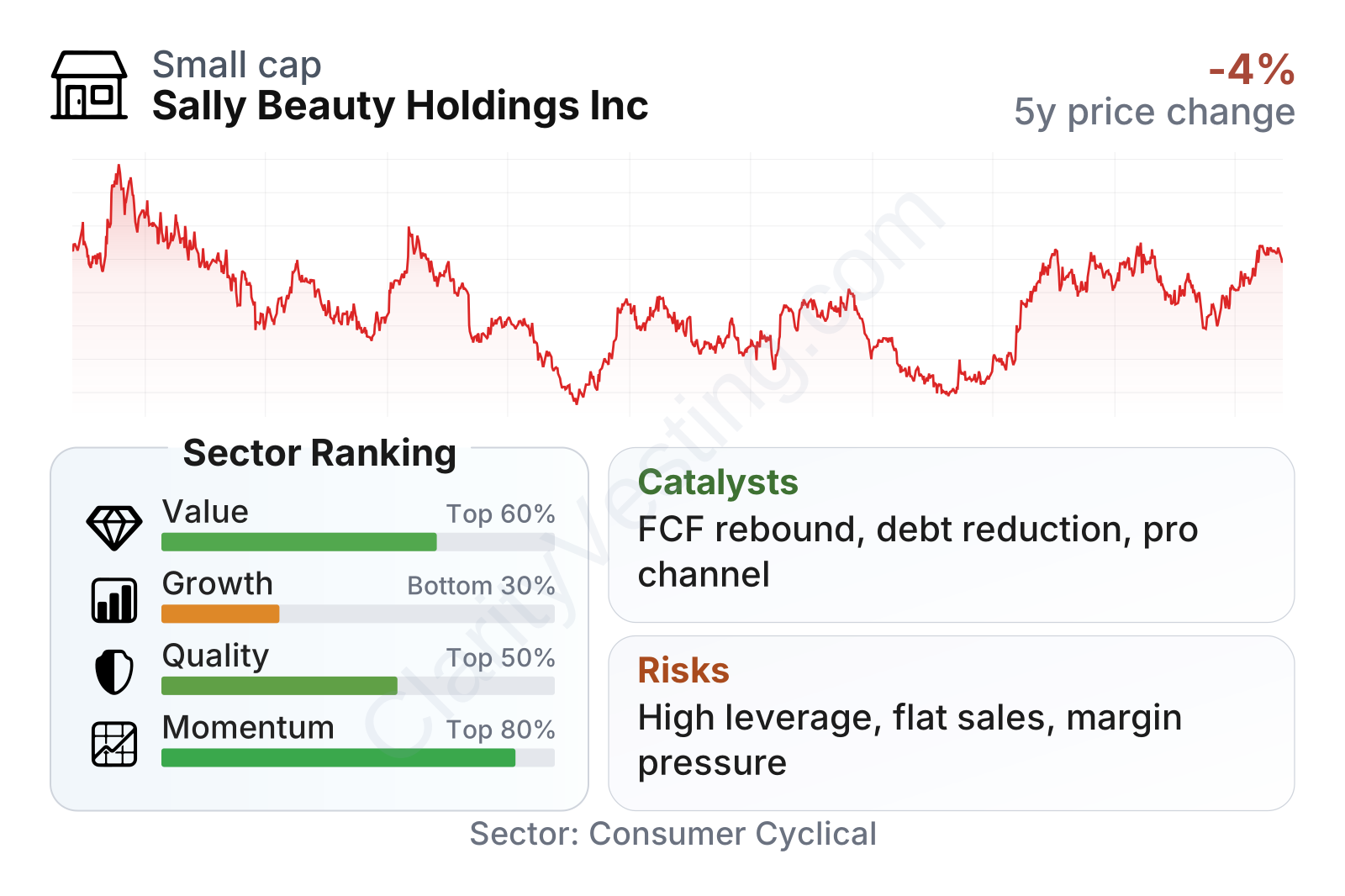
Sally Beauty is a mid-sized retailer with a market value around $1.5 billion and a share price history that has been volatile over the last few years. On a factor basis, the company looks stronger in value and roughly average in quality, while growth is clearly the weakest area. The most notable positives are a low earnings multiple compared with the sector, a free cash flow yield that stands well above the sector median, and returns on invested capital that remain respectable. The main offsets are slow revenue expansion, pressure on margins over time, and leverage that is still elevated even after improvement.
Growth
The beauty category is generally considered an attractive long-term consumer market because demand tends to be recurring and less vulnerable to abrupt shifts than many other discretionary categories. Hair color, maintenance, and salon-related spending benefit from repeat habits rather than one-time purchases. That said, Sally Beauty is not operating in a fast-growth corner of retail. It is participating in a stable category, but one where market share, merchandising, digital execution, and product innovation matter more than broad industry expansion alone.
Sally Beauty’s recent growth pattern has been modest. Revenue growth has moved between small declines and low single-digit gains, and the latest year-over-year pace is close to flat. That makes this more of an execution and efficiency case than a pure expansion case.
The recent revenue trend suggests stabilization rather than acceleration. After several uneven quarters, the company appears to be finding a floor, but it has not yet shown the kind of sustained top-line momentum that would clearly separate it from slower specialty retailers.
The company’s strategy for future growth is centered on a few practical levers: improving product assortment, growing owned and exclusive brands, strengthening loyalty programs, increasing digital engagement, and serving salon professionals more effectively. Those initiatives make sense because they build on existing strengths instead of pushing the company into unfamiliar categories. Exclusive products are especially important because they can support better margins and give shoppers a reason to come back rather than compare prices elsewhere.
Another useful support is cash generation. Even with limited sales growth, the company has remained capable of producing meaningful free cash flow, which can be used for debt reduction, store investments, technology upgrades, and share repurchases.
Free cash flow has improved sharply in the most recent trailing period, rising from the mid-$100 millions in prior years to well above $200 million. That does not prove a new long-term trend by itself, but it does show the business can still convert a mature revenue base into real cash when operations are managed well.
As for near-term catalysts, the most important ones are not likely to come from a single dramatic event. Instead, they would come from a combination of steadier same-store sales, better mix toward higher-margin products, continued debt reduction, and ongoing improvements in the professional channel. Recent company updates have also emphasized initiatives around customer engagement, assortment, and operational discipline, which fit the company’s current needs.
Risks
This article is for informational purposes only and does not constitute financial advice. Some content is AI-generated. See Disclaimer