Stock Analysis · Sanmina Corporation (SANM)
Overview
Sanmina Corporation is a large electronics manufacturing services company. In simple terms, it helps other companies design, build, assemble, test, and repair complex electronic products. Its customers are typically not buying a finished consumer brand from Sanmina; instead, they hire Sanmina as a manufacturing and engineering partner. The company serves industries where reliability matters a lot, including cloud infrastructure, communications networks, medical devices, industrial equipment, defense, aerospace, automotive, and semiconductor systems.
Sanmina’s business model is broader than basic contract assembly. It also provides product design, printed circuit boards, backplanes, cables, enclosures, precision machining, optics, memory and storage systems, and after-sales support. That makes it more integrated than many low-cost assemblers and helps it participate in more specialized, higher-complexity programs.
Based on the company’s latest annual filing, revenue comes mainly from two segments.
- Integrated Manufacturing Solutions (IMS): about 83% of revenue. This is the core business and includes printed circuit board assembly, system assembly, design and engineering, direct-order fulfillment, logistics, and repair services for end markets such as communications, cloud infrastructure, industrial, medical, defense, and automotive.
- Components, Products and Services (CPS): about 17% of revenue. This segment includes higher-value specialized offerings such as printed circuit boards, backplanes, cable systems, mechanical systems, precision machining, optical products, storage solutions, and some defense and aerospace-related products and services.
One useful way to understand Sanmina is that it sits behind many important technology and industrial systems without owning the final customer brand. That position can create steady demand when customers want manufacturing scale, regulatory know-how, and supply-chain support, but it also means revenue depends heavily on customer programs and spending cycles.
The business consistently converts a very large share of revenue into material and production costs, which is normal for contract manufacturing. The more important trend is that gross profit and operating income improved materially from 2021 to 2023, then softened in 2024 before recovering again in 2025 as revenue rebounded.
Key Figures
| Metric | Value | Sector ⓘ |
|---|---|---|
| Date | Sep 12, 2026 | |
| Context | ||
| Sector | Technology | |
| Industry | Electronic Components | |
| Market Cap ⓘ | $11.58B | |
| Beta ⓘ | 1.60 | |
Value (Cheapness) | ||
| P/E Ratio ⓘ | 38.57 | 29.51 |
| FCF Yield ⓘ | 5.13% | 4.25% |
| EBIT / EV ⓘ | 3.45% | 2.85% |
| PEG ⓘ | 0.70 | |
Growth (Business expansion) | ||
| Revenue Growth ⓘ | 69.70% | 15.40% |
| RPS Growth (5Y CAGR) ⓘ | 10.74% | 8.56% |
| EPS Growth (5Y CAGR) ⓘ | 14.72% | -11.88% |
| Margin Growth (5Y Trend) ⓘ | -0.24% | 0.46% |
| FCF Growth (5Y CAGR) ⓘ | 15.48% | 9.80% |
Quality (Business durability) | ||
| ROIC (Latest) ⓘ | 9.02% | 9.44% |
| ROIC (5Y Median) ⓘ | 23.12% | 8.30% |
| Net Debt / EBIT (Latest) ⓘ | 1.41 | 0.54 |
| Net Debt / EBIT (5Y Median) ⓘ | -0.70 | 0.44 |
| Operating Margin (Latest) ⓘ | 3.74% | 9.58% |
| Operating Margin (5Y Median) ⓘ | 4.47% | 8.25% |
| Debt to Equity (Latest) ⓘ | 95.05% | 33.33% |
| Profit Margin (Latest) ⓘ | 2.41% | 7.14% |
| Free Cash Flow (Latest) ⓘ | $594.15M | |
Momentum (Price trend) | ||
| 3Y Return ⓘ | +313.08% | +45.48% |
| 12M Return (excl. last month) ⓘ | +68.69% | +23.48% |
| 6M Return ⓘ | +70.95% | +20.93% |
| Price vs. 200-Day MA ⓘ | +17.06% | +7.43% |
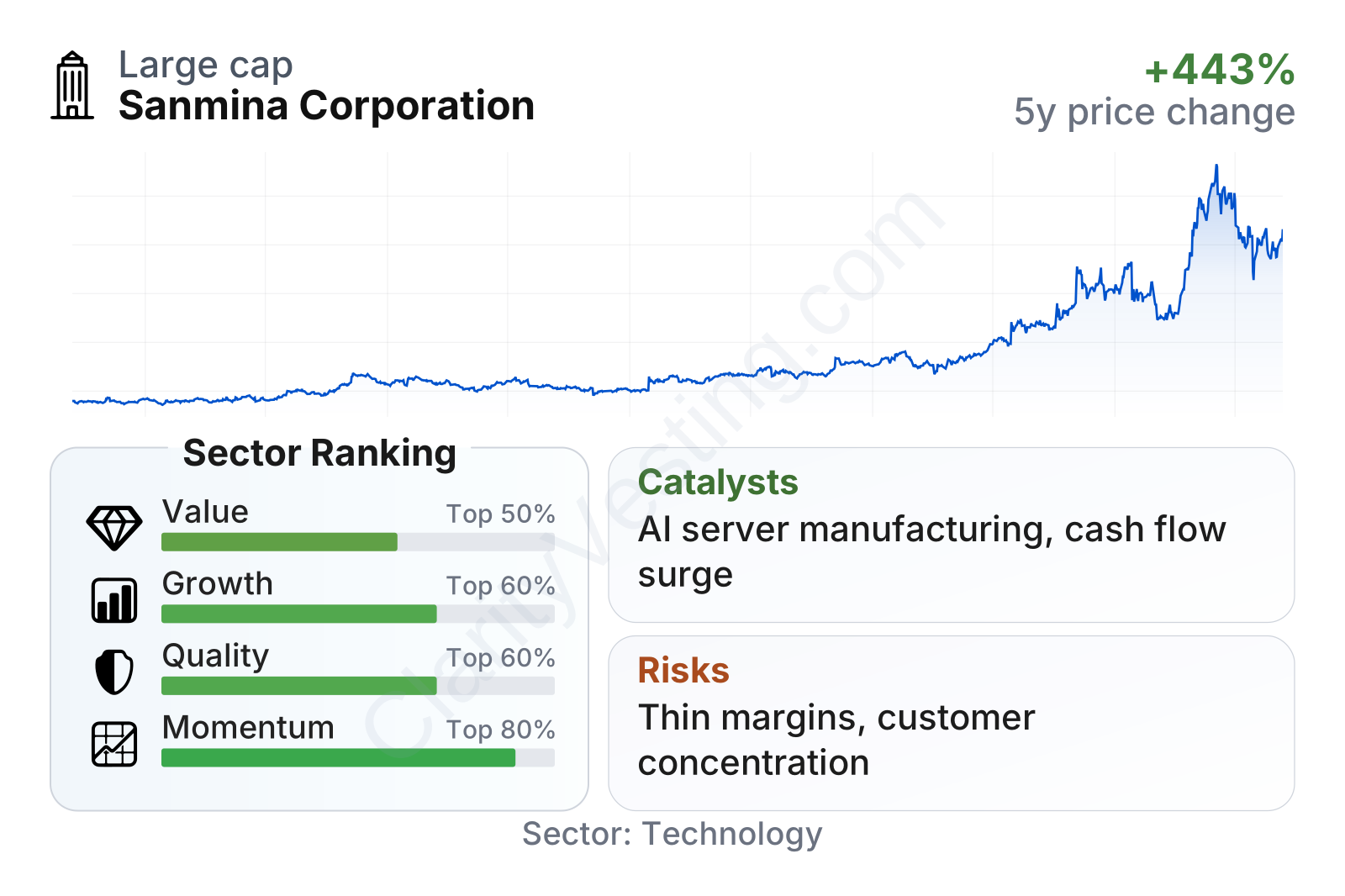
Sanmina stands out more for growth and cash generation than for classic high-margin quality. Its value profile is mixed: the earnings multiple is above the sector median, but cash-flow-based measures remain more favorable. Growth metrics are notably strong, with revenue, earnings, and free cash flow trends running well ahead of many peers, while profitability ratios remain modest for a technology company because contract manufacturing is structurally a lower-margin business.
Share-price performance has been exceptionally strong over the last three years, with a particularly sharp acceleration more recently. That kind of rerating usually reflects improving business momentum, but it also means expectations are higher than they were a few years ago.
Growth
Sanmina operates in parts of the market that still have long-term expansion drivers. Cloud infrastructure, AI-related hardware, industrial automation, medical technology, defense electronics, and more complex communications equipment all require advanced electronic manufacturing. Even when end markets move in cycles, the broader direction remains favorable because products are becoming more sophisticated and harder to manufacture at scale.
The company’s strategy appears logical for that environment. Sanmina is not trying to compete only on the lowest labor cost. Instead, it emphasizes complex manufacturing, engineering support, regulated industries, and specialized components. That matters because customers in medical, aerospace, defense, and high-performance computing often care more about precision, certification, and supply-chain reliability than just headline assembly cost.
The revenue trend has been volatile, which is common in this industry, but the latest phase shows a sharp rebound after a weaker period in 2023 and 2024. Recent year-over-year growth moved far above the broader sector median, suggesting Sanmina is benefiting from program ramps, acquisitions, or both rather than simply tracking the average electronics cycle.
Cash generation has also strengthened significantly. Trailing free cash flow rose from much lower levels a few years ago to well above $700 million at its recent peak, which is important because it shows the business is not relying only on accounting profits. Stronger cash flow gives Sanmina more room for debt management, acquisitions, capacity investments, and share repurchases.
A major recent growth catalyst is the acquisition of ZT Systems’ manufacturing operations and related AI infrastructure business assets from Advanced Micro Devices. That transaction expands Sanmina’s role in cloud and AI server manufacturing, one of the most active hardware buildout areas today. The deal also adds customer relationships, manufacturing capabilities, and exposure to systems tied to accelerated computing infrastructure. For a company already experienced in complex electronics, that is a strategically meaningful step rather than a side project.
Another supportive factor is the continuing trend toward supply-chain diversification and regional manufacturing resilience. Large customers increasingly want trusted manufacturing partners with global reach, quality systems, and the ability to support programs across industries and geographies. Sanmina’s footprint and broad service offering fit that need well.
Risks
This article is for informational purposes only and does not constitute financial advice. Some content is AI-generated. See Disclaimer