Stock Analysis · Sonic Automotive Inc (SAH)
Overview
Sonic Automotive is a U.S. auto retail company that sells new and used vehicles, arranges financing and insurance for buyers, and provides parts, maintenance, collision repair, and other aftersale services. The company operates through traditional franchised dealerships under the Sonic Automotive name and through EchoPark, its used-vehicle business. It also has a smaller powersports and commercial vehicle presence in selected markets. In simple terms, Sonic makes money both when a car is sold and when that vehicle comes back later for service, repairs, parts, and related products.
Based on the latest annual filings, revenue is concentrated in vehicle sales, while a much smaller share comes from higher-margin service and finance activities. A practical breakdown is:
- New vehicle sales: approximately 52% to 56% of revenue. This is the sale of new cars and light trucks through franchised dealerships.
- Used vehicle sales: approximately 27% to 31% of revenue. This includes used retail vehicles sold through Sonic dealerships and EchoPark.
- Wholesale vehicles and other: approximately 6% to 10% of revenue. This mainly covers vehicles sold to other dealers or auctions, plus smaller ancillary items.
- Parts, service, and collision repair: approximately 8% to 10% of revenue. This includes maintenance, repairs, replacement parts, and body shop work.
- Finance and insurance: approximately 2% to 4% of revenue. This includes arranging loans, leases, service contracts, and other vehicle-related protection products.
That revenue mix matters because the smaller categories, especially parts/service and finance/insurance, usually carry better margins than vehicle sales. Sonic’s long-term business quality therefore depends not just on how many cars it sells, but on whether it can expand customer retention, aftersale work, and disciplined used-car operations.
Operationally, the business remains low-margin by nature. Revenue has grown from roughly $12.4 billion in 2021 to about $15.2 billion in 2025, but a large majority of that revenue is absorbed by vehicle acquisition costs and operating expenses. Interest expense has also become much heavier than it was a few years ago, which helps explain why revenue growth has not translated into equally strong profit growth.
Key Figures
| Metric | Value | Sector ⓘ |
|---|---|---|
| Date | Sep 12, 2026 | |
| Context | ||
| Sector | Consumer Cyclical | |
| Industry | Auto & Truck Dealerships | |
| Market Cap ⓘ | $2.40B | |
| Beta ⓘ | 0.86 | |
Value (Cheapness) | ||
| P/E Ratio ⓘ | 12.18 | 17.10 |
| FCF Yield ⓘ | -2.30% | 8.53% |
| EBIT / EV ⓘ | 7.13% | 6.46% |
| PEG ⓘ | 0.73 | |
Growth (Business expansion) | ||
| Revenue Growth ⓘ | 7.60% | 5.75% |
| RPS Growth (5Y CAGR) ⓘ | 11.12% | 9.14% |
| EPS Growth (5Y CAGR) ⓘ | -25.48% | -18.21% |
| Margin Growth (5Y Trend) ⓘ | -1.79% | -0.23% |
| FCF Growth (5Y CAGR) ⓘ | 167.94% | 4.91% |
Quality (Business durability) | ||
| ROIC (Latest) ⓘ | 7.29% | 12.61% |
| ROIC (5Y Median) ⓘ | 7.69% | 10.72% |
| Net Debt / EBIT (Latest) ⓘ | 9.23 | 2.10 |
| Net Debt / EBIT (5Y Median) ⓘ | 9.05 | 2.32 |
| Operating Margin (Latest) ⓘ | 3.26% | 9.25% |
| Operating Margin (5Y Median) ⓘ | 2.95% | 9.64% |
| Debt to Equity (Latest) ⓘ | 455.52% | 75.78% |
| Profit Margin (Latest) ⓘ | 1.37% | 5.33% |
| Free Cash Flow (Latest) ⓘ | -$55.20M | |
Momentum (Price trend) | ||
| 3Y Return ⓘ | +56.19% | +14.53% |
| 12M Return (excl. last month) ⓘ | +5.48% | +3.08% |
| 6M Return ⓘ | +26.46% | +0.55% |
| Price vs. 200-Day MA ⓘ | +4.15% | -0.54% |
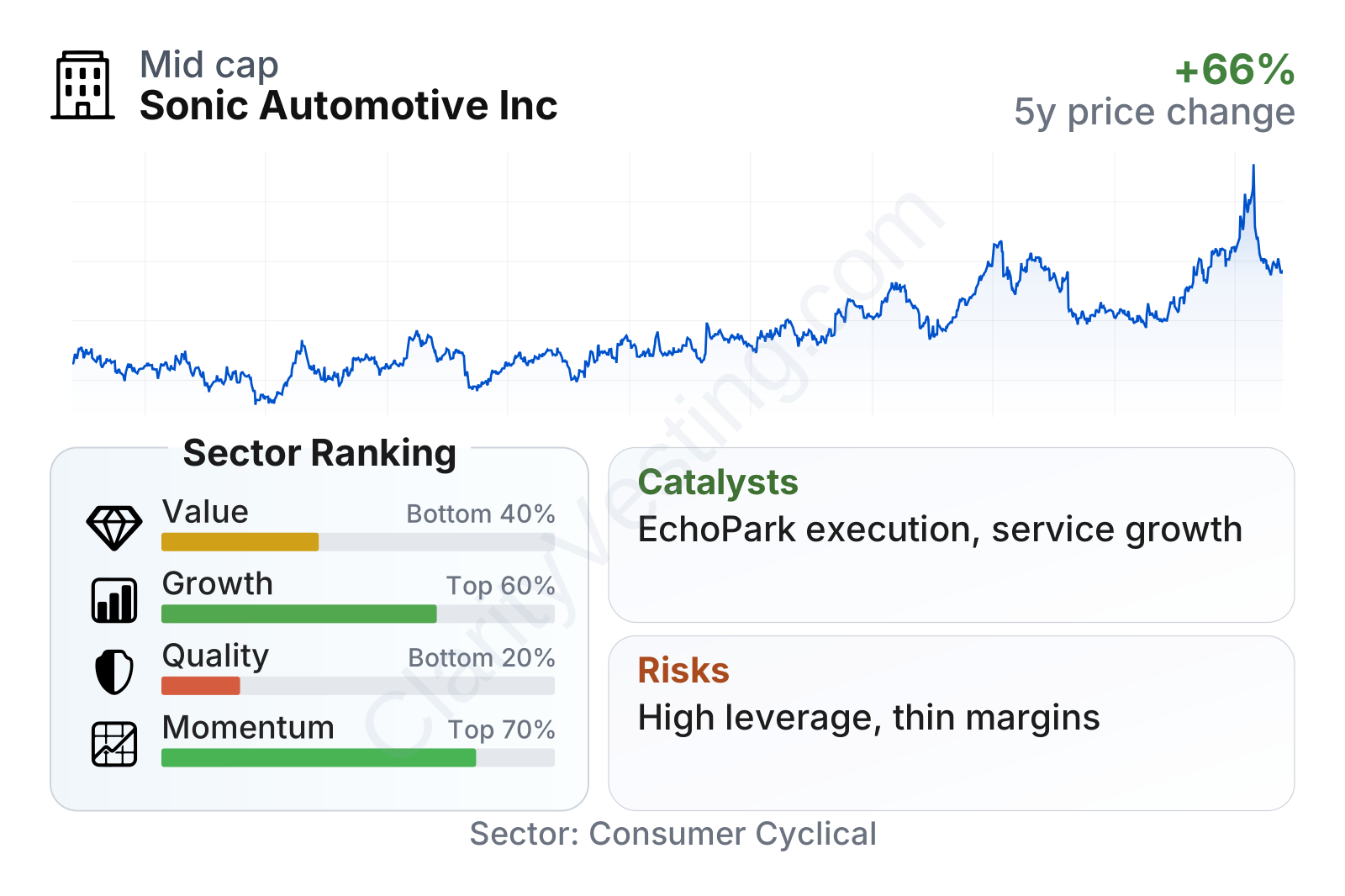
Sonic is a mid-sized public company in auto retail. The stock’s recent trading strength has been notable, with share performance over the last several years clearly ahead of much of the broader consumer cyclical universe. On valuation multiples, the shares do not screen as broadly expensive versus the sector median, but the quality profile is weaker: profitability, returns on invested capital, and balance-sheet leverage all sit below many peers. Growth indicators are more mixed, with sales expansion looking acceptable, while earnings and margins have been less consistent.
Growth
The company operates in a sector that is mature rather than fast-growing, but still capable of producing expansion through market share gains, acquisitions, used-vehicle execution, and higher service penetration. Auto retail benefits from a very large installed vehicle base in the U.S., which supports recurring demand for repairs, maintenance, replacement parts, and financing products even when new-car demand cools. That gives Sonic some exposure to a steadier revenue stream beyond vehicle unit sales.
Sonic’s strategy for future growth has two main pillars. The first is strengthening its franchised dealership network, where new-car sales feed later service visits, parts purchases, and financing opportunities. The second is improving the economics of EchoPark, which gives the company access to the large and fragmented used-car market. If management can improve inventory discipline, pricing, and local market density, the used-car platform could support volume growth without depending entirely on new-vehicle supply cycles.
Revenue growth has been uneven, which is normal in auto retail, but the recent trend has turned positive again. Over the latest period, year-over-year revenue growth was in the high single digits, slightly ahead of the sector median. Over five years, revenue per share growth has also been better than the typical peer. This suggests that Sonic has been able to expand its sales base, even though that growth has not flowed cleanly through to earnings.
Cash generation is another area to watch closely. Free cash flow has been volatile, moving from negative levels in earlier periods to a strong positive reading more recently, before the latest metrics table showed trailing free cash flow slipping back below zero. In this business, swings in vehicle inventory, working capital, and expansion spending can cause major short-term changes in cash flow. For a long-term view, the important question is whether Sonic can convert revenue growth into steadier cash generation rather than one-off rebounds.
Several industry and company-specific catalysts could help. A more normal new-vehicle supply environment supports dealership throughput. Growth in higher-margin fixed operations can lift earnings quality. Used-vehicle market normalization can also help if pricing remains disciplined. Recent company updates have also highlighted portfolio actions and operational focus around dealership performance and used-vehicle execution, which are more meaningful than headline unit growth alone.
Risks
This article is for informational purposes only and does not constitute financial advice. Some content is AI-generated. See Disclaimer


