Stock Analysis · SentinelOne Inc (S)
Stock Analysis · SentinelOne Inc (S)

Overview

SentinelOne is a cybersecurity software company focused on protecting computers, servers, cloud workloads, identities, and data from cyberattacks. Its platform uses artificial intelligence to detect threats, respond automatically, and help security teams investigate incidents more quickly. In simple terms, the company sells tools that help organizations prevent hackers from getting in, limit damage when something goes wrong, and manage security across complex digital environments.

The business has increasingly expanded from endpoint security into a broader platform approach. That matters because large customers often prefer fewer vendors and more integrated tools. SentinelOne positions itself as an AI-native security platform rather than a single-product provider, with products spanning endpoint protection, cloud security, identity security, security data, and managed offerings.

Its revenue is overwhelmingly subscription-based, which is common in software and helps create recurring sales. Based on the company’s filings, revenue is primarily generated from software subscriptions and related platform services, while a much smaller share comes from professional services.

  • Subscription revenue: roughly 95%+ of total revenue. This includes recurring access to the Singularity platform and related security capabilities.
  • Professional services and other: roughly under 5%. This includes implementation, support-related activities, and other non-recurring services.

Geographically, SentinelOne serves customers globally, with the United States representing the largest market, followed by international regions. The business model is attractive in principle: recurring revenue, high gross margins, and security products that become deeply embedded in customer operations. The main question is not whether the need exists, but whether SentinelOne can translate that demand into durable profitability.

The company’s recent financial pattern shows strong revenue expansion and a gross profit base that has scaled well, but operating costs still remain high. Research and development and sales spending continue to absorb much of the gross profit, which explains why the company has reached positive free cash flow while still posting sizable accounting losses.

Revenue has risen sharply over the last several years and gross profit has expanded with it, showing the underlying software economics are solid. The more difficult piece is operating discipline: spending on product development and sales remains heavy, so the business is still in a transition from rapid expansion toward sustainable earnings.

Key Figures

MetricValueSector
DateJul 18, 2026
Context
SectorTechnology
IndustrySoftware - Infrastructure
Market Cap $6.73B
Beta 0.82
Value
(Cheapness)
P/E Ratio N/A31.76
FCF Yield 0.66%4.18%
EBIT / EV -4.76%2.56%
PEG N/A
Growth
(Business expansion)
Revenue Growth 20.80%13.50%
RPS Growth (5Y CAGR) 26.71%8.57%
EPS Growth (5Y CAGR) -38.03%-21.87%
Margin Growth (5Y Trend) N/A0.41%
FCF Growth (5Y CAGR) N/A9.76%
Quality
(Business durability)
ROIC (Latest) -15.25%8.54%
ROIC (5Y Median) -15.91%8.12%
Net Debt / EBIT (Latest) N/A0.38
Net Debt / EBIT (5Y Median) N/A0.38
Operating Margin (Latest) -27.66%9.58%
Operating Margin (5Y Median) -53.39%8.25%
Debt to Equity (Latest) N/A33.52%
Profit Margin (Latest) -30.39%6.96%
Free Cash Flow (Latest) $44.33M
Momentum
(Price trend)
3Y Return +30.90%+30.91%
12M Return (excl. last month) -16.85%+28.90%
6M Return +38.99%+5.38%
Price vs. 200-Day MA +26.67%+7.61%
Better than sector median
Slightly worse than sector median
More than 20% worse than sector median

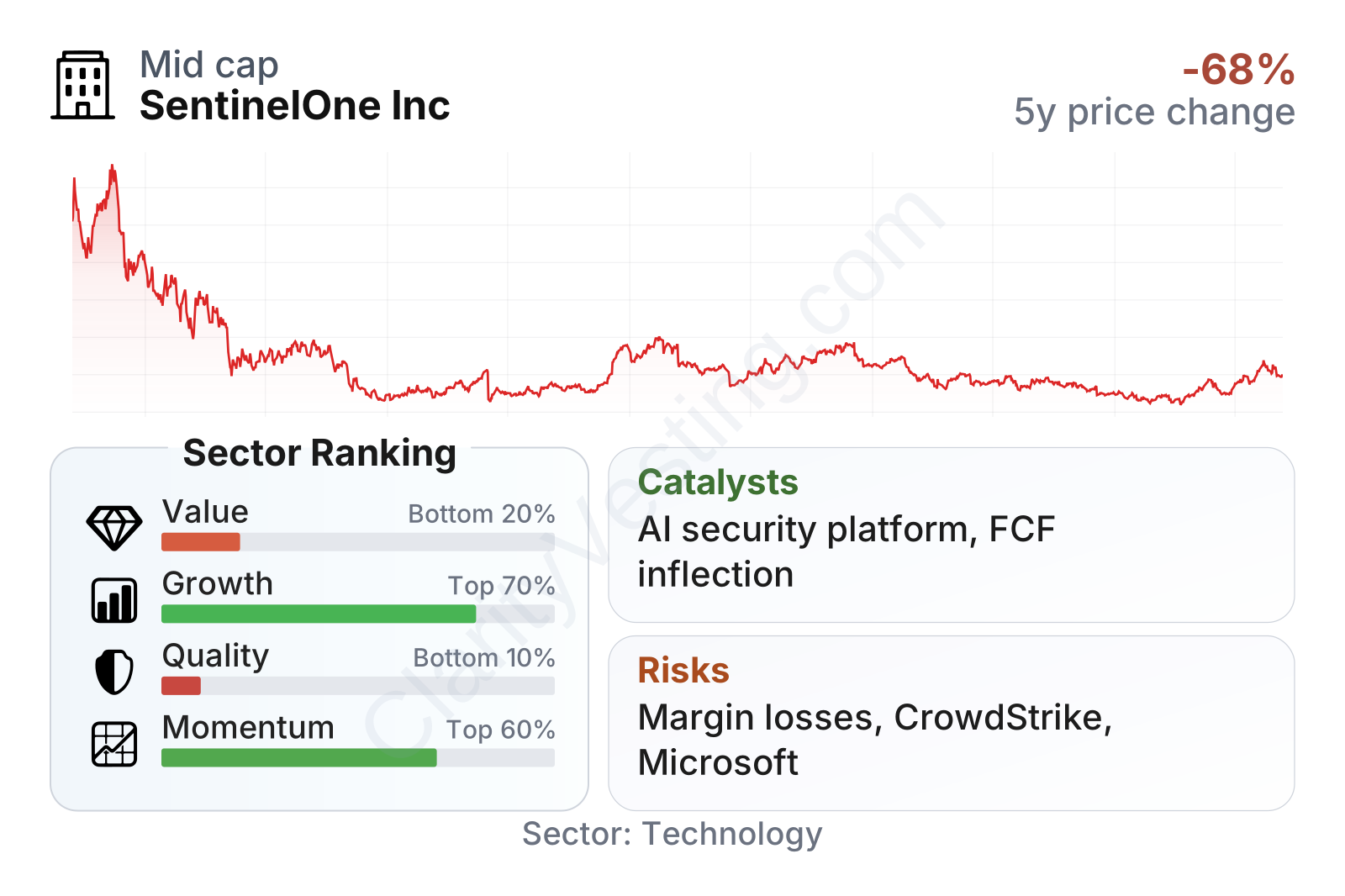
SentinelOne combines above-sector revenue growth with weak profitability and modest market momentum. Its growth profile remains one of the stronger points relative to the software infrastructure group, but quality metrics are still weighed down by negative margins and negative returns on invested capital. The market value is in the mid-cap range, and the stock’s beta below 1 suggests volatility has been lower than many technology names, even though the share price trend since listing has been uneven.

Growth

Cybersecurity remains a structurally growing market. Companies and public institutions are dealing with more connected devices, more cloud workloads, more remote access, and more sophisticated attacks. That creates ongoing demand for tools that can automate detection and response. SentinelOne operates in one of the more durable parts of enterprise software because security spending is often treated as essential rather than optional.

Its strategy also makes sense from a long-term industry standpoint. Instead of staying narrowly focused on endpoint protection, SentinelOne has been building a broader platform that includes cloud security, identity-related capabilities, AI-driven threat analysis, and security data tools. This platform expansion can support larger contracts, deeper customer relationships, and more cross-selling over time. The company has also emphasized partnerships and enterprise adoption, which are important in a market where large organizations rarely rely on a single point product.

The growth trend has clearly moderated from the extremely high rates seen earlier in the company’s public life, which is normal as the revenue base gets larger. Even so, recent year-over-year growth remains around the low-20% range, still above the sector median. That suggests SentinelOne is no longer in hypergrowth, but it continues to outpace many software peers on the top line.

One of the more encouraging operational shifts is the move from deeply negative free cash flow to positive territory over the last two years. That does not mean the business is fully mature, but it does suggest cost control and collections are improving. For a company still reporting net losses, positive cash generation is a meaningful milestone because it reduces dependence on external financing and gives management more flexibility.

A major catalyst is the company’s push around AI-powered security operations. SentinelOne has promoted capabilities that help automate detection, triage, investigation, and response, and this fits well with a market where customers face talent shortages and rising attack complexity. Another opportunity comes from platform consolidation: if enterprises want fewer security vendors, a broader product set could help SentinelOne win a bigger share of customer budgets.

Recent company updates have also pointed to traction in larger customer relationships, including growth in customers with higher annual recurring revenue commitments. That is important because enterprise adoption tends to improve retention and opens the door to add-on modules over time. Reaching roughly $1 billion in annual revenue is also a signaling point: SentinelOne is no longer a tiny challenger, even if it remains much smaller than the biggest players in cybersecurity.

Risks

The biggest risk is that SentinelOne is still not consistently profitable under standard accounting measures. Despite strong gross margins, the company continues to post negative operating and net margins. That leaves little room for execution mistakes if growth slows further or competitive pressure forces heavier spending.

Balance sheet risk is not the main concern here. Debt levels are extremely low relative to equity and have stayed far below the sector norm. That gives SentinelOne financial flexibility and reduces the danger that leverage becomes a problem during a weaker operating period.

Profitability remains the weak spot. Margins have improved dramatically from the very large losses of earlier years, but they are still meaningfully below sector norms and remain negative. This gap shows that the company has made progress, yet it has not proven that its growth can consistently translate into earnings power.

Competition is intense. SentinelOne operates against some of the best-known names in cybersecurity, including CrowdStrike, Microsoft, Palo Alto Networks, Trellix, and other endpoint, cloud, and security operations vendors. CrowdStrike is often viewed as the closest direct benchmark in AI-driven endpoint and platform security, while Microsoft has enormous distribution advantages through its enterprise software ecosystem. Palo Alto Networks adds pressure by combining network, cloud, and platform security at large scale.

SentinelOne does have real competitive strengths. Its technology is recognized for automation, machine-speed response, and a platform designed around AI from the start. It also benefits from a modern architecture and a strong reputation in endpoint detection and response. However, it is not the clear market leader. In size, profitability, and enterprise reach, several rivals remain ahead. That means SentinelOne often has to prove it can win on product performance and platform breadth rather than on incumbency.

Another risk is the possibility of growth compression. Revenue is still expanding, but at a much slower pace than in earlier years. If that trend continues without a matching improvement in margins, the market may become less willing to assign premium valuation multiples. In addition, the company uses stock-based compensation as many software firms do, which can support hiring and retention but also affects reported profitability and dilution over time.

No major public scandal or governance crisis stands out as a defining concern from the company’s recent filings. The more material risks are operational: fierce competition, the need to keep innovating quickly, pressure to convert growth into profits, and the challenge of defending pricing in a crowded market.

Valuation

Valuing SentinelOne is not straightforward because traditional earnings-based measures are not very helpful while profits remain negative.

The lack of a meaningful price-to-earnings reading reflects the company’s negative earnings rather than an absence of market interest. In practice, the stock is better judged through a mix of revenue growth, free cash flow progress, balance sheet strength, and how much room remains before margins approach industry standards.

On that basis, the valuation profile looks demanding from a fundamentals perspective, even after a long share-price decline from earlier highs. SentinelOne ranks weakly on value metrics relative to the sector, largely because free cash flow yield is still low and operating earnings remain negative. In other words, the market is still paying mainly for future potential rather than current profit generation.

Whether the current price looks justified depends heavily on confidence in two things: first, that SentinelOne can sustain above-sector revenue growth; second, that margin improvement will continue meaningfully over the next several years. The balance sheet supports that case because low debt reduces financial strain, and positive free cash flow adds credibility. Still, compared with more established cybersecurity peers, the company carries more execution risk because it has not yet demonstrated durable profitability.

That leaves the stock in an in-between position. It no longer carries the same inflated expectations seen during earlier software market exuberance, but it also cannot be described as cheap on present-day earnings or cash-flow generation. The market appears to be assigning value to platform potential, not finished financial maturity.

Conclusion

SentinelOne stands out as a credible cybersecurity platform company operating in a market with durable long-term demand. The business has built a meaningful presence in AI-driven endpoint and cloud security, expanded toward a broader platform model, and continued to grow faster than many software peers. The shift to positive free cash flow and the company’s very low debt load are important signs of improving financial resilience.

At the same time, the investment profile remains shaped by unfinished execution. Profit margins are still negative, returns on capital remain weak, and competition is intense against larger and more established rivals. SentinelOne looks stronger as a business than its share-price history might suggest, but the gap between revenue momentum and bottom-line performance is still too large to ignore.

The overall picture is that of a company with real strategic relevance and improving operating traction, but one that still needs to prove it can turn scale into consistent profitability. The valuation context reflects that tension: there is visible business progress, yet much of the long-term case still depends on future margin conversion rather than current earnings strength.

Sources:

  • SentinelOne, Inc. Form 10-K for the fiscal year ended January 31, 2026
  • SentinelOne, Inc. Form 10-Q filings filed in 2026
  • SentinelOne, Inc. Current Reports on Form 8-K filed in 2026
  • SentinelOne Investor Relations — quarterly earnings releases published in 2026
  • SEC EDGAR — SentinelOne, Inc. company filings
  • SentinelOne Investor Relations — shareholder letters and company-hosted webcast materials
  • Wikipedia — SentinelOne

This article is for informational purposes only and does not constitute financial advice. Some content is AI-generated. See Disclaimer


Sign up for exclusive research and insights.

Unsubscribe anytime.
