Stock Analysis · Rackspace Technology Inc (RXT)
Overview
Rackspace Technology is an infrastructure and cloud services company. In simple terms, it helps businesses run, manage, secure, and modernize their information technology systems. That includes public cloud environments such as Amazon Web Services, Microsoft Azure, and Google Cloud, as well as private cloud, applications, data, cybersecurity, and traditional infrastructure support. Its role is less about owning a dominant cloud platform and more about being a service partner that designs, migrates, operates, and supports complex technology environments for customers.
The company’s revenue is mainly service-based and recurring in nature, generated from managing customer environments over time rather than from one-time software sales. Based on company reporting, revenue is organized primarily into two broad segments.
- Private Cloud: approximately 60% to 65% of revenue in recent years. This includes managed hosting, private cloud, dedicated infrastructure, colocation-related services, and support for customers that still rely on customized or legacy environments.
- Public Cloud: approximately 35% to 40% of revenue. This includes managed services tied to hyperscale cloud platforms, cloud migration, cloud-native operations, FinOps, data and AI-related work, cloud security, and related professional services.
That mix is important because Private Cloud remains the larger business, but industry growth is generally stronger in Public Cloud. Rackspace has been trying to shift toward higher-value services around hybrid cloud, multicloud management, security, and artificial intelligence while stabilizing the older infrastructure base.
The business model is therefore understandable: customers pay Rackspace to reduce the complexity of running mission-critical technology. The challenge is that this is a highly competitive market with pressure on pricing, margins, and customer retention.
The long-term financial flow shows a difficult transition. Revenue has trended down from just above $3.0 billion earlier in the period to the high-$2.6 billion range more recently, while gross profit has contracted much faster. Interest expense improved after debt actions, but operating losses and net losses have remained a defining feature.
Key Figures
| Metric | Value | Sector ⓘ |
|---|---|---|
| Date | Sep 12, 2026 | |
| Context | ||
| Sector | Technology | |
| Industry | Software - Infrastructure | |
| Market Cap ⓘ | $1.07B | |
| Beta ⓘ | 3.10 | |
Value (Cheapness) | ||
| P/E Ratio ⓘ | N/A | 29.51 |
| FCF Yield ⓘ | 3.82% | 4.25% |
| EBIT / EV ⓘ | -0.35% | 2.85% |
| PEG ⓘ | 4.93 | |
Growth (Business expansion) | ||
| Revenue Growth ⓘ | 0.60% | 15.40% |
| RPS Growth (5Y CAGR) ⓘ | -6.09% | 8.56% |
| EPS Growth (5Y CAGR) ⓘ | N/A | -11.88% |
| Margin Growth (5Y Trend) ⓘ | N/A | 0.46% |
| FCF Growth (5Y CAGR) ⓘ | -23.34% | 9.80% |
Quality (Business durability) | ||
| ROIC (Latest) ⓘ | 0.40% | 9.44% |
| ROIC (5Y Median) ⓘ | -12.49% | 8.30% |
| Net Debt / EBIT (Latest) ⓘ | N/A | 0.54 |
| Net Debt / EBIT (5Y Median) ⓘ | N/A | 0.44 |
| Operating Margin (Latest) ⓘ | -0.55% | 9.58% |
| Operating Margin (5Y Median) ⓘ | -20.05% | 8.25% |
| Debt to Equity (Latest) ⓘ | -257.47% | 33.33% |
| Profit Margin (Latest) ⓘ | -5.88% | 7.14% |
| Free Cash Flow (Latest) ⓘ | $41.00M | |
Momentum (Price trend) | ||
| 3Y Return ⓘ | +89.64% | +45.48% |
| 12M Return (excl. last month) ⓘ | +209.03% | +23.48% |
| 6M Return ⓘ | +929.59% | +20.93% |
| Price vs. 200-Day MA ⓘ | +62.31% | +7.43% |
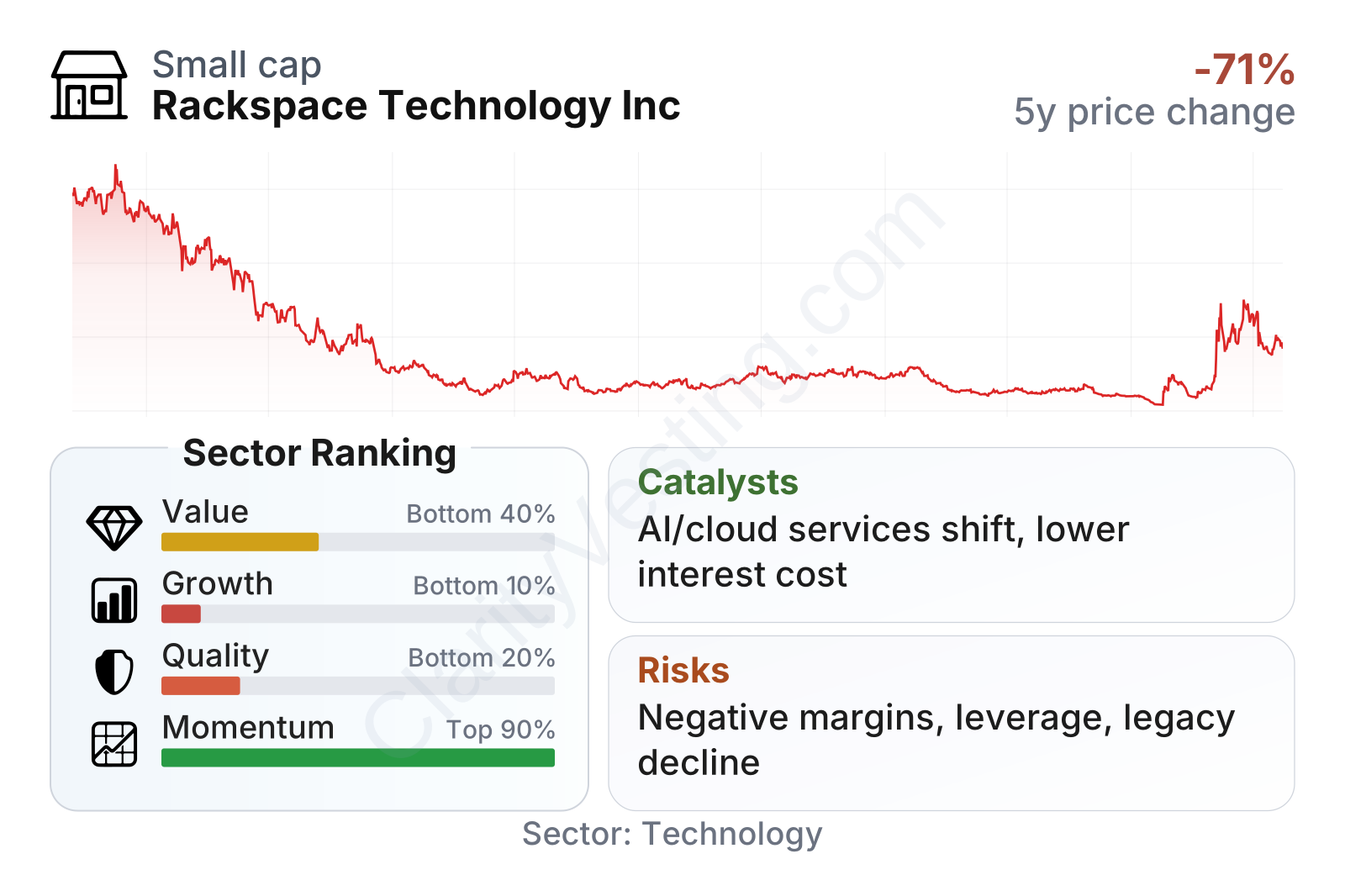
Rackspace is now a relatively small public company by market value, and the shares have been extremely volatile, with a beta above 3. The factor profile is mixed: momentum is very strong, but growth, quality, and value rank poorly versus the broader technology sector. In practice, that means the stock has recently moved much better than the underlying business fundamentals. Free cash flow is still positive, but profitability and returns on capital remain far below sector norms.
Growth
Rackspace operates in a sector with attractive long-term demand drivers. Cloud migration, cybersecurity, hybrid infrastructure, automation, and AI-related workloads are all expanding areas of enterprise spending. Many companies still need outside help to manage complicated technology estates across older on-premise systems and newer cloud platforms, and that ongoing complexity supports demand for managed services.
Rackspace’s strategy also makes sense on paper. It is focused on being a neutral partner across multiple cloud platforms rather than competing directly with AWS, Microsoft, or Google. That can appeal to customers that want flexibility, cost control, and operational support across several vendors. The company has also emphasized higher-value services such as AI consulting, data modernization, security, and multicloud operations, which are more aligned with where enterprise spending is heading.
The problem is that the recent growth record has been weak. Revenue growth slowed steadily from solid positive levels in 2021 to declines through much of 2023, 2024, and 2025, with only a modest improvement back toward flat to slightly positive territory more recently. Compared with the sector median, the company’s latest year-over-year revenue growth is far behind. For a long-term business case, the key issue is not whether cloud is growing overall, but whether Rackspace can convert that industry tailwind into durable company-level expansion.
Cash generation offers a more constructive sign than earnings. Free cash flow has remained positive, although it has fallen sharply from earlier levels and has been uneven. The recent rebound from lower levels suggests the restructuring and cost actions have had some effect, but the cash profile is still much less robust than it was a few years ago. For a company in turnaround mode, preserving positive free cash flow matters because it provides room to operate while the business mix shifts.
One notable catalyst in recent periods has been the company’s effort to sharpen its portfolio around managed cloud, AI, and security services while simplifying costs and improving execution. Another important development has been balance-sheet work that reduced interest expense versus prior years, which can help if operations stabilize. If Rackspace can show sustained improvement in Public Cloud and newer service lines while slowing declines in legacy infrastructure, that would be a meaningful change in the growth picture.
Risks
This article is for informational purposes only and does not constitute financial advice. Some content is AI-generated. See Disclaimer


