Stock Analysis · Rexel S.A (RXLSF)
Overview
Rexel S.A. is a global distributor of electrical products and related services. In simple terms, it sits between manufacturers and end customers, supplying the equipment used to power, connect, automate, and improve buildings and industrial sites. Its catalog covers low- and medium-voltage electrical products, cables, lighting, automation components, energy management systems, and an expanding set of solutions linked to energy efficiency, solar, electric vehicle charging, and building renovation.
The business model is built on scale, local branch networks, digital ordering tools, logistics, and technical support. Rexel does not mainly depend on creating new hardware itself; instead, it earns revenue by sourcing products from many suppliers and distributing them efficiently to electricians, contractors, industrial customers, and commercial building operators.
Based on recent annual reporting, revenue is primarily split by geography rather than by a few narrow product lines, which is useful because it shows where demand is strongest and where economic conditions matter most.
- Europe: about 52% of revenue. This includes a broad range of electrical distribution activities across major European markets, serving residential, commercial, and industrial customers.
- North America: about 42% of revenue. The region is heavily exposed to non-residential construction, industrial maintenance, and energy-related demand, especially in the United States and Canada.
- Asia-Pacific: about 6% of revenue. This is the smallest segment and gives Rexel some exposure to faster-growing markets, but it is not yet a major earnings driver.
Within end markets, the company is typically exposed to a mix of industrial customers, commercial buildings, and residential renovation or construction. It also highlights faster-growing categories such as electrification, automation, renewable energy-related equipment, and energy efficiency upgrades. That matters for long-term analysis because electrical distribution tends to benefit when buildings and factories become more connected, more automated, and more energy-conscious.
The long-term financial profile shows a high-volume, lower-margin distribution business. Revenue has risen from roughly €14.7 billion in 2021 to around €19.4 billion in 2025, but profits have been more uneven. Gross profit remained relatively stable near €4.8 billion in the last three years, while operating income and net income have fluctuated more sharply, reflecting margin pressure, financing costs, and market conditions rather than a collapse in sales.
The broad picture is that Rexel has built a large global platform with steady sales and solid gross profit generation, but the conversion of those sales into bottom-line earnings has been less stable in the most recent period.
Key Figures
| Metric | Value | Sector ⓘ |
|---|---|---|
| Date | Sep 12, 2026 | |
| Context | ||
| Sector | Technology | |
| Industry | Electronics & Computer Distribution | |
| Market Cap ⓘ | $12.11B | |
| Beta ⓘ | 0.99 | |
Value (Cheapness) | ||
| P/E Ratio ⓘ | 15.65 | 29.51 |
| FCF Yield ⓘ | 6.56% | 4.25% |
| EBIT / EV ⓘ | N/A | 2.85% |
| PEG ⓘ | N/A | |
Growth (Business expansion) | ||
| Revenue Growth ⓘ | 2.20% | 15.40% |
| RPS Growth (5Y CAGR) ⓘ | 7.93% | 8.56% |
| EPS Growth (5Y CAGR) ⓘ | -17.61% | -11.88% |
| Margin Growth (5Y Trend) ⓘ | -0.63% | 0.46% |
| FCF Growth (5Y CAGR) ⓘ | 1.68% | 9.80% |
Quality (Business durability) | ||
| ROIC (Latest) ⓘ | N/A | 9.44% |
| ROIC (5Y Median) ⓘ | 9.61% | 8.30% |
| Net Debt / EBIT (Latest) ⓘ | 4.23 | 0.54 |
| Net Debt / EBIT (5Y Median) ⓘ | 3.45 | 0.44 |
| Operating Margin (Latest) ⓘ | 5.84% | 9.58% |
| Operating Margin (5Y Median) ⓘ | 6.06% | 8.25% |
| Debt to Equity (Latest) ⓘ | 106.94% | 33.33% |
| Profit Margin (Latest) ⓘ | 3.41% | 7.14% |
| Free Cash Flow (Latest) ⓘ | $794.60M | |
Momentum (Price trend) | ||
| 3Y Return ⓘ | +105.87% | +45.48% |
| 12M Return (excl. last month) ⓘ | +43.85% | +23.48% |
| 6M Return ⓘ | +0.08% | +20.93% |
| Price vs. 200-Day MA ⓘ | +17.15% | +7.43% |
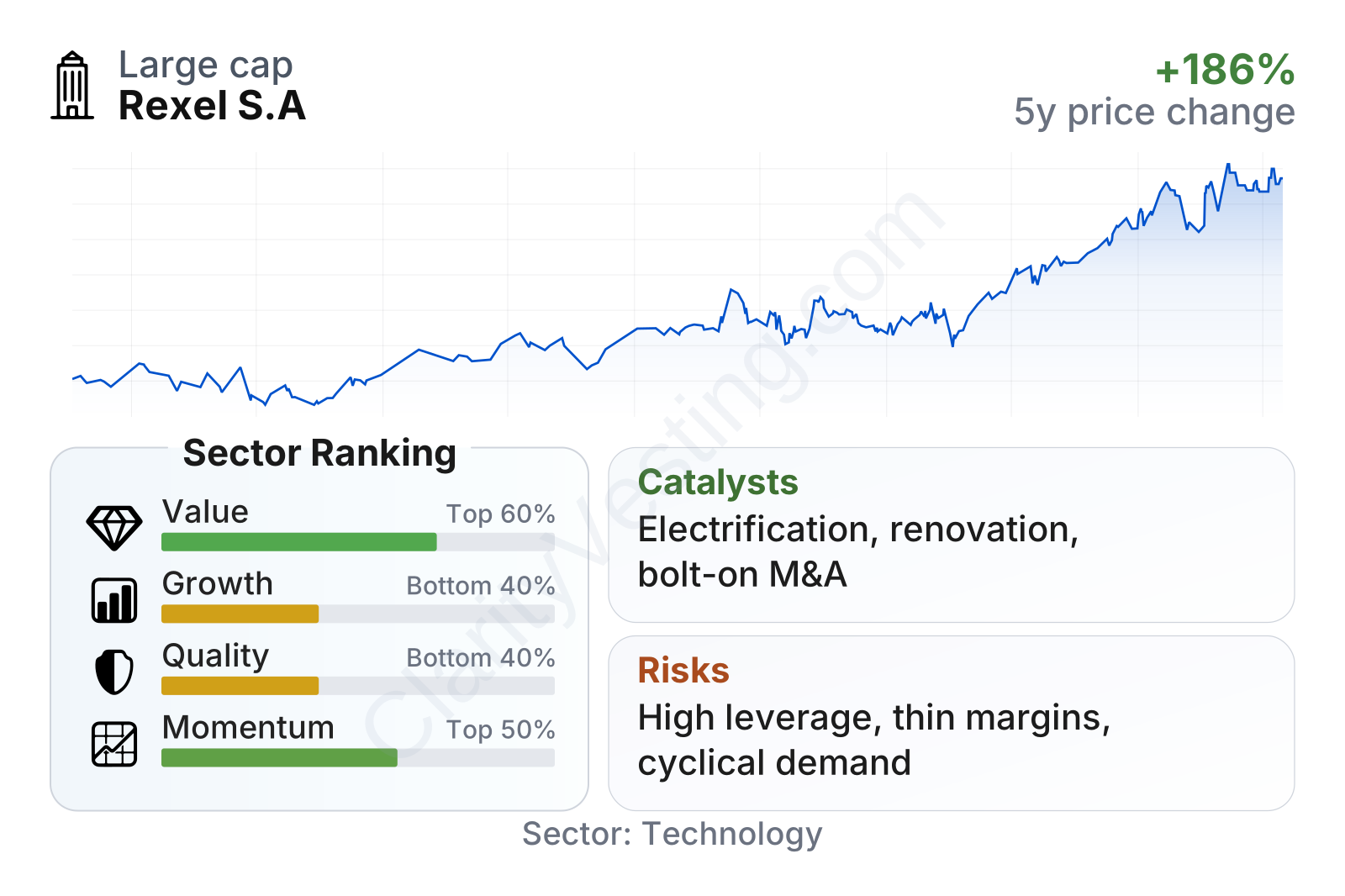
Rexel is a large company by market value, with share-price volatility close to the broader market. The main takeaway from the current metrics is mixed but understandable: valuation looks more moderate than much of its sector, cash generation is respectable, and recent stock performance has been strong, while growth and balance-sheet quality are less impressive. Relative to the sector median, the company stands out more for pricing discipline and cash flow than for high expansion or very strong margins.
The stock’s multi-year performance has been notable, with the share price rising significantly since 2021 and accelerating over the last two years. That suggests the market has become more confident in the company’s resilience and strategic positioning, even though operating quality indicators still sit below many peers in the broader technology and distribution universe.
Growth
Rexel operates in a sector supported by several durable themes: electrification, building renovation, industrial automation, data-related power infrastructure, energy efficiency upgrades, and the expansion of distributed energy systems such as solar and EV charging. These are not short-lived trends. They are linked to the way homes, offices, factories, and infrastructure are being upgraded over many years.
The company’s strategy broadly fits those trends. Management has emphasized digital sales channels, value-added services, bolt-on acquisitions, and exposure to higher-growth categories such as electrification and energy transition products. For a distributor, this makes sense: it is easier to grow by expanding product mix, improving logistics, and increasing share with installers and contractors than by trying to invent new end-products.
Recent growth has been positive but not especially fast. Year-over-year revenue growth is running near 2%, well below the median of the wider sector used for comparison. Over a five-year view, revenue per share growth has been decent rather than exceptional. This points to a business with expansion potential, but one that is still influenced by construction cycles, industrial demand, and pricing conditions.
Free cash flow remains an important positive feature. Trailing free cash flow is around $650 million, and free cash flow yield is modestly better than the sector median. That matters because distributors need working capital discipline to turn revenue into real cash. Even when accounting profits move around, cash generation can support acquisitions, debt service, and shareholder returns.
A meaningful catalyst comes from the long renovation cycle in electrical infrastructure. In many developed markets, buildings and industrial facilities need upgrades for energy management, heat pumps, automation, backup power, and charging infrastructure. Rexel already sells into these channels, so it does not need to create demand from scratch; it needs to capture share as customers modernize their installations.
Another potential opportunity is consolidation. Electrical distribution remains fragmented in several markets, and Rexel has a history of acquisitions. If it continues to buy local distributors or specialist businesses in automation and energy solutions without overpaying, that could strengthen density, customer reach, and digital scale.
Risks
This article is for informational purposes only and does not constitute financial advice. Some content is AI-generated. See Disclaimer


