Stock Analysis · Rexel SA (RXEEY)
Overview
Rexel SA is a global distributor of electrical supplies and related services. In simple terms, it sits between manufacturers and end customers, helping businesses buy the products needed to build, equip, maintain, and modernize electrical systems. Its customers include electricians, industrial companies, commercial building operators, and residential contractors. The group’s role is not only to move products, but also to simplify sourcing, inventory management, technical selection, and increasingly energy-efficiency and automation projects.
The business is tied to everyday but essential needs: power distribution, lighting, cable management, industrial control, automation, and energy solutions. This makes Rexel less like a pure technology inventor and more like an infrastructure enabler. It benefits when buildings are constructed, factories are upgraded, warehouses are automated, and energy systems become smarter and more efficient.
Revenue mainly comes from selling electrical products and solutions across three major geographic regions. Based on recent annual reporting, the mix is approximately:
- Europe: about half of revenue, making it the company’s largest contributor.
- North America: a little over one-third of revenue.
- Asia-Pacific: a smaller but still meaningful share, roughly in the low-to-mid teens.
By end market, Rexel is broadly exposed to non-residential construction, industrial customers, and residential activity, with additional support from retrofit, maintenance, and energy-transition projects. Product categories typically include electrical installation equipment, cables and conduits, lighting, automation and control, and faster-growing energy-related offers such as solar, EV charging, and building-efficiency solutions.
One useful feature of the business model is that it produces large revenue on relatively thin margins, which is common in distribution. That means execution matters a lot: purchasing discipline, branch productivity, digital tools, and working-capital control can make a major difference in earnings and cash generation.
Over the last several years, revenue has stayed at a very large scale, while profitability has been more cyclical. Gross profit has held up better than net income, showing that the pressure has come more from operating costs, interest expense, and the broader slowdown in parts of construction and industry than from a collapse in demand.
Key Figures
| Metric | Value | Sector ⓘ |
|---|---|---|
| Date | Sep 12, 2026 | |
| Context | ||
| Sector | Technology | |
| Industry | Electronics & Computer Distribution | |
| Market Cap ⓘ | $12.42B | |
| Beta ⓘ | 0.99 | |
Value (Cheapness) | ||
| P/E Ratio ⓘ | 16.56 | 29.51 |
| FCF Yield ⓘ | 6.40% | 4.25% |
| EBIT / EV ⓘ | N/A | 2.85% |
| PEG ⓘ | N/A | |
Growth (Business expansion) | ||
| Revenue Growth ⓘ | 2.20% | 15.40% |
| RPS Growth (5Y CAGR) ⓘ | 7.93% | 8.56% |
| EPS Growth (5Y CAGR) ⓘ | 7.04% | -11.88% |
| Margin Growth (5Y Trend) ⓘ | -0.53% | 0.46% |
| FCF Growth (5Y CAGR) ⓘ | 1.68% | 9.80% |
Quality (Business durability) | ||
| ROIC (Latest) ⓘ | N/A | 9.44% |
| ROIC (5Y Median) ⓘ | 10.93% | 8.30% |
| Net Debt / EBIT (Latest) ⓘ | 4.23 | 0.54 |
| Net Debt / EBIT (5Y Median) ⓘ | 3.06 | 0.44 |
| Operating Margin (Latest) ⓘ | 5.84% | 9.58% |
| Operating Margin (5Y Median) ⓘ | 6.06% | 8.25% |
| Debt to Equity (Latest) ⓘ | 106.94% | 33.33% |
| Profit Margin (Latest) ⓘ | 3.41% | 7.14% |
| Free Cash Flow (Latest) ⓘ | $794.60M | |
Momentum (Price trend) | ||
| 3Y Return ⓘ | +102.06% | +45.48% |
| 12M Return (excl. last month) ⓘ | +45.58% | +23.48% |
| 6M Return ⓘ | +13.59% | +20.93% |
| Price vs. 200-Day MA ⓘ | +5.13% | +7.43% |
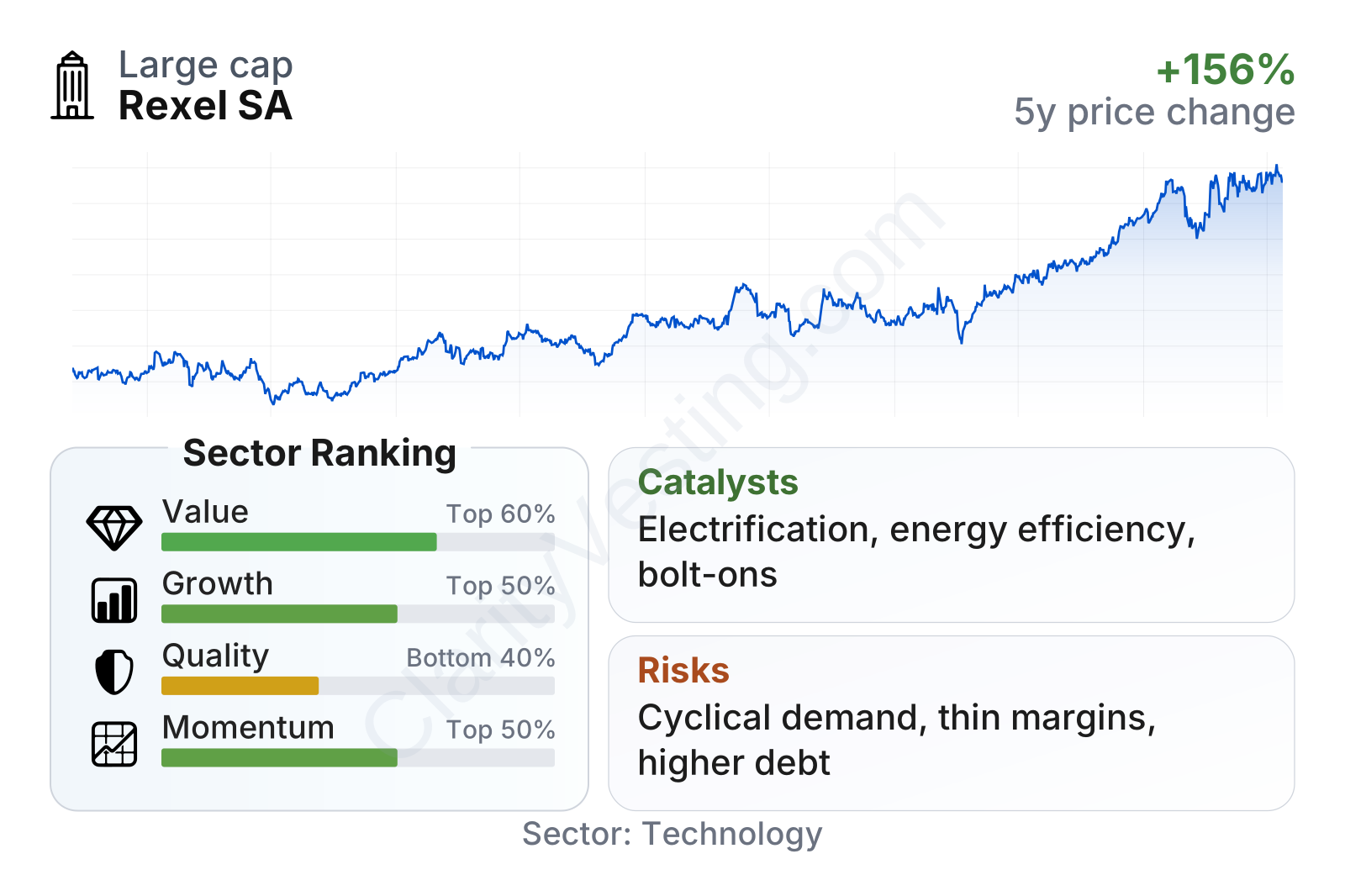
Rexel’s market value is in the large-cap range for a distributor, and its share-price volatility has been close to the broader market rather than extremely speculative. The stock has had a strong multi-year run, with gains well above the sector median over three years, although the path has not been smooth.
On valuation, the earnings multiple sits below the sector median, which suggests the market is not treating Rexel like a high-growth technology name. On growth, the picture is mixed: near-term revenue growth has been flat to slightly negative, but five-year earnings growth remains respectable. On quality, the company looks weaker than many sector peers because margins are modest and leverage is high for the peer set, even though long-term returns on invested capital have been solid. In short, the market appears to recognize Rexel as a mature, cash-generating operator rather than a premium multiple compounder.
Growth
Rexel operates in a sector with structural support from electrification. Even if short-term demand moves with construction cycles and industrial spending, the long-term backdrop is helped by trends that are likely to last for years: building renovation, energy-efficiency upgrades, factory automation, grid modernization, EV charging infrastructure, and the wider push to manage electricity use more intelligently. These are not niche themes; they are becoming central to how buildings and industrial sites are designed and upgraded.
The company’s strategy broadly fits that environment. Management has been emphasizing digital sales channels, higher-value technical solutions, and exposure to energy-transition categories rather than relying only on traditional branch distribution. This matters because distribution can be a scale business, but the more attractive economics often come from becoming harder to replace in the customer workflow through service, product breadth, and technical support.
Near-term sales momentum has been soft compared with many companies in the wider sector. That does not necessarily signal a broken model; it reflects the fact that Rexel is linked to real-world installation activity, which can slow when industrial customers delay spending or construction markets cool. Over a five-year view, revenue per share has still trended upward, even if not at an exceptional pace.
Cash generation remains one of the more important supports for the investment case. Free cash flow has come off prior highs but still remains meaningful in absolute dollars, which gives the company room to fund operations, acquisitions, and shareholder returns while navigating cyclical demand. For a distributor, the ability to keep producing cash during softer periods is a key sign of resilience.
Recent company communications have also pointed to continued focus on bolt-on acquisitions and on categories tied to electrification and energy management. Those smaller strategic deals can matter because they deepen local presence, add technical capabilities, and strengthen exposure to markets where customers need more than simple product delivery. The strongest catalyst is not a single breakthrough event, but the steady expansion of electrical complexity in buildings and industry, which raises the value of a capable distributor with broad inventory, local reach, and digital tools.
Risks
This article is for informational purposes only and does not constitute financial advice. Some content is AI-generated. See Disclaimer


