Stock Analysis · Revolve Group LLC (RVLV)
Overview
Revolve Group LLC is an online fashion retailer focused mainly on millennial and Gen Z consumers. The company sells apparel, footwear, accessories, and beauty products through a digital-first model that combines e-commerce, social media marketing, influencer relationships, and a data-driven merchandising approach. Its business is built around curated fashion, fast product rotation, and direct engagement with shoppers through its websites, mobile experience, and branded events.
Revolve operates primarily through two customer-facing segments: REVOLVE and FWRD. REVOLVE is the larger business and focuses on contemporary fashion with a broad assortment of dresses, denim, shoes, accessories, and beauty. FWRD is the smaller but more premium platform, centered on luxury fashion and higher-end designer labels. In recent filings, the company has also highlighted owned brands as an important part of its model, alongside a large mix of third-party brands.
The main sources of revenue are approximately the following:
- REVOLVE segment: about 84% to 86% of revenue. This is the core platform, selling contemporary women’s apparel, footwear, accessories, and beauty products, plus a growing men’s offering.
- FWRD segment: about 14% to 16% of revenue. This business focuses on luxury apparel, handbags, shoes, jewelry, and premium accessories.
- By product type, apparel remains the largest category, followed by footwear, accessories, and beauty, although exact category percentages are not always disclosed in detail in recent quarterly reporting.
- By brand mix, third-party brands account for the majority of sales, while owned brands represent a smaller but strategically important share because they can support higher gross margins and stronger control over product design and inventory.
- Geographically, the United States is the largest market, with international sales forming a meaningful minority of revenue through global shipping and localized digital marketing.
Over the last several years, the business has shown a pattern of recovering revenue after the 2023 slowdown while keeping a relatively healthy gross profit structure. At the same time, operating costs have risen enough to keep earnings below the peak levels reached earlier in the cycle, which is one of the key themes to watch in assessing the company’s long-term quality.
The long-term picture shows a company that expanded annual revenue from under $0.9 billion in 2021 to above $1.2 billion in 2025, with gross profit also moving higher. However, net income has not kept pace with revenue growth, which suggests that customer acquisition, fulfillment, and overhead discipline remain central to the investment debate.
Key Figures
| Metric | Value | Sector ⓘ |
|---|---|---|
| Date | Sep 12, 2026 | |
| Context | ||
| Sector | Consumer Cyclical | |
| Industry | Internet Retail | |
| Market Cap ⓘ | $1.51B | |
| Beta ⓘ | 1.62 | |
Value (Cheapness) | ||
| P/E Ratio ⓘ | 20.72 | 17.10 |
| FCF Yield ⓘ | 1.68% | 8.53% |
| EBIT / EV ⓘ | 5.61% | 6.46% |
| PEG ⓘ | 1.20 | |
Growth (Business expansion) | ||
| Revenue Growth ⓘ | 12.40% | 5.75% |
| RPS Growth (5Y CAGR) ⓘ | 9.20% | 9.14% |
| EPS Growth (5Y CAGR) ⓘ | -15.95% | -18.21% |
| Margin Growth (5Y Trend) ⓘ | -5.03% | -0.23% |
| FCF Growth (5Y CAGR) ⓘ | -5.48% | 4.91% |
Quality (Business durability) | ||
| ROIC (Latest) ⓘ | 12.71% | 12.61% |
| ROIC (5Y Median) ⓘ | 12.86% | 10.72% |
| Net Debt / EBIT (Latest) ⓘ | -3.55 | 2.10 |
| Net Debt / EBIT (5Y Median) ⓘ | -3.16 | 2.32 |
| Operating Margin (Latest) ⓘ | 6.70% | 9.25% |
| Operating Margin (5Y Median) ⓘ | 6.71% | 9.64% |
| Debt to Equity (Latest) ⓘ | 5.74% | 75.78% |
| Profit Margin (Latest) ⓘ | 5.54% | 5.33% |
| Free Cash Flow (Latest) ⓘ | $25.42M | |
Momentum (Price trend) | ||
| 3Y Return ⓘ | +56.17% | +14.53% |
| 12M Return (excl. last month) ⓘ | +15.49% | +3.08% |
| 6M Return ⓘ | -7.49% | +0.55% |
| Price vs. 200-Day MA ⓘ | -13.79% | -0.54% |
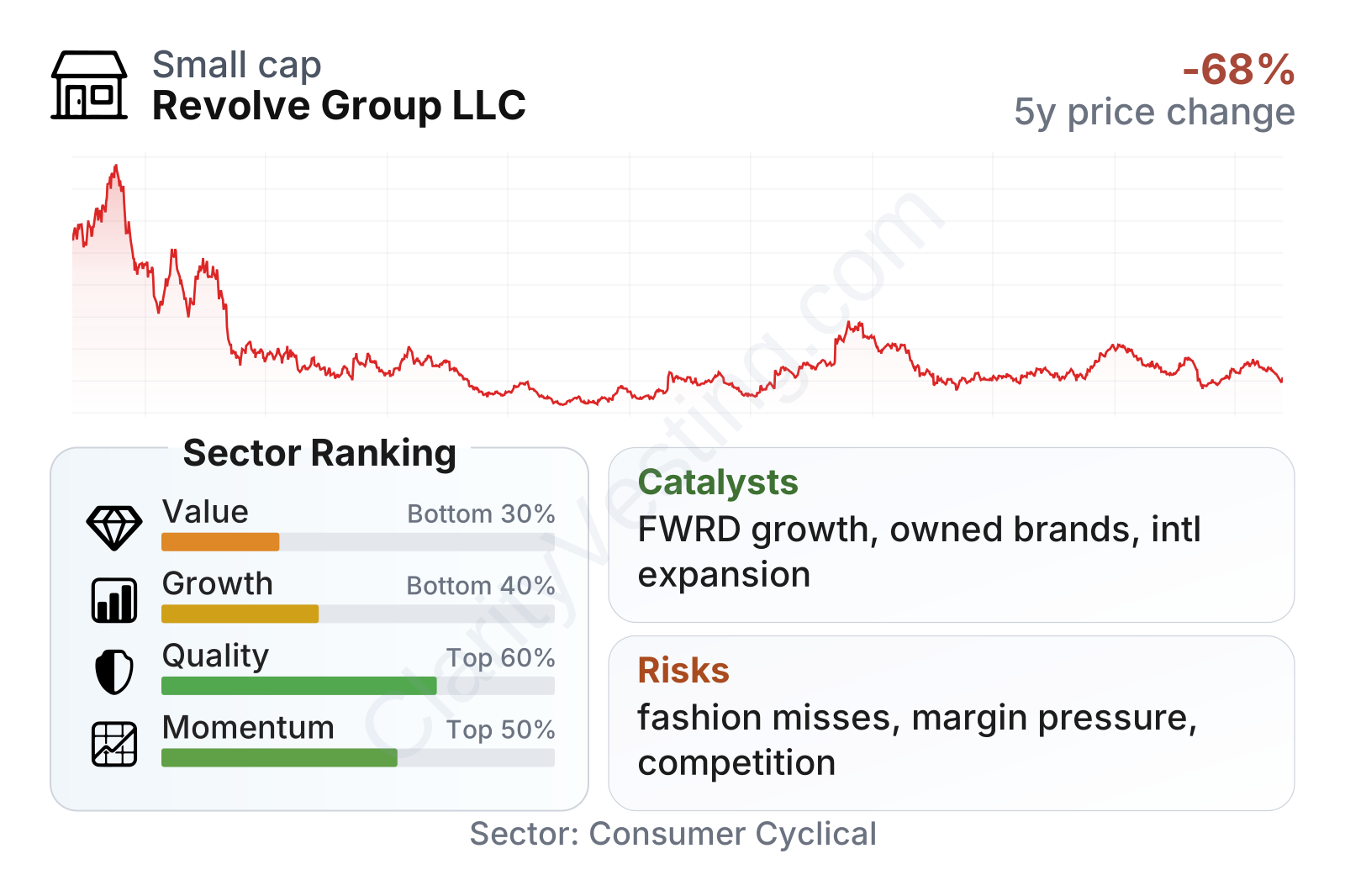
Revolve is a mid-sized online retail company with a stock that has been notably volatile. After peaking in late 2021, the share price fell sharply through 2022 and 2023, then recovered during 2024 before weakening again in 2025 and parts of 2026. That pattern reflects how sensitive the business is to consumer demand, fashion cycles, and changes in profitability.
The latest metrics present a mixed profile. On growth, recent revenue expansion is stronger than the sector median, but longer-term earnings and free cash flow trends are less impressive. On quality, the balance sheet stands out positively: debt is very low at roughly 6% of equity, and the company holds a net cash position rather than being burdened by leverage. Profitability is decent, with profit margin around 5.5%, roughly in line with the sector, though operating margin remains below the broader industry median. On valuation, the shares trade at a price-to-earnings multiple above the sector median, which indicates the market is still assigning some premium for brand strength and future expansion.
Growth
Revolve operates in an attractive part of retail: online fashion. Over the long term, apparel and accessories continue to shift toward digital channels, and younger consumers are especially comfortable discovering products through social platforms, creators, and mobile shopping. That broad industry direction supports Revolve’s model. The company’s niche is not simply selling clothes online; it is combining trend detection, merchandising speed, and influencer-driven marketing into a curated shopping experience that is difficult to replicate perfectly at scale.
The recent revenue trend has turned more favorable after the weak 2023 period. Growth moved back into positive territory during 2024 and stayed positive through 2025 and into 2026, with recent year-over-year growth running in the low double digits. That matters because it suggests the business regained momentum rather than merely stabilizing.
The improvement in sales growth is encouraging because it appears more durable than a one-quarter rebound. It also compares favorably with much of the broader consumer cyclical sector, where growth has often been weaker and less consistent. For a fashion platform, sustained positive growth usually means customer engagement, brand relevance, and inventory alignment are working reasonably well.
Revolve’s strategy for future expansion makes sense in several ways. First, the company keeps investing in owned brands, which can improve merchandise margins and reduce dependence on external labels. Second, FWRD gives it exposure to luxury customers, broadening the price range and customer mix. Third, its event-based and influencer-centered marketing remains distinctive in fashion e-commerce, where attention is increasingly fragmented across social channels. Fourth, international growth remains an opportunity because the platform already has global reach without needing a heavy store footprint.
Cash generation has also improved from the depressed levels seen after 2022. Free cash flow remains positive, and the trailing twelve-month trend has recovered meaningfully from earlier lows, although it is still not consistently strong enough to remove all questions about margin durability.
The free cash flow recovery supports the view that the business is moving back toward healthier operations. It is particularly important for Revolve because fashion retail can consume cash if inventory builds too quickly or if demand softens. Positive free cash flow, even if still modest relative to revenue, gives the company more flexibility to invest in marketing, technology, logistics, and new brand initiatives without relying on debt.
A notable catalyst is the continued normalization of profitability after the 2023 slump. If Revolve can keep revenue growing while improving expense efficiency, earnings could scale faster than sales. Another meaningful opportunity is further development of FWRD and the owned-brand portfolio, both of which may help mix shift toward categories with better economics. Recent company communications have also emphasized active customers, order growth, and inventory discipline as areas of operational focus, all of which can materially influence the next leg of growth.
Risks
This article is for informational purposes only and does not constitute financial advice. Some content is AI-generated. See Disclaimer


