Stock Analysis · Restaurant Brands International Limited Partnership (RSTRF)
Overview
Restaurant Brands International Limited Partnership is the operating entity behind one of the world’s largest quick-service restaurant groups. Through its parent organization, it oversees globally recognized chains including Tim Hortons, Burger King, Popeyes, and Firehouse Subs. The business model is built largely around franchising rather than owning most restaurants directly. That matters for long-term analysis because franchise-heavy restaurant groups usually need less capital to expand, can generate steady royalty income, and often produce stronger margins than operators that run a large number of company-owned stores.
The company’s revenue comes from a mix of franchise royalties and fees, supply chain and distribution-related activities, and sales from company-owned restaurants. In broad terms, royalties and franchise fees are the economic core of the business because they are typically more profitable and less volatile than direct restaurant operations. The mix can shift by brand and geography, but the overall structure is generally weighted toward recurring franchise income.
Approximate revenue sources can be understood as follows:
- Sales at company-owned restaurants and other restaurant revenue: the largest reported line in recent years, supported by consolidated restaurant operations and supply-related activity.
- Franchise and property revenues: a major source of earnings, including royalties, rent, and fees paid by franchisees.
- Advertising, supply chain, and other revenues: a smaller but still relevant contribution depending on brand structure and regional arrangements.
By brand importance, Burger King remains the largest contributor to the system, followed by Tim Hortons, while Popeyes has been an important growth engine and Firehouse Subs is still the smallest brand within the portfolio. The overall picture is a multi-brand restaurant platform with global scale and a business model that leans heavily on franchise economics.
The long-term financial flow shows a business that has expanded revenue meaningfully over the last several years, while maintaining strong operating income. At the same time, interest costs have been substantial, which is an important theme for understanding both profitability and risk.
Key Figures
| Metric | Value | Sector ⓘ |
|---|---|---|
| Date | Sep 12, 2026 | |
| Context | ||
| Sector | Consumer Cyclical | |
| Industry | Restaurants | |
| Market Cap ⓘ | $25.17B | |
| Beta ⓘ | 0.31 | |
Value (Cheapness) | ||
| P/E Ratio ⓘ | 18.75 | 17.10 |
| FCF Yield ⓘ | 6.46% | 8.53% |
| EBIT / EV ⓘ | 4.59% | 6.46% |
| PEG ⓘ | N/A | |
Growth (Business expansion) | ||
| Revenue Growth ⓘ | 4.60% | 5.75% |
| RPS Growth (5Y CAGR) ⓘ | 13.66% | 9.14% |
| EPS Growth (5Y CAGR) ⓘ | -8.33% | -18.21% |
| Margin Growth (5Y Trend) ⓘ | -9.83% | -0.23% |
| FCF Growth (5Y CAGR) ⓘ | -2.75% | 4.91% |
Quality (Business durability) | ||
| ROIC (Latest) ⓘ | N/A | 12.61% |
| ROIC (5Y Median) ⓘ | 11.26% | 10.72% |
| Net Debt / EBIT (Latest) ⓘ | 7.69 | 2.10 |
| Net Debt / EBIT (5Y Median) ⓘ | 6.50 | 2.32 |
| Operating Margin (Latest) ⓘ | 19.56% | 9.25% |
| Operating Margin (5Y Median) ⓘ | 29.17% | 9.64% |
| Debt to Equity (Latest) ⓘ | 407.06% | 75.78% |
| Profit Margin (Latest) ⓘ | 17.53% | 5.33% |
| Free Cash Flow (Latest) ⓘ | $1.63B | |
Momentum (Price trend) | ||
| 3Y Return ⓘ | +22.04% | +14.53% |
| 12M Return (excl. last month) ⓘ | +6.55% | +3.08% |
| 6M Return ⓘ | -5.97% | +0.55% |
| Price vs. 200-Day MA ⓘ | +17.34% | -0.54% |
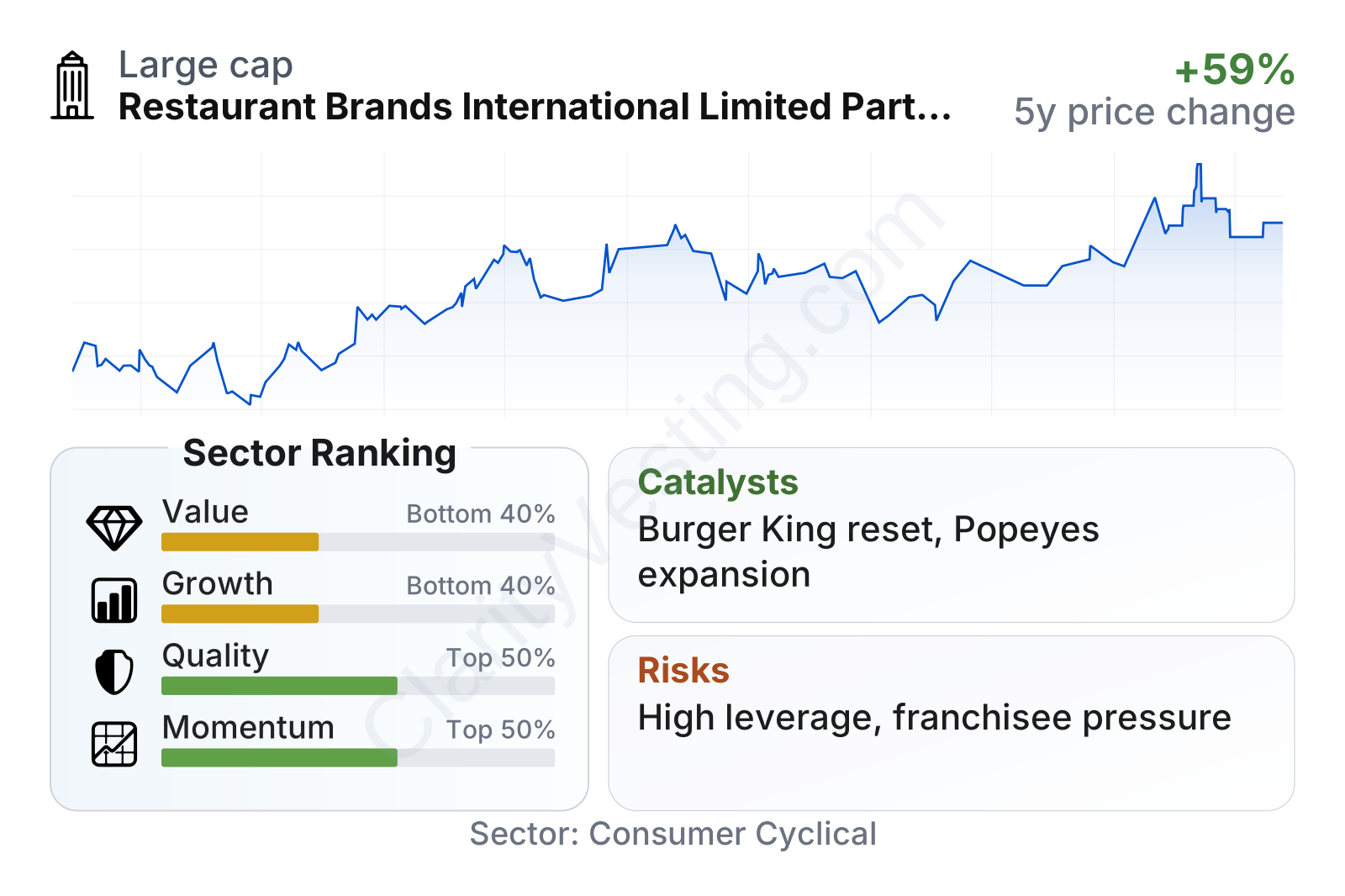
The company stands out for its scale, with a market value in the mid-$20 billion range, and for relatively low share-price volatility compared with many consumer discretionary names. Profitability remains clearly above the restaurant sector median, especially on operating margin and net margin. However, the table also points to a less favorable mix on valuation and balance-sheet strength: earnings multiples are above typical sector levels, free-cash-flow yield is not especially high, and leverage is much heavier than most peers. Growth is mixed as well, with revenue trends still positive but earnings and cash-flow progression less consistent over a multi-year period.
Growth
The company operates in a sector that still has room for long-term expansion, even though it is not a high-growth industry in the same way as software or semiconductors. Quick-service restaurants benefit from global urbanization, convenience-driven consumption, digital ordering, delivery, and the ability to offer relatively affordable meals during uncertain economic periods. Those characteristics make the category structurally resilient, especially for large brands with broad geographic reach.
Restaurant Brands International’s strategy is logical for this environment. Its growth formula relies on opening more restaurants, improving same-store sales, expanding digital channels, and strengthening franchisee economics so that partners continue investing in new locations. This approach is especially relevant for Burger King, where modernization and operational improvement can lift system performance, and for Popeyes and Firehouse Subs, where the whitespace for international and domestic expansion is still meaningful.
Revenue growth has remained positive, and recent year-over-year increases have generally been in the mid-single-digit range after stronger rebounds earlier in the cycle. That suggests the business is still expanding, but no longer benefiting from the unusually easy comparisons that helped the restaurant sector immediately after the pandemic recovery. Over five years, revenue per share growth has outpaced the sector median, which supports the view that the platform has genuine scale advantages even if profit conversion has not improved at the same pace.
Cash generation is another important piece of the growth case. Free cash flow has not followed a straight upward line, but it has remained solid in absolute terms and has recently recovered toward earlier highs. For a franchise-led restaurant company, this matters because cash can support debt service, dividends at the parent level, selective reinvestment, and brand development. A steady recovery in free cash flow would be a meaningful sign that restaurant growth is translating into stronger owner earnings.
Recent company communications have continued to emphasize restaurant development, digital engagement, and brand-specific operational initiatives. For long-term observers, the most significant catalyst is not a single headline event but the possibility that Burger King’s turnaround efforts, combined with continued growth at Popeyes and expansion of Firehouse Subs, create a broader improvement across the entire portfolio.
Risks
This article is for informational purposes only and does not constitute financial advice. Some content is AI-generated. See Disclaimer


