Stock Analysis · Ross Stores Inc (ROST)
Overview
Ross Stores is a large U.S. off-price retailer focused on selling branded apparel and home-related goods at discounted prices. It operates mainly through two chains: Ross Dress for Less, the larger banner, and dd’s DISCOUNTS, a smaller format aimed at more value-focused shoppers. The company’s model is simple: buy branded merchandise opportunistically, keep store presentation basic, turn inventory quickly, and pass part of the savings on to customers.
Its revenue is overwhelmingly generated by in-store retail sales in the United States. Ross Stores does not depend on a broad e-commerce platform the way many other retailers do, which means its performance is tied mainly to store traffic, merchandising discipline, and inventory execution.
Based on the company’s store base and segment disclosures, the main sources of revenue are approximately:
- Ross Dress for Less: about 88% to 90% of revenue. This banner sells branded apparel, footwear, accessories, and home fashions at discount prices and represents the core of the business.
- dd’s DISCOUNTS: about 10% to 12% of revenue. This chain targets lower-income households with a sharper value proposition across apparel, shoes, home, and basic everyday categories.
Financially, the company’s recent trend shows expanding sales, solid gross profit, and strong net income conversion. Revenue rose from roughly $19 billion in fiscal 2022 to about $22.8 billion in fiscal 2026, while net income moved from around $1.7 billion to $2.1 billion. That points to a business that has recovered well from the weaker 2023 period and is scaling efficiently again.
The income flow highlights a business with steady merchandise margins and tight expense control. Over the past few years, sales and gross profit have both moved higher, while interest expense has remained modest, which helps more of each sales dollar reach the bottom line.
Key Figures
| Metric | Value | Sector ⓘ |
|---|---|---|
| Date | Sep 12, 2026 | |
| Context | ||
| Sector | Consumer Cyclical | |
| Industry | Apparel Retail | |
| Market Cap ⓘ | $74.02B | |
| Beta ⓘ | 0.86 | |
Value (Cheapness) | ||
| P/E Ratio ⓘ | 27.87 | 17.10 |
| FCF Yield ⓘ | 3.77% | 8.53% |
| EBIT / EV ⓘ | 3.60% | 6.46% |
| PEG ⓘ | 2.42 | |
Growth (Business expansion) | ||
| Revenue Growth ⓘ | 13.30% | 5.75% |
| RPS Growth (5Y CAGR) ⓘ | 7.13% | 9.14% |
| EPS Growth (5Y CAGR) ⓘ | -2.07% | -18.21% |
| Margin Growth (5Y Trend) ⓘ | 0.30% | -0.23% |
| FCF Growth (5Y CAGR) ⓘ | 16.93% | 4.91% |
Quality (Business durability) | ||
| ROIC (Latest) ⓘ | 30.15% | 12.61% |
| ROIC (5Y Median) ⓘ | N/A | 10.72% |
| Net Debt / EBIT (Latest) ⓘ | 0.20 | 2.10 |
| Net Debt / EBIT (5Y Median) ⓘ | 0.34 | 2.32 |
| Operating Margin (Latest) ⓘ | 12.34% | 9.25% |
| Operating Margin (5Y Median) ⓘ | 12.49% | 9.64% |
| Debt to Equity (Latest) ⓘ | 70.28% | 75.78% |
| Profit Margin (Latest) ⓘ | 10.85% | 5.33% |
| Free Cash Flow (Latest) ⓘ | $2.79B | |
Momentum (Price trend) | ||
| 3Y Return ⓘ | +100.71% | +14.53% |
| 12M Return (excl. last month) ⓘ | +69.26% | +3.08% |
| 6M Return ⓘ | +10.62% | +0.55% |
| Price vs. 200-Day MA ⓘ | +8.30% | -0.54% |
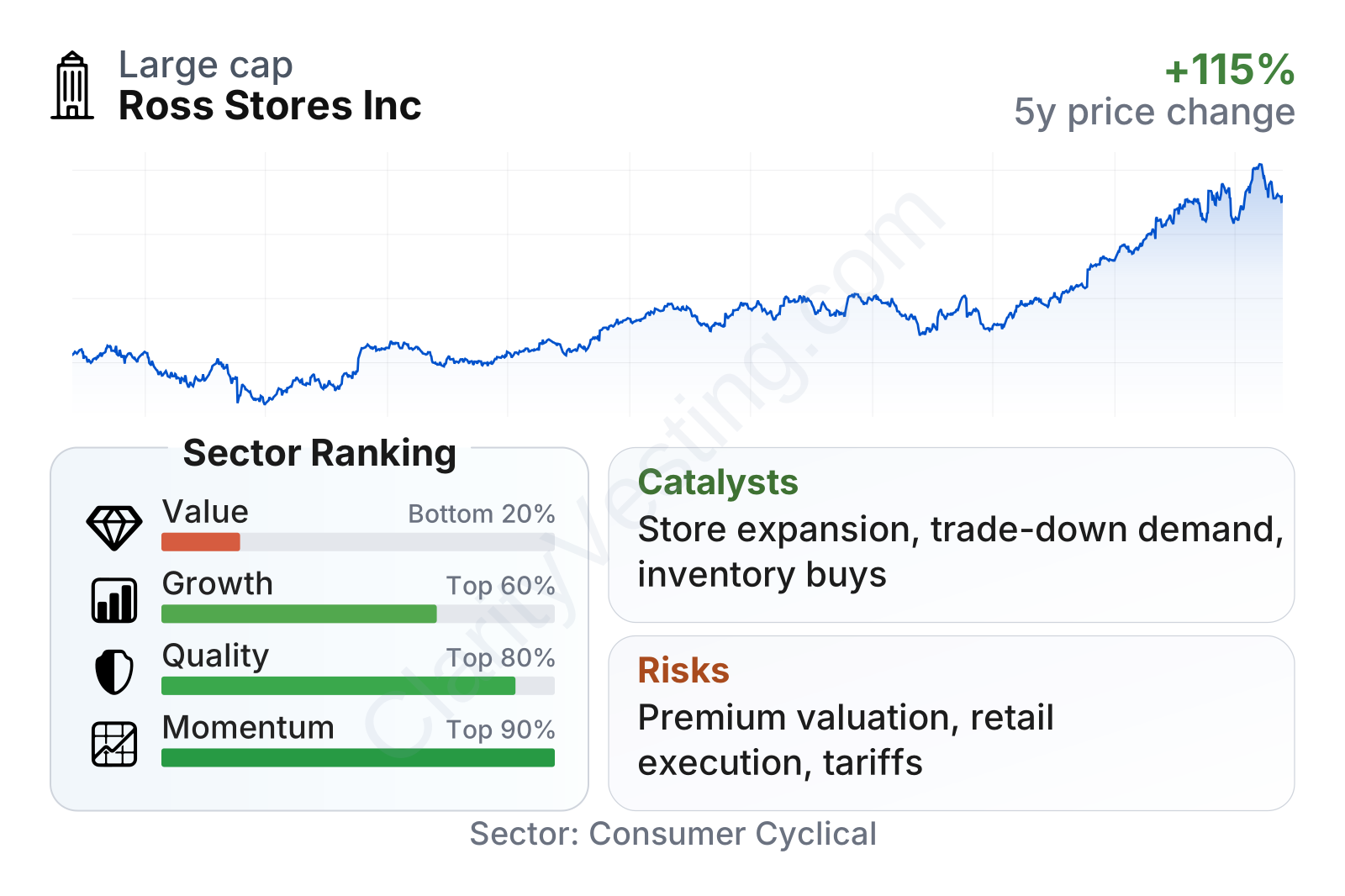
Ross Stores stands out for business quality more than for cheap valuation. Profitability is comfortably above much of the consumer cyclical sector, with returns on invested capital around 30% and operating margins in the low teens, both strong for brick-and-mortar retail. Growth metrics are mixed but still favorable overall: recent revenue growth has been stronger than the sector median, and free cash flow has compounded well over five years. The weaker area is valuation, where the shares trade at noticeably richer multiples than the sector, suggesting the market is already recognizing the company’s consistency and resilience.
The stock’s longer-term price trend has also been very strong. Over the past three years, share performance has materially outpaced the broader sector sample, showing that the market has rewarded Ross for dependable execution and improving fundamentals.
Growth
Ross Stores operates in a part of retail that has remained relevant across very different consumer environments. Off-price retail tends to perform well when shoppers become more price-conscious, but it can also gain share in healthier periods because many customers enjoy branded goods at lower prices regardless of the economic cycle. That makes the sector more resilient than many traditional apparel retailers.
The company’s growth strategy is also straightforward and credible. It continues to expand its store base, especially through Ross Dress for Less while gradually building dd’s DISCOUNTS. Management has long emphasized that the U.S. market can support significantly more locations over time. Because the model does not require heavy digital spending to drive most sales, expansion economics can remain attractive if site selection and inventory discipline stay strong.
Recent sales growth has accelerated after a softer period in 2022 and early 2023. The latest year-over-year readings moved back into the low-double-digit range, which is a meaningful improvement for a mature retailer. This suggests Ross has been benefiting from a combination of new stores, healthy customer traffic, and continued demand for value-oriented shopping.
Cash generation has improved clearly over time, with trailing free cash flow rising from just above $1 billion in 2022 to above $2 billion more recently. For a retailer, that matters because free cash flow supports store openings, supply chain investments, and shareholder returns without putting pressure on the balance sheet.
A major catalyst is the possibility that a tougher consumer environment actually helps the company attract more traffic. Off-price retailers often gain access to attractive branded inventory when full-price retailers are overstocked, creating a favorable buying environment for experienced operators. Ross’s scale and vendor relationships can make that a meaningful advantage. Another growth support is category breadth: apparel remains central, but home, accessories, and footwear help diversify the shopping basket.
Recent company updates have continued to point to store growth, disciplined expense management, and confidence in the off-price model’s long runway in the U.S. market. For a business of Ross’s size, that combination is one of the more important reasons the market continues to assign it a premium multiple.
Risks
This article is for informational purposes only and does not constitute financial advice. Some content is AI-generated. See Disclaimer


