Stock Analysis · Roper Technologies Inc (ROP)
Overview
Roper Technologies is a diversified software and technology company that has evolved far beyond its industrial roots. Today, the business is centered on asset-light, high-margin software, data, and niche technology products that are used in specialized markets such as healthcare, insurance, legal, education, water, construction, and transportation. Rather than competing in broad consumer software, Roper tends to own market-leading products in narrow professional categories where customers rely on them for mission-critical workflows and are less likely to switch providers.
The company reports results through application software, network software, and technology-enabled product businesses. Based on recent annual reporting, revenue is now primarily software-driven, with recurring and subscription-like revenue playing a major role. A practical way to think about Roper’s revenue mix is the following:
- Application software: about 45% to 50% of revenue. This includes vertical software used in healthcare, education, legal, construction, and other professional end markets.
- Network software: about 30% to 35% of revenue. This covers transaction-based and data-network businesses, including software platforms tied to insurance, freight, tolling, and other connected workflows.
- Technology enabled products: about 20% to 25% of revenue. This includes niche engineered products and software-linked solutions, often serving laboratories, water, medical, and industrial customers.
This mix matters because software and data businesses usually produce stronger margins, steadier cash generation, and lower capital needs than traditional manufacturing. Over the last several years, Roper’s revenue and gross profit have both expanded materially, while operating profit has also increased, showing that the company has been able to scale without losing discipline. At the same time, interest expense has risen as debt has been used to support acquisitions, which is an important part of the investment picture.
The business model shows a clear tilt toward high gross profit and strong operating income conversion. Revenue has climbed steadily since 2021, and profit has broadly followed, although financing costs have become more noticeable as the company continues to reshape its portfolio.
Key Figures
| Metric | Value | Sector ⓘ |
|---|---|---|
| Date | Sep 12, 2026 | |
| Context | ||
| Sector | Technology | |
| Industry | Software - Application | |
| Market Cap ⓘ | $38.43B | |
| Beta ⓘ | 0.75 | |
Value (Cheapness) | ||
| P/E Ratio ⓘ | 16.26 | 29.51 |
| FCF Yield ⓘ | 6.82% | 4.25% |
| EBIT / EV ⓘ | 6.82% | 2.85% |
| PEG ⓘ | 1.54 | |
Growth (Business expansion) | ||
| Revenue Growth ⓘ | 8.50% | 15.40% |
| RPS Growth (5Y CAGR) ⓘ | 12.73% | 8.56% |
| EPS Growth (5Y CAGR) ⓘ | -10.13% | -11.88% |
| Margin Growth (5Y Trend) ⓘ | 2.43% | 0.46% |
| FCF Growth (5Y CAGR) ⓘ | 6.34% | 9.80% |
Quality (Business durability) | ||
| ROIC (Latest) ⓘ | 9.60% | 9.44% |
| ROIC (5Y Median) ⓘ | 5.96% | 8.30% |
| Net Debt / EBIT (Latest) ⓘ | 3.25 | 0.54 |
| Net Debt / EBIT (5Y Median) ⓘ | 3.98 | 0.44 |
| Operating Margin (Latest) ⓘ | 40.69% | 9.58% |
| Operating Margin (5Y Median) ⓘ | 28.25% | 8.25% |
| Debt to Equity (Latest) ⓘ | 60.53% | 33.33% |
| Profit Margin (Latest) ⓘ | 30.24% | 7.14% |
| Free Cash Flow (Latest) ⓘ | $2.62B | |
Momentum (Price trend) | ||
| 3Y Return ⓘ | -19.70% | +45.48% |
| 12M Return (excl. last month) ⓘ | -23.25% | +23.48% |
| 6M Return ⓘ | +12.60% | +20.93% |
| Price vs. 200-Day MA ⓘ | +3.94% | +7.43% |
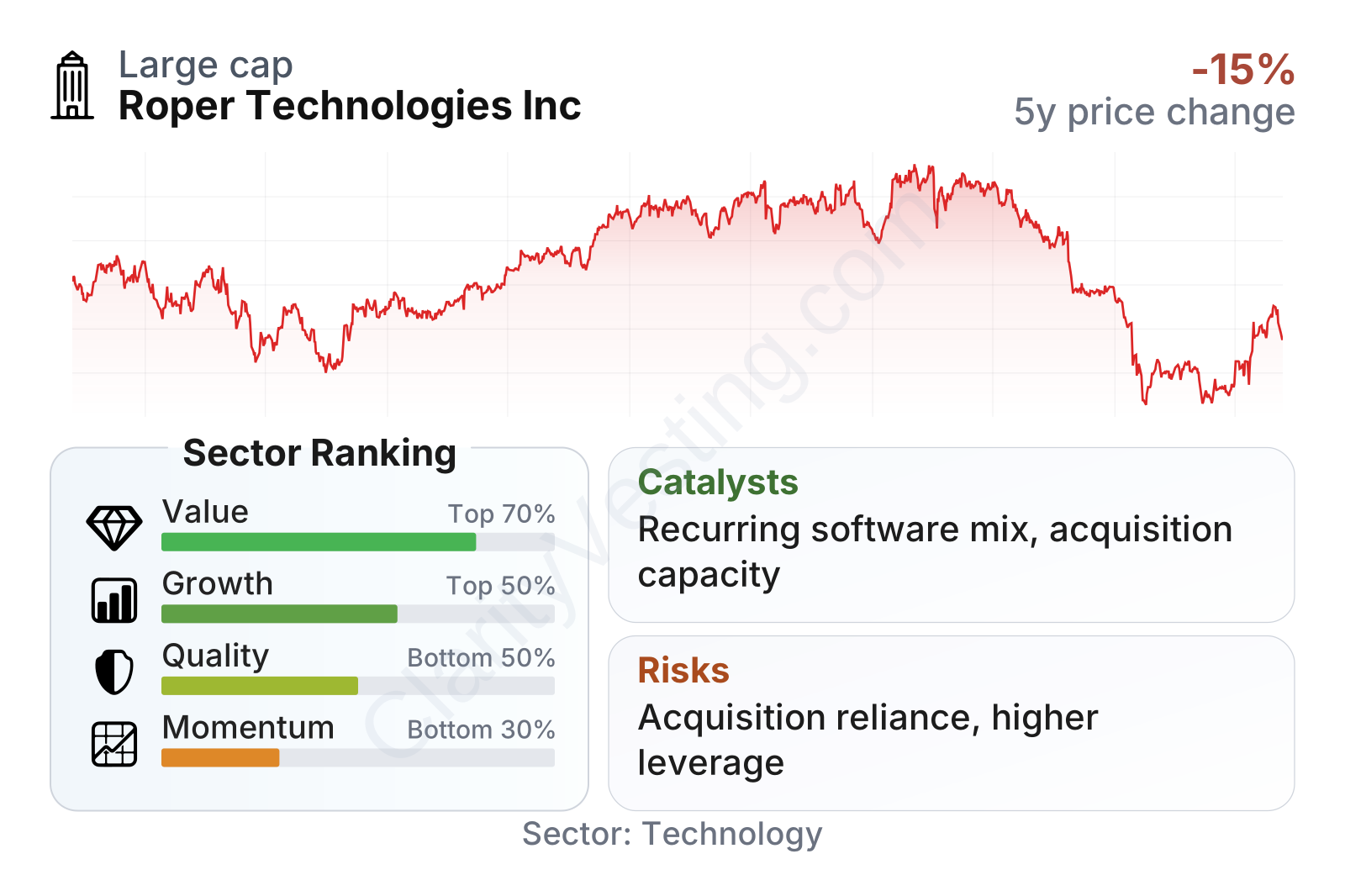
Roper is a large-cap company with a relatively low beta, meaning its share price has historically moved less than many technology names. The current factor profile is mixed but understandable: valuation appears stronger than the sector median, growth is respectable rather than exceptional, profitability is very strong, and balance-sheet leverage pulls down the quality score. Momentum has been weak, reflecting a major stock-price reset from prior highs.
The most striking operating figures are margin and cash generation. Operating margin is around 31% and profit margin is around 30%, both far above typical sector levels. Free cash flow is also substantial, and the cash flow yield and earnings-based valuation metrics screen better than much of the software universe. The weaker points are leverage and a return-on-invested-capital profile that does not stand out as much as the margins do, partly because acquisitions require significant capital allocation over time.
Growth
Roper operates in segments of the economy that still have room for long-duration software adoption. Healthcare workflow tools, insurance software, legal information services, campus and education systems, and transportation networks are not glamorous markets, but they are sticky and often slow to change. That can be attractive for long-term business durability. These sectors are not usually driven by one-time device sales; they tend to depend on recurring customer relationships, embedded data, and operational dependence.
The company’s strategy has been consistent: acquire niche leaders, improve operations, emphasize recurring revenue, and recycle capital away from lower-quality assets. That approach makes strategic sense because it avoids direct competition with large horizontal software vendors and instead builds a collection of specialized franchises. It also helps explain why Roper has delivered better five-year revenue-per-share growth than the sector median even though its recent year-over-year growth has moderated.
Recent growth has slowed from the mid-teens range seen earlier in the cycle to high-single-digit territory. That is not unusual for a company of Roper’s size and maturity, but it does mean future expansion will likely depend more on acquisitions, pricing, recurring revenue retention, and cross-selling than on rapid organic acceleration alone.
Free cash flow remains one of the strongest parts of the case. After some volatility, trailing cash generation has recovered sharply and moved to record levels, reaching roughly $2.5 billion. That gives Roper meaningful flexibility to fund bolt-on deals, reduce debt, and keep reshaping the portfolio.
A key catalyst in recent years has been the continued migration toward software and data-centric operations. Another is the company’s acquisition engine itself: when Roper finds high-retention businesses in niche markets, it can often integrate them without heavy capital spending. Public company updates have also emphasized portfolio optimization, which suggests management remains focused on improving the overall mix rather than simply chasing size.
Risks
This article is for informational purposes only and does not constitute financial advice. Some content is AI-generated. See Disclaimer


