Stock Analysis · Rollins Inc (ROL)
Overview
Rollins is a pest control company best known for the Orkin brand. It provides services to residential customers, commercial clients, and businesses that need regular inspection, treatment, and prevention for termites, rodents, insects, and other pests. The company operates mainly in North America, with additional operations in international markets, and its business model is built around recurring service relationships rather than one-time projects.
Revenue comes primarily from pest and termite services sold through a portfolio of brands. Based on company disclosures, the business is heavily concentrated in pest control, with termite-related work and ancillary services making up the balance. A practical breakdown is:
- Residential pest control: approximately 45% to 50% of revenue. This includes recurring household services for insects, rodents, and preventive treatments.
- Commercial pest control: approximately 30% to 35% of revenue. This serves restaurants, healthcare facilities, property managers, retailers, and other businesses that need compliance-sensitive pest management.
- Termite and ancillary services: approximately 15% to 20% of revenue. This includes termite protection, inspections, and related add-on services.
- Other and international activities: a smaller remaining share, generally below 10%, depending on acquisitions and reporting scope.
What stands out in Rollins’ operating profile is the consistency of the model. Customers often sign up for ongoing service plans, which makes revenue more predictable than in many other consumer-facing service businesses. The company has also expanded steadily through acquisitions, using local brands and branch networks to deepen coverage in attractive markets.
Over the last several years, revenue, gross profit, operating income, and net income have all moved higher. The business has remained profitable while scaling, although selling and administrative costs have also risen as Rollins expands and integrates acquired operations.
The long-term picture is one of a large, cash-generative service company with a simple offering, strong brand recognition, and a revenue base that is spread across many small and mid-sized customer relationships rather than a handful of major accounts.
Key Figures
| Metric | Value | Sector ⓘ |
|---|---|---|
| Date | Sep 12, 2026 | |
| Context | ||
| Sector | Consumer Cyclical | |
| Industry | Personal Services | |
| Market Cap ⓘ | $16.71B | |
| Beta ⓘ | 0.74 | |
Value (Cheapness) | ||
| P/E Ratio ⓘ | 31.57 | 17.10 |
| FCF Yield ⓘ | 3.71% | 8.53% |
| EBIT / EV ⓘ | 4.16% | 6.46% |
| PEG ⓘ | 2.78 | |
Growth (Business expansion) | ||
| Revenue Growth ⓘ | 7.90% | 5.75% |
| RPS Growth (5Y CAGR) ⓘ | 12.06% | 9.14% |
| EPS Growth (5Y CAGR) ⓘ | -7.66% | -18.21% |
| Margin Growth (5Y Trend) ⓘ | -0.54% | -0.23% |
| FCF Growth (5Y CAGR) ⓘ | 14.77% | 4.91% |
Quality (Business durability) | ||
| ROIC (Latest) ⓘ | 27.36% | 12.61% |
| ROIC (5Y Median) ⓘ | 29.41% | 10.72% |
| Net Debt / EBIT (Latest) ⓘ | 1.37 | 2.10 |
| Net Debt / EBIT (5Y Median) ⓘ | 1.10 | 2.32 |
| Operating Margin (Latest) ⓘ | 18.71% | 9.25% |
| Operating Margin (5Y Median) ⓘ | 19.40% | 9.64% |
| Debt to Equity (Latest) ⓘ | 78.02% | 75.78% |
| Profit Margin (Latest) ⓘ | 13.55% | 5.33% |
| Free Cash Flow (Latest) ⓘ | $619.17M | |
Momentum (Price trend) | ||
| 3Y Return ⓘ | +0.39% | +14.53% |
| 12M Return (excl. last month) ⓘ | -35.99% | +3.08% |
| 6M Return ⓘ | -37.01% | +0.55% |
| Price vs. 200-Day MA ⓘ | -32.41% | -0.54% |
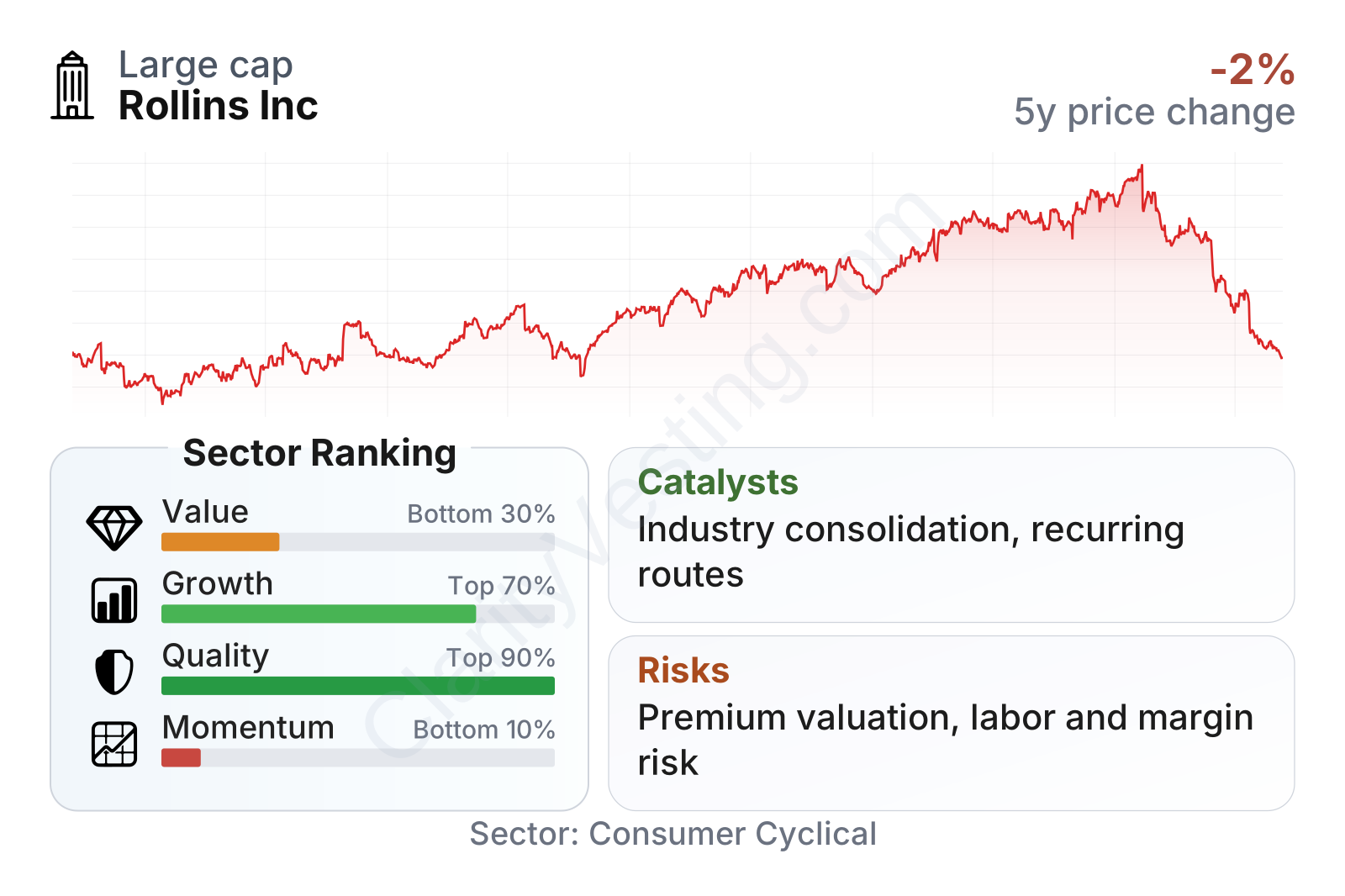
Rollins is a large company by industry standards, with a market value around the high teens in billions of dollars and a stock that has historically shown lower volatility than the broader market, as reflected by a beta below 1. In the factor breakdown, quality is the clearest strength: returns on invested capital are far above the sector median, operating margin is close to 19% versus roughly 9% for the sector median, and profit margin is near 14% versus roughly 6% for the median. Growth is solid rather than explosive, with revenue and free cash flow trends generally ahead of the sector. The weaker area is valuation, where the earnings multiple and cash flow yield indicate a richer price than most peers, while recent stock momentum has been notably soft.
Growth
Pest control is a structurally resilient industry. Demand does not depend heavily on consumers making discretionary upgrades; homes, restaurants, warehouses, offices, and healthcare sites all need pest prevention and treatment regardless of the economic cycle. In addition, urban density, food safety requirements, climate-related shifts in pest patterns, and rising awareness of public health standards all support steady long-term demand.
Rollins’ strategy for growth is straightforward and sensible. It combines organic expansion through pricing, customer retention, route density, and cross-selling with acquisitions of local and regional operators. This is an attractive formula in a fragmented market, because smaller operators can be acquired and folded into a broader network with stronger branding, technology, training, and procurement. Rollins has used this model for years, and its branch-based structure supports continued consolidation.
Revenue growth has been consistently positive for an extended period, often around high-single-digit to low-double-digit rates, and it remains above the sector median. That matters because it suggests demand has held up even as the company has become much larger. The pace has moderated from the strongest periods, but it still points to a business that continues to expand rather than merely defend its position.
Cash generation is another encouraging signal. Free cash flow has climbed steadily from the low-$300 million range a few years ago to above $600 million on a trailing basis. That rising cash pool gives the company flexibility to fund acquisitions, invest in operations, pay dividends, and maintain balance sheet discipline without depending too heavily on outside financing.
A notable catalyst for future growth is continued industry consolidation. Pest control remains fragmented despite the presence of several large players, and Rollins has both the scale and operational track record to keep acquiring smaller businesses. Another catalyst is the stickiness of recurring service relationships: once routes are established and customer density improves in a local market, additional revenue can be added efficiently. Recent company communications have also emphasized ongoing demand, route-based expansion, and the contribution of acquired businesses, which together reinforce the view that growth is still being driven by practical operating levers rather than one-off events.
Risks
This article is for informational purposes only and does not constitute financial advice. Some content is AI-generated. See Disclaimer


