Stock Analysis · Rogers Corporation (ROG)
Overview
Rogers Corporation is a specialty materials company that designs engineered products used in demanding electronic and industrial applications. In simple terms, it makes high-performance materials that help devices manage heat, carry signals reliably, protect sensitive components, and improve efficiency. Its products are found in areas such as electric vehicles, advanced driver-assistance systems, power electronics, industrial equipment, portable electronics, aerospace, and telecommunications infrastructure.
The company reports its business in two main operating segments. The larger business is Advanced Electronics Solutions, which supplies circuit materials, ceramic substrates, busbars, and thermal management products used in electric vehicles, power modules, and other high-reliability electronics. The second segment is Elastomeric Material Solutions, which provides engineered polyurethane and silicone materials for cushioning, sealing, vibration management, and protection in consumer, transportation, and industrial uses. Rogers also has a smaller corporate and other category that mainly reflects non-operating items rather than a major revenue engine.
Based on the company’s recent annual reporting, revenue is broadly concentrated as follows:
- Advanced Electronics Solutions: roughly three-quarters to four-fifths of total revenue
- Elastomeric Material Solutions: roughly one-fifth to one-quarter of total revenue
- Other: minimal direct revenue contribution
That revenue mix matters because it ties Rogers closely to long-cycle technology and industrial themes, especially vehicle electrification and higher-performance power systems. At the same time, it also means results can move with customer inventory corrections and swings in industrial demand. Over the last several years, revenue has softened from earlier peaks, and profitability has fallen much more sharply than sales, showing that cost absorption has become a major issue.
The business flow over time shows a clear pattern: sales have declined from the 2021-2022 high point, but the larger pressure has come from shrinking gross profit and weaker operating income. Research and development spending has remained meaningful, which supports product depth, yet lower revenue has made the cost base harder to carry.
Key Figures
| Metric | Value | Sector ⓘ |
|---|---|---|
| Date | Jul 18, 2026 | |
| Context | ||
| Sector | Technology | |
| Industry | Electronic Components | |
| Market Cap ⓘ | $2.36B | |
| Beta ⓘ | 0.49 | |
Value (Cheapness) | ||
| P/E Ratio ⓘ | N/A | 31.76 |
| FCF Yield ⓘ | 4.25% | 4.18% |
| EBIT / EV ⓘ | 2.08% | 2.56% |
| PEG ⓘ | 0.77 | |
Growth (Business expansion) | ||
| Revenue Growth ⓘ | 5.20% | 13.50% |
| RPS Growth (5Y CAGR) ⓘ | -2.84% | 8.57% |
| EPS Growth (5Y CAGR) ⓘ | -40.36% | -21.87% |
| Margin Growth (5Y Trend) ⓘ | -19.13% | 0.41% |
| FCF Growth (5Y CAGR) ⓘ | 7.47% | 9.76% |
Quality (Business durability) | ||
| ROIC (Latest) ⓘ | 2.05% | 8.54% |
| ROIC (5Y Median) ⓘ | 4.14% | 8.12% |
| Net Debt / EBIT (Latest) ⓘ | -3.78 | 0.38 |
| Net Debt / EBIT (5Y Median) ⓘ | -0.70 | 0.38 |
| Operating Margin (Latest) ⓘ | 5.67% | 9.58% |
| Operating Margin (5Y Median) ⓘ | 6.92% | 8.25% |
| Debt to Equity (Latest) ⓘ | 1.80% | 33.52% |
| Profit Margin (Latest) ⓘ | -6.81% | 6.96% |
| Free Cash Flow (Latest) ⓘ | $100.20M | |
Momentum (Price trend) | ||
| 3Y Return ⓘ | -22.27% | +30.91% |
| 12M Return (excl. last month) ⓘ | +134.06% | +28.90% |
| 6M Return ⓘ | +31.07% | +5.38% |
| Price vs. 200-Day MA ⓘ | +20.00% | +7.61% |
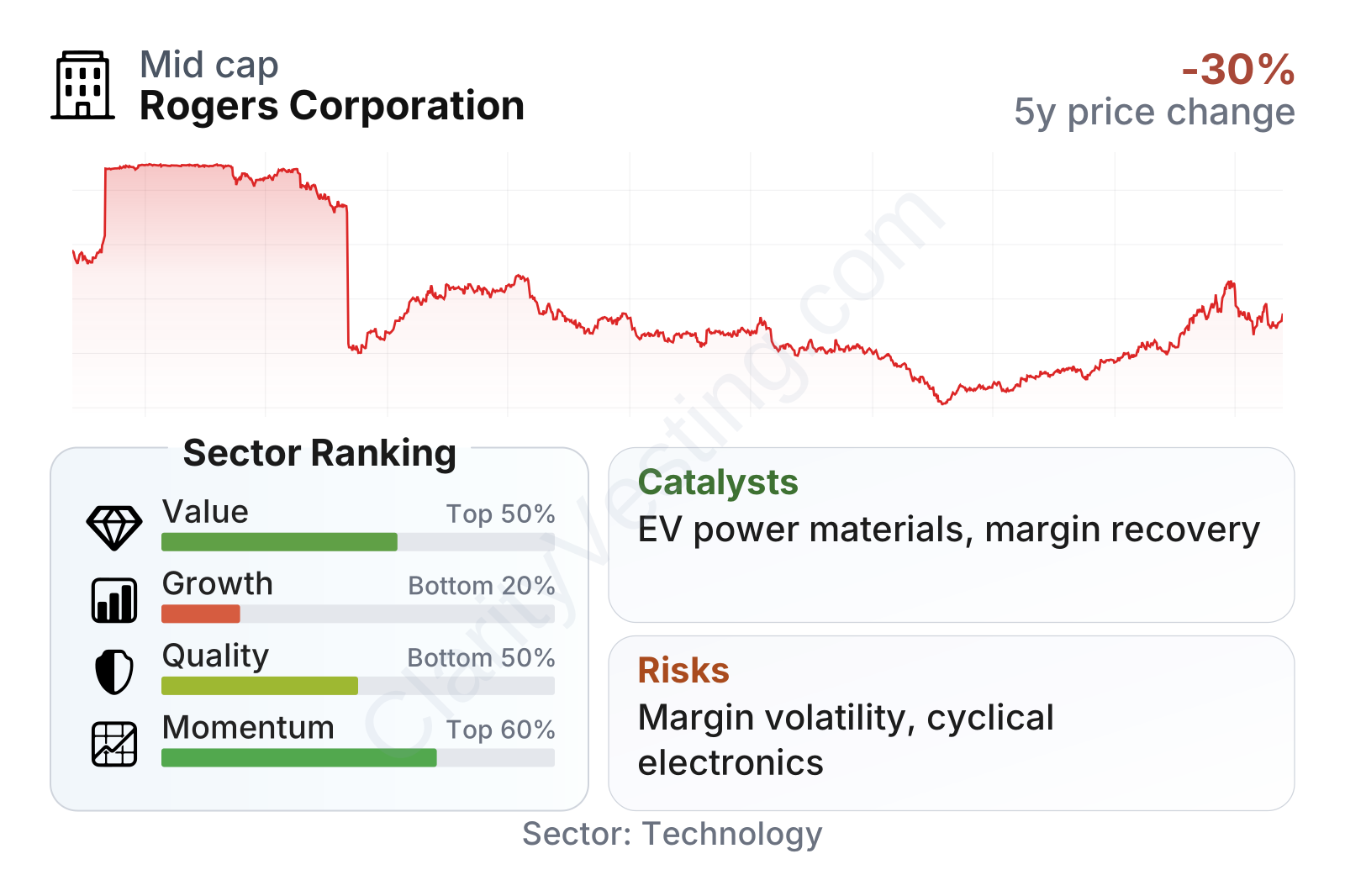
Rogers is currently a mid-cap company with a market value around $3 billion and a relatively low beta, which suggests the stock has historically moved less than many technology names. The broader factor picture is mixed. Balance sheet strength stands out, with extremely low debt and net cash characteristics, but growth and profitability metrics are weaker than many peers in the electronic components space. Recent share-price momentum has improved sharply, even though the underlying operating profile still looks uneven.
The contrast is important: the market has recently become more optimistic, but the company’s ranking on growth and quality remains below the sector median in several areas. That usually means the next phase for the stock depends less on financial engineering and more on whether management can rebuild margins and return to steadier organic growth.
Growth
Rogers operates in markets that still have attractive long-term demand drivers. Electric vehicles need more advanced power electronics and thermal management. Data, communications, aerospace, and defense systems continue to require high-reliability materials. As electronics become more powerful and compact, material performance becomes more important, not less. That gives Rogers exposure to structural growth areas even if its recent company-level results have lagged those themes.
The challenge is that being in a good sector is not the same as growing consistently. Revenue growth turned negative for an extended period after the 2022 peak, reflecting weaker end markets, customer inventory adjustments, and slower order activity. More recently, the year-over-year trend has turned positive again, but only modestly, which points more to stabilization than a full rebound so far.
The recent improvement in sales growth is encouraging because it breaks a long sequence of declines, but the pace remains well below the sector’s typical expansion. For Rogers, the key question is not whether demand themes exist; it is whether those themes can translate into sustained volume recovery and better factory utilization.
Management’s strategy still makes industrial sense. The company focuses on specialized materials where qualification cycles are long, switching can be difficult, and product performance matters more than price alone. That positioning can be powerful in electric vehicle power modules, thermal solutions, and high-frequency electronics. If customers move from testing to broader production programs, Rogers can benefit from content growth per system rather than simply chasing unit volumes.
Cash generation has recovered much better than accounting earnings. Free cash flow moved from negative territory several years ago to a solid positive level more recently, with a noticeable rebound over the trailing twelve months. That suggests working capital discipline and capital spending control have helped offset weaker profitability. For a cyclical materials business, that is a meaningful sign of resilience.
Recent company communications have also highlighted efforts around operational improvement, portfolio focus, and participation in electrification-related applications. The most significant opportunity remains the same one that has shaped the investment case for years: if electric vehicle and power electronics demand normalizes and utilization improves, the earnings response could be larger than the revenue response because margins are currently depressed.
Risks
The main risk is execution during a downcycle. Rogers has seen revenue contract from earlier highs, but the larger problem has been margin deterioration. Net margin has moved from clearly positive levels a few years ago to negative territory recently, and operating margin also sits below sector norms. That pattern can reflect underused manufacturing capacity, weaker pricing power in some product lines, or a cost base that is not yet aligned with demand.
One major strength offsets part of that risk: the balance sheet is unusually conservative. Debt-to-equity is very low, far below the sector median, and net debt relative to EBIT is negative, indicating a net cash position. This does not solve operating issues, but it gives the company time and flexibility to work through them without the same financing pressure many cyclical businesses face.
The profit trend is the area that deserves the closest attention. Rogers previously ran above the sector median on net margin, but that advantage has reversed. The latest reading remains negative while the sector stays profitable on average. In other words, this is not just a slower-growth period; it is also a period in which the company is converting too little of its sales into bottom-line earnings.
Competitive positioning is mixed. Rogers has real advantages in specialized materials, application know-how, customer qualification requirements, and long-standing relationships in demanding end markets. Those are meaningful barriers, especially where failure is costly and redesigns take time. However, it is not the dominant global leader across all of its niches, and it competes against larger, diversified materials and electronics suppliers with broader scale.
Main competitors vary by product family, but the landscape includes companies such as DuPont in advanced electronic materials, 3M in certain specialty materials applications, CoorsTek in technical ceramics, and other niche substrate, thermal management, and elastomer suppliers. Compared with these rivals, Rogers is more specialized and often more exposed to a narrower set of end-market swings. That can be an advantage in expertise, but it can also amplify volatility when demand softens.
Another risk is customer and market concentration. A large share of Rogers’ business is connected to electronics, transportation, and industrial programs that can be cyclical and project-based. Product qualification can create stickiness once won, but design cycles are long, and order timing can be uneven. A slower electric vehicle buildout, delayed industrial recovery, or extended inventory correction could all limit near-term progress.
There does not appear to be a major public scandal or governance shock defining the current picture. The more relevant risk is operational: whether management can convert strategic exposure to attractive markets into better utilization, higher returns on invested capital, and restored profitability.
Valuation
Valuing Rogers is not straightforward right now because traditional earnings multiples are distorted by weak or negative earnings. The historical valuation pattern shows the stock has often traded above the sector median on a price-to-earnings basis, and once earnings turned negative, that measure effectively stopped being useful. That means investors looking only at P/E can easily get a misleading picture.
The more useful reading is relative to cash flow, assets, and recovery potential. On the latest factor snapshot, Rogers does not screen as obviously cheap compared with the sector on free-cash-flow yield or EBIT relative to enterprise value, even after the business slowdown. At the same time, its PEG ratio appears more favorable, which suggests the market may be assigning value to a rebound rather than to current earnings strength.
This leaves the valuation case balanced between two opposing ideas. On one side, the company has a clean balance sheet, real exposure to durable electronics and electrification themes, and cash generation that looks better than reported earnings. On the other side, recent profitability is weak, returns on capital are low, and the growth record over the last five years trails the sector by a wide margin. In that context, the current price seems to reflect a partial recovery scenario rather than a deeply distressed one.
So the stock does not look plainly expensive in the context of a potential earnings rebound, but it also does not look obviously discounted given how much operational improvement still needs to be demonstrated. The valuation is easier to justify if margins recover meaningfully; it is harder to justify if revenue stays sluggish and profit conversion remains weak.
Conclusion
Rogers Corporation is a specialized materials company with credible exposure to attractive long-term themes such as electric vehicles, power electronics, thermal management, and high-reliability industrial systems. That strategic positioning is the most compelling part of the business, and its very low debt adds an important layer of financial resilience.
The difficulty is that the company’s recent operating results have not matched the quality of those end markets. Revenue has only recently stabilized after a prolonged decline, margins have compressed sharply, returns on capital are modest, and net income has turned negative. In other words, the business still looks like a recovery situation rather than a company currently firing on all cylinders.
For long-term analysis, the central issue is whether Rogers can translate its niche product strength into better utilization and stronger profitability as demand normalizes. If that happens, the company has room to look much stronger than today’s earnings suggest. If it does not, the stock’s recent rebound may prove to be running ahead of the underlying business. The overall picture is more promising than distressed, but it remains dependent on execution and margin repair rather than on sector tailwinds alone.
Sources:
- Rogers Corporation — Annual Report on Form 10-K for fiscal year 2025
- Rogers Corporation — Quarterly Report on Form 10-Q for quarter ended March 31, 2026
- Rogers Corporation — SEC EDGAR company filings database
- Rogers Corporation Investor Relations — earnings releases and investor presentation materials
- Rogers Corporation Investor Relations — public webcast and earnings call materials
- Wikipedia — Rogers Corporation
This article is for informational purposes only and does not constitute financial advice. Some content is AI-generated. See Disclaimer


