Stock Analysis · Renishaw plc (RNSHF)
Overview
Renishaw plc is a British engineering and technology company focused on precision measurement, motion control, and advanced manufacturing tools. In simple terms, it makes high-accuracy instruments that help manufacturers build parts correctly, verify quality, and automate complex industrial processes. Its products are used in industries where precision matters a great deal, including semiconductor equipment, electronics, aerospace, automotive, energy, and medical technology.
The business is built around two main activities. The larger one is manufacturing technologies, which includes metrology systems, machine tool probes, calibration equipment, encoder systems, and products tied to process control and automation. The second is analytical instruments and medical-related technology, including spectroscopy products and additive manufacturing systems. Renishaw also has a dental and neuroscience presence, but these are not the main economic drivers today.
Based on recent company reporting, revenue is concentrated in a few broad categories, with manufacturing-oriented products dominating the mix. The split can vary by year, but the business is commonly understood along these lines:
- Industrial metrology and machine tool products: roughly the majority of revenue, likely around 60% to 70%.
- Position measurement and encoder systems: an important secondary contributor, often around 15% to 25%.
- Analytical instruments, additive manufacturing, and medical-related technologies: the remaining portion, approximately 10% to 20%.
Geographically, Renishaw is a global exporter, with meaningful exposure to Asia, Europe, and the Americas. That international footprint gives it access to large end markets, but it also means results can be affected by global industrial demand, foreign exchange moves, and shifts in capital spending.
What stands out financially is that the company still converts a healthy share of sales into operating profit, but the mix has become less favorable over the last few years. Revenue has edged upward, while gross profit and net income have not kept pace because product costs and operating expenses, especially research and development, have risen. That pattern suggests a company still investing heavily in technology, but with near-term profitability under pressure.
Key Figures
| Metric | Value | Sector ⓘ |
|---|---|---|
| Date | Sep 12, 2026 | |
| Context | ||
| Sector | Technology | |
| Industry | Scientific & Technical Instruments | |
| Market Cap ⓘ | $5.03B | |
| Beta ⓘ | 1.13 | |
Value (Cheapness) | ||
| P/E Ratio ⓘ | 50.08 | 29.51 |
| FCF Yield ⓘ | 2.89% | 4.25% |
| EBIT / EV ⓘ | N/A | 2.85% |
| PEG ⓘ | N/A | |
Growth (Business expansion) | ||
| Revenue Growth ⓘ | 7.10% | 15.40% |
| RPS Growth (5Y CAGR) ⓘ | 5.89% | 8.56% |
| EPS Growth (5Y CAGR) ⓘ | 9.76% | -11.88% |
| Margin Growth (5Y Trend) ⓘ | -9.35% | 0.46% |
| FCF Growth (5Y CAGR) ⓘ | -2.31% | 9.80% |
Quality (Business durability) | ||
| ROIC (Latest) ⓘ | N/A | 9.44% |
| ROIC (5Y Median) ⓘ | 14.67% | 8.30% |
| Net Debt / EBIT (Latest) ⓘ | -0.36 | 0.54 |
| Net Debt / EBIT (5Y Median) ⓘ | -0.62 | 0.44 |
| Operating Margin (Latest) ⓘ | 13.94% | 9.58% |
| Operating Margin (5Y Median) ⓘ | 21.17% | 8.25% |
| Debt to Equity (Latest) ⓘ | 1.60% | 33.33% |
| Profit Margin (Latest) ⓘ | 10.06% | 7.14% |
| Free Cash Flow (Latest) ⓘ | $145.14M | |
Momentum (Price trend) | ||
| 3Y Return ⓘ | +63.72% | +45.48% |
| 12M Return (excl. last month) ⓘ | +94.66% | +23.48% |
| 6M Return ⓘ | +17.51% | +20.93% |
| Price vs. 200-Day MA ⓘ | +19.08% | +7.43% |
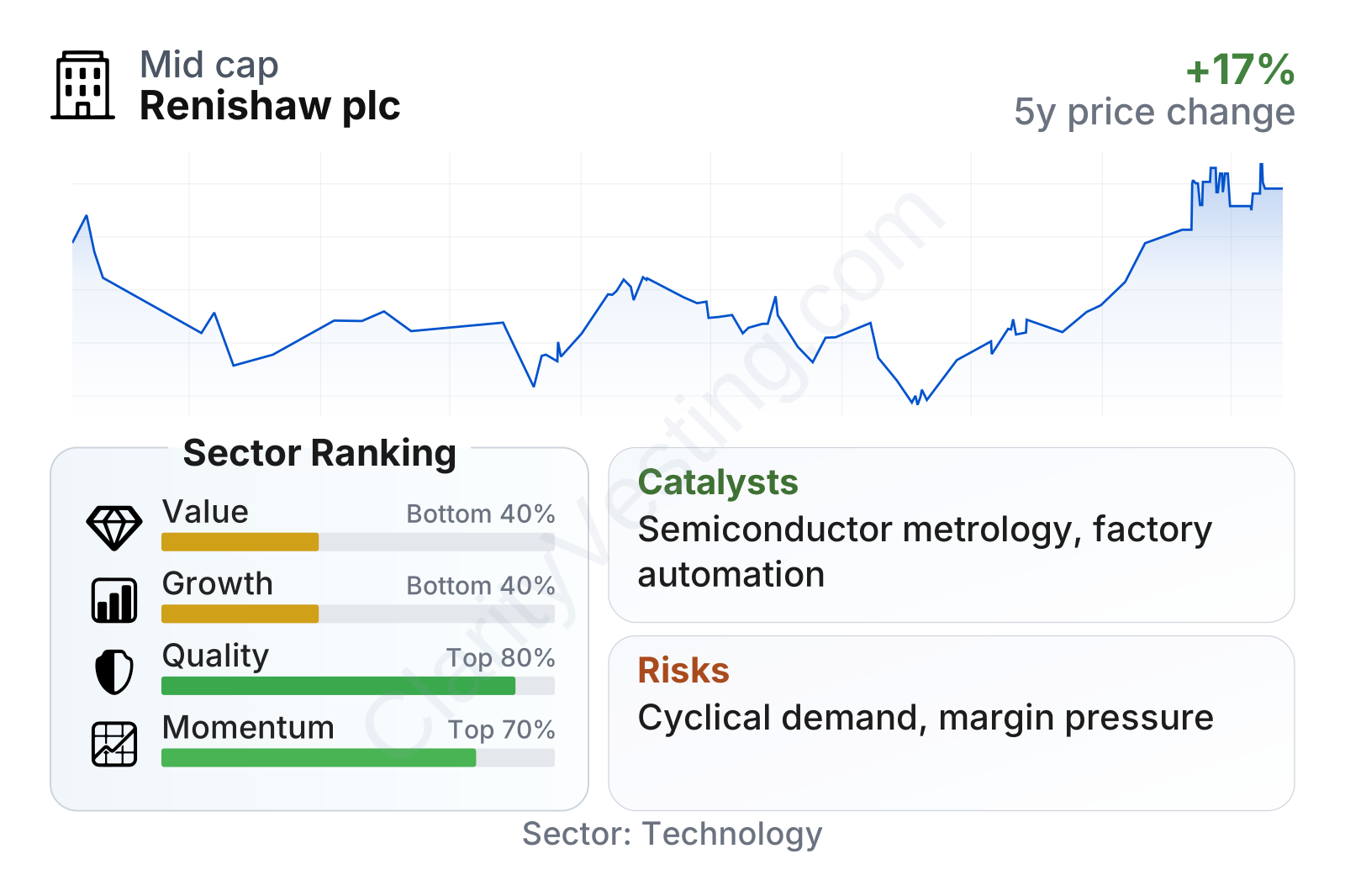
Renishaw sits in the mid-cap range at about $6.5 billion, with share-price volatility a little above the broader market. The overall picture is mixed: business quality looks solid, momentum has been strong, but valuation and recent growth metrics are less favorable. Profitability remains above many peers, and the balance sheet is unusually conservative for an industrial technology company, with very low leverage and net cash rather than net debt. On the other hand, revenue growth has been modest relative to the wider technology instrument group, and cash-flow expansion has not matched the pace seen across many sector peers.
Growth
Renishaw operates in several areas with attractive long-term demand drivers. Precision metrology benefits from rising quality requirements in advanced manufacturing. Encoders and motion-control products are linked to factory automation and increasingly sophisticated equipment. The company also has exposure to semiconductor manufacturing, where ever-tighter tolerances and process control are essential. These are not short-lived themes; they are tied to structural changes in how complex products are made.
The company’s strategy also makes sense in that context. Renishaw tends to compete through engineering depth rather than through mass-market volume. It invests heavily in research and development, which can weigh on current margins but helps protect its position in specialized applications. This matters because customers using measurement systems inside production lines often care more about reliability, repeatability, and integration than about the lowest upfront price.
Growth has been present, but not especially fast. Recent year-over-year sales growth has been positive, yet still below the sector median, and the five-year revenue-per-share trend also looks more moderate than many peers. That suggests Renishaw is participating in attractive end markets without currently converting that opportunity into standout top-line acceleration.
Cash generation remains meaningful, with trailing free cash flow still positive at roughly $145 million, but the longer-term trend has been less convincing than the revenue line. That weaker cash-flow progression likely reflects a mix of margin pressure, ongoing investment, and the naturally cyclical nature of customer demand. For a company of this type, sustained improvement in free cash flow would be an important sign that growth is becoming more efficient.
One potential catalyst is the continued buildout of advanced manufacturing capacity worldwide, especially where precision inspection and process control are critical. Semiconductor-related demand, higher automation intensity in factories, and tighter engineering standards in aerospace and medical applications could all support future orders. Renishaw has also continued to introduce and refine products across metrology and encoder lines, which can help deepen its role with existing customers rather than relying only on entirely new markets.
Recent corporate updates have also pointed to ongoing interest in manufacturing productivity, automation, and quality assurance solutions. For Renishaw, the most meaningful opportunities are likely to come not from a single breakthrough product but from broader industrial customers needing higher precision across larger parts of the production process.
Risks
This article is for informational purposes only and does not constitute financial advice. Some content is AI-generated. See Disclaimer


