Stock Analysis · Rambus Inc (RMBS)
Overview
Rambus is a semiconductor technology company, but it does not operate like a typical chip manufacturer. Its business is centered on designing high-value chip interfaces, security technologies, and memory-related intellectual property that other companies license or integrate into their own products. In simple terms, Rambus helps make data move faster and more securely inside data centers, AI systems, servers, and other advanced electronics.
The company’s activities are mainly organized around two engines: product revenue and licensing revenue. Product revenue comes from selling semiconductor and hardware-related solutions, especially memory interface chips and security components. Licensing revenue comes from letting customers use Rambus-developed technology and patents, often under long-term agreements.
Based on recent company reporting, Rambus revenue is largely split between its semiconductor products business and its IP-based licensing business, with products now representing the larger share. A practical way to think about the revenue mix is:
- Semiconductor products: approximately 60% to 70% of revenue. This includes memory interface chips and related solutions used in servers, AI infrastructure, and high-performance computing.
- Licensing and royalties: approximately 30% to 40% of revenue. This includes patent and technology licensing tied to memory, interface, and security intellectual property.
That mix matters because product sales can give Rambus more direct exposure to fast-growing hardware markets, while licensing can provide higher-margin and more recurring cash flows. Over the last several years, the business has also become meaningfully more profitable, suggesting Rambus has been converting revenue growth into stronger operating earnings rather than simply expanding at any cost.
Another important point for long-term analysis is business model quality. Rambus combines engineering-heavy development with intellectual property ownership. That can create a useful middle ground: the company participates in semiconductor growth without taking on the full capital intensity of running large fabrication plants.
The financial flow has improved noticeably over time. Revenue has risen from the low hundreds of millions to above $700 million annually, while gross profit and operating income have expanded faster than sales. Research and development remains substantial, which fits Rambus’s technology-driven model, but overhead has become more efficient relative to revenue.
Key Figures
| Metric | Value | Sector ⓘ |
|---|---|---|
| Date | Sep 12, 2026 | |
| Context | ||
| Sector | Technology | |
| Industry | Semiconductors | |
| Market Cap ⓘ | $9.43B | |
| Beta ⓘ | 1.87 | |
Value (Cheapness) | ||
| P/E Ratio ⓘ | 39.89 | 29.51 |
| FCF Yield ⓘ | 3.18% | 4.25% |
| EBIT / EV ⓘ | 3.66% | 2.85% |
| PEG ⓘ | 3.80 | |
Growth (Business expansion) | ||
| Revenue Growth ⓘ | 20.40% | 15.40% |
| RPS Growth (5Y CAGR) ⓘ | 22.56% | 8.56% |
| EPS Growth (5Y CAGR) ⓘ | N/A | -11.88% |
| Margin Growth (5Y Trend) ⓘ | 29.69% | 0.46% |
| FCF Growth (5Y CAGR) ⓘ | 14.27% | 9.80% |
Quality (Business durability) | ||
| ROIC (Latest) ⓘ | 18.30% | 9.44% |
| ROIC (5Y Median) ⓘ | 16.78% | 8.30% |
| Net Debt / EBIT (Latest) ⓘ | -0.21 | 0.54 |
| Net Debt / EBIT (5Y Median) ⓘ | -0.34 | 0.44 |
| Operating Margin (Latest) ⓘ | 40.91% | 9.58% |
| Operating Margin (5Y Median) ⓘ | 36.19% | 8.25% |
| Debt to Equity (Latest) ⓘ | 1.49% | 33.33% |
| Profit Margin (Latest) ⓘ | 31.69% | 7.14% |
| Free Cash Flow (Latest) ⓘ | $299.54M | |
Momentum (Price trend) | ||
| 3Y Return ⓘ | +52.98% | +45.48% |
| 12M Return (excl. last month) ⓘ | +32.14% | +23.48% |
| 6M Return ⓘ | -3.13% | +20.93% |
| Price vs. 200-Day MA ⓘ | -19.43% | +7.43% |
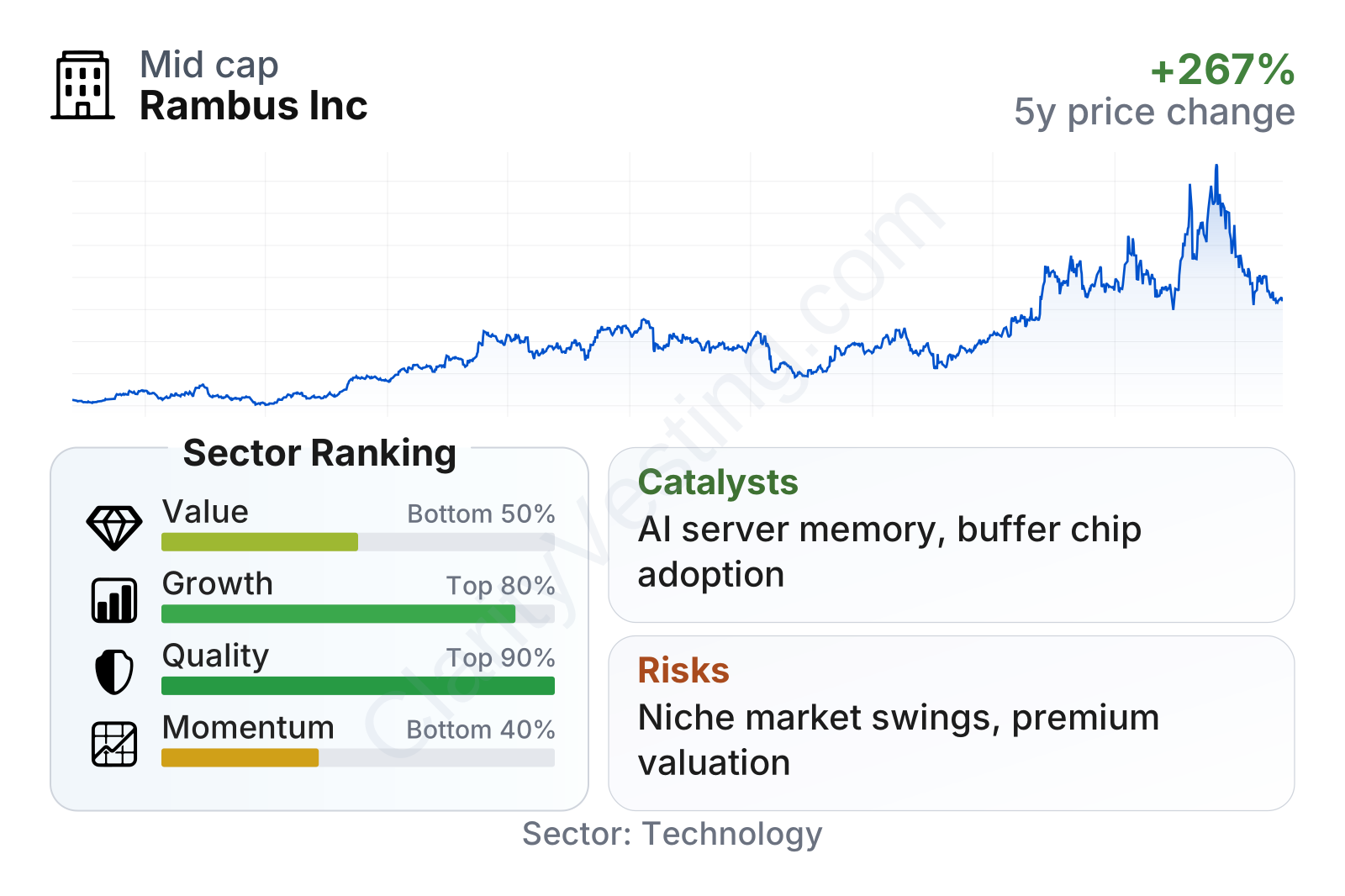
Rambus stands out most on quality and growth. Profitability is far above the sector median, with operating margin around 41% and net profit margin around 32%, both unusually strong for a semiconductor-related company. Return on invested capital is also well above the industry midpoint, which suggests the company has been allocating capital effectively. On the balance sheet, debt is very low at roughly 1.5% of equity, and net debt remains negative, meaning cash exceeds debt.
The weaker area is valuation and recent momentum. The earnings multiple is above the sector median, free cash flow yield is lower than the sector norm, and the stock has pulled back over the last six months despite strong multi-year performance. That combination often means the market still assigns Rambus a premium for its business quality, even after short-term volatility.
Growth
Rambus operates in a part of the technology market with long-term structural support. AI servers, cloud data centers, high-performance computing, and increasingly complex memory systems all require faster and more reliable data movement. That directly supports demand for advanced memory interface chips and related designs. Security is another tailwind, because modern infrastructure needs hardware-based protection for data and device authentication.
The company’s strategy also makes sense in this context. Rather than trying to compete as a broad chip giant, Rambus focuses on specialized layers where performance bottlenecks matter and technical know-how can command better margins. This narrower approach can work well when customers are willing to pay for reliability, speed, interoperability, and long design expertise.
Revenue growth has not been perfectly smooth, but the broader pattern remains favorable. After a softer stretch in 2023, growth reaccelerated strongly through 2024 and 2025, and the latest year-over-year pace remains above the sector median at roughly 20%. Over a five-year period, revenue per share growth has also been much stronger than the typical company in the sector, which points to durable expansion rather than a one-quarter spike.
Cash generation reinforces the growth case. Free cash flow has moved from around $200 million a few years ago to above $300 million on a trailing basis. That is important because it shows expansion is not only visible in accounting earnings; it is also turning into real cash that can support product development, acquisitions, repurchases, or strategic flexibility.
A major catalyst is the continued buildout of AI infrastructure. Advanced memory subsystems and high-speed interfaces are becoming increasingly important as computing workloads grow more demanding. Rambus has also continued to announce product and design progress around memory buffer chips and security solutions, which suggests it is aligned with where data center architecture is heading. For a company of Rambus’s size, even a modest increase in adoption across AI and server platforms can have a meaningful effect on results.
Risks
This article is for informational purposes only and does not constitute financial advice. Some content is AI-generated. See Disclaimer


