Stock Analysis · Rivian Automotive Inc (RIVN)
Overview
Rivian Automotive is an electric vehicle manufacturer focused on premium adventure-oriented consumer vehicles and commercial vans. Its best-known products are the R1T pickup, the R1S SUV, and electric delivery vans originally developed through a large partnership with Amazon. Beyond vehicles, Rivian also develops software, electrical architecture, charging services, and related aftermarket offerings around its vehicle platform.
Revenue still comes overwhelmingly from selling vehicles and related automotive products and services. Based on recent annual reporting, the business mix is concentrated in a few core streams:
- Automotive sales: roughly 92% to 95% of revenue. This includes sales of R1 consumer vehicles and commercial vans.
- Regulatory credits: roughly 3% to 6% of revenue. These are credits sold to other automakers that need help meeting emissions rules.
- Services and other automotive-related revenue: roughly 1% to 3% of revenue. This can include repairs, maintenance, accessories, software-related items, and other support activities.
That structure shows a company that is still primarily a vehicle manufacturer rather than a diversified mobility platform. The encouraging point is that revenue has expanded sharply from the startup phase, while the business has also improved manufacturing economics. The less encouraging point is that Rivian remains highly dependent on scaling production efficiently enough to turn those sales into durable profits.
The long-term trend has been clear: revenue has risen from a very small base to several billions of dollars, losses have narrowed, and gross profit recently moved from deeply negative territory to slightly positive. That is an important operational milestone, even though operating expenses and net losses remain large.
Key Figures
| Metric | Value | Sector ⓘ |
|---|---|---|
| Date | Sep 12, 2026 | |
| Context | ||
| Sector | Consumer Cyclical | |
| Industry | Auto Manufacturers | |
| Market Cap ⓘ | $23.24B | |
| Beta ⓘ | 1.62 | |
Value (Cheapness) | ||
| P/E Ratio ⓘ | N/A | 17.10 |
| FCF Yield ⓘ | -15.01% | 8.53% |
| EBIT / EV ⓘ | -12.74% | 6.46% |
| PEG ⓘ | N/A | |
Growth (Business expansion) | ||
| Revenue Growth ⓘ | 27.20% | 5.75% |
| RPS Growth (5Y CAGR) ⓘ | 102.60% | 9.14% |
| EPS Growth (5Y CAGR) ⓘ | -38.06% | -18.21% |
| Margin Growth (5Y Trend) ⓘ | N/A | -0.23% |
| FCF Growth (5Y CAGR) ⓘ | -13.35% | 4.91% |
Quality (Business durability) | ||
| ROIC (Latest) ⓘ | -25.01% | 12.61% |
| ROIC (5Y Median) ⓘ | -28.42% | 10.72% |
| Net Debt / EBIT (Latest) ⓘ | N/A | 2.10 |
| Net Debt / EBIT (5Y Median) ⓘ | N/A | 2.32 |
| Operating Margin (Latest) ⓘ | -50.28% | 9.25% |
| Operating Margin (5Y Median) ⓘ | -117.52% | 9.64% |
| Debt to Equity (Latest) ⓘ | 104.41% | 75.78% |
| Profit Margin (Latest) ⓘ | -54.96% | 5.33% |
| Free Cash Flow (Latest) ⓘ | -$3.49B | |
Momentum (Price trend) | ||
| 3Y Return ⓘ | -32.02% | +14.53% |
| 12M Return (excl. last month) ⓘ | +33.08% | +3.08% |
| 6M Return ⓘ | +4.77% | +0.55% |
| Price vs. 200-Day MA ⓘ | -1.75% | -0.54% |
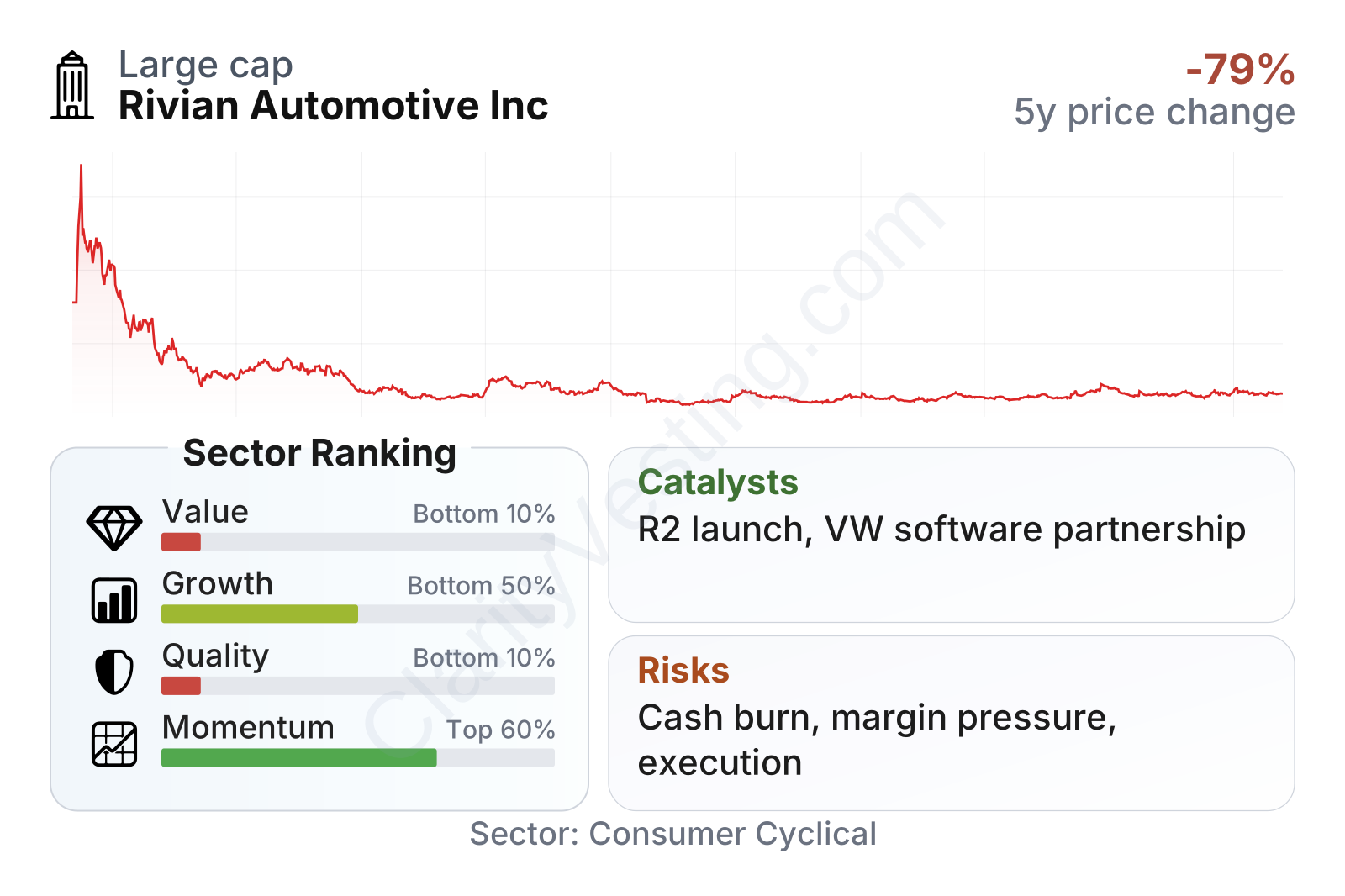
Rivian sits in the large-cap range, but its profile remains closer to a scaling manufacturer than a mature automaker. The table points to a business with strong top-line expansion but weak profitability, weak capital efficiency, and negative cash generation. Relative to the broader auto group, growth is better than many peers on revenue, while value and quality metrics remain near the bottom because earnings and free cash flow are still negative.
The share price history also reflects this split picture. After a very strong public-market debut, the stock fell sharply as investors reassessed production ramp challenges, losses, and the tougher financing backdrop for EV makers. More recently, trading has been volatile rather than directional, which is typical for companies where future execution matters more than current earnings.
Growth
Rivian operates in the electric vehicle market, which remains a growing sector over the long run even if growth has become less linear than many expected a few years ago. Stricter emissions rules, improving battery technology, and rising consumer familiarity with EVs still support long-term industry expansion. Commercial fleet electrification is also an important tailwind because vans with predictable routes are one of the easier vehicle categories to electrify.
Rivian’s strategy makes sense if viewed as a staged build-out. The company first established a premium brand with the R1 lineup, then built expertise in software and vehicle architecture, and is now working toward lower-cost, higher-volume products. That future step matters most because premium vehicles alone rarely create the scale needed to compete broadly in autos. Rivian’s planned midsize platform, especially the R2 and later R3 family, could open a much larger addressable market than the current product set.
Revenue growth has been uneven quarter to quarter, which is normal for an automaker balancing production changes, demand, and pricing. Even so, the latest annual pace remains far above the sector median, showing that Rivian is still expanding faster than a typical auto company. The key issue is no longer whether revenue can grow at all, but whether growth can come with better unit economics.
Cash burn is still substantial, but the trend is better than in the earlier ramp-up years. Rivian has reduced the scale of free cash outflows compared with its worst period, although recent trailing figures show that the business has not yet reached a steady self-funding position. For a long-term assessment, this is one of the most important operating measures because it shows how much outside financing the company may still need before reaching consistent profitability.
A major catalyst is the company’s partnership framework with Volkswagen Group, centered on electrical architecture and software. That arrangement has the potential to validate Rivian’s technology beyond its own vehicle lineup while also bringing in capital and strategic relevance. Another significant growth driver is the launch path toward the R2 platform, which is intended to move Rivian into a broader price range and materially larger customer base than the current premium segment.
Recent company communications have also highlighted continued work on manufacturing efficiency, cost reductions, and supply chain simplification. If those efforts continue to improve gross margin while new platforms arrive on schedule, Rivian’s growth profile could become more durable and less dependent on external funding.
Risks
This article is for informational purposes only and does not constitute financial advice. Some content is AI-generated. See Disclaimer


