Stock Analysis · Rigetti Computing Inc (RGTI)
Overview
Rigetti Computing is a quantum computing company. In simple terms, it is trying to build computers that use quantum physics to solve certain types of problems that are very hard for today’s classical computers. The company designs and manufactures its own superconducting quantum processors, connects them into computing systems, and gives customers access through the cloud. Rigetti also develops the software layer that lets researchers, enterprises, and government users run quantum programs on its machines.
Its business model is still early-stage, so revenue is small and can move sharply from one quarter to another depending on contracts, project timing, and research activity. Based on company filings, Rigetti’s revenue mainly comes from a mix of cloud access, professional services, and government- or research-related development work rather than large-scale commercial product sales.
The main revenue sources can be summarized as follows:
- Quantum computing services and cloud access: access to Rigetti’s quantum systems through its Quantum Cloud Services platform and partner marketplaces. This appears to be the company’s core commercial offering.
- Professional services and technical development work: application development, support, and collaborative projects tied to quantum computing use cases.
- Government and research contracts: work performed for public-sector agencies and research institutions, including funded development programs related to quantum technology.
Rigetti does not currently disclose a stable, simple revenue split that would support reliable percentages across these categories in the latest period. What is clear is that the company remains heavily dependent on a relatively small base of specialized customers and funded programs, which is typical for a business at this stage of the quantum computing industry.
The broader financial pattern is also important. Revenue has stayed very small compared with operating costs, and research and development remains the dominant expense line. That reflects a company still spending primarily to build technology rather than harvest mature commercial demand.
The long-term picture shows a business with limited annual revenue, persistent gross margin pressure in some periods, and very high research spending. That is consistent with Rigetti’s identity as a development-stage technology platform rather than an established hardware vendor.
Key Figures
| Metric | Value | Sector ⓘ |
|---|---|---|
| Date | Sep 12, 2026 | |
| Context | ||
| Sector | Technology | |
| Industry | Computer Hardware | |
| Market Cap ⓘ | $5.06B | |
| Beta ⓘ | 2.01 | |
Value (Cheapness) | ||
| P/E Ratio ⓘ | N/A | 29.51 |
| FCF Yield ⓘ | -1.73% | 4.25% |
| EBIT / EV ⓘ | -4.99% | 2.85% |
| PEG ⓘ | N/A | |
Growth (Business expansion) | ||
| Revenue Growth ⓘ | 185.30% | 15.40% |
| RPS Growth (5Y CAGR) ⓘ | -52.51% | 8.56% |
| EPS Growth (5Y CAGR) ⓘ | -31.90% | -11.88% |
| Margin Growth (5Y Trend) ⓘ | N/A | 0.46% |
| FCF Growth (5Y CAGR) ⓘ | N/A | 9.80% |
Quality (Business durability) | ||
| ROIC (Latest) ⓘ | -34.27% | 9.44% |
| ROIC (5Y Median) ⓘ | N/A | 8.30% |
| Net Debt / EBIT (Latest) ⓘ | N/A | 0.54 |
| Net Debt / EBIT (5Y Median) ⓘ | N/A | 0.44 |
| Operating Margin (Latest) ⓘ | -2253.59% | 9.58% |
| Operating Margin (5Y Median) ⓘ | -577.35% | 8.25% |
| Debt to Equity (Latest) ⓘ | 1.43% | 33.33% |
| Profit Margin (Latest) ⓘ | N/A | 7.14% |
| Free Cash Flow (Latest) ⓘ | -$87.58M | |
Momentum (Price trend) | ||
| 3Y Return ⓘ | +683.08% | +45.48% |
| 12M Return (excl. last month) ⓘ | +13.70% | +23.48% |
| 6M Return ⓘ | -4.98% | +20.93% |
| Price vs. 200-Day MA ⓘ | -20.10% | +7.43% |
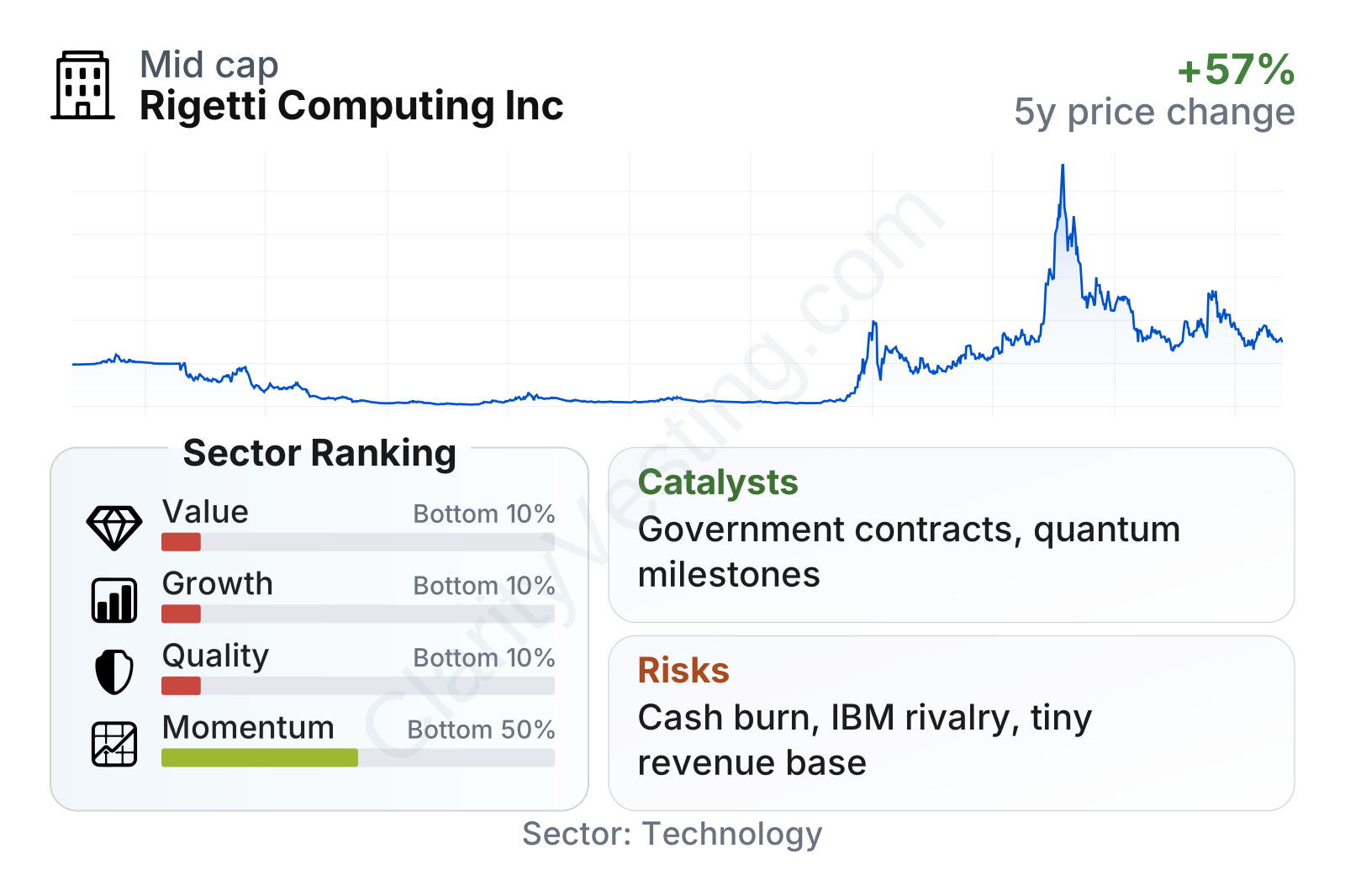
Rigetti is now valued by the market as a mid-sized public company despite producing only modest revenue and ongoing losses. The stock has been extremely volatile over the past several years, including a deep decline after its public listing period and then a powerful rebound. That kind of price behavior usually signals that market expectations are being driven more by future potential than by current business fundamentals.
The factor table also points to a very unusual profile. Value, quality, and growth rank near the bottom of the technology sector, while momentum is stronger. In plain language, the market has rewarded the stock price recently, but the underlying business still looks weak on profitability, cash generation, and long-term consistency.
Growth
Quantum computing is clearly a growing field in terms of research funding, government interest, and long-range corporate experimentation. Major technology companies, national laboratories, defense agencies, and universities are all investing in the area. That does not mean near-term commercial demand is already large, but it does mean Rigetti operates in a sector with meaningful strategic relevance if the technology improves enough to solve practical problems better than classical systems.
Rigetti’s strategy is logical for that environment. It is trying to control more of the stack than many smaller peers: chip design, fabrication partnerships, system development, cloud delivery, and software tools. If the technology matures, that integrated approach could help it capture more value than a company that only provides software or only supplies components.
Another useful part of the strategy is its focus on government, research, and technical partnerships. In an immature market, these relationships can provide funding, credibility, and testing ground for future commercial use. For a company like Rigetti, externally funded development work can matter almost as much as direct product revenue because it helps support the technology roadmap.
Recent revenue growth has improved sharply on a year-over-year basis, but the historical pattern is uneven. There have been multiple periods of contraction followed by sudden rebounds. That usually suggests revenue timing rather than a smooth expansion in customer adoption. It is encouraging to see triple-digit growth recently, especially relative to the sector, yet it would be too early to treat that as a stable trend.
Cash generation remains the main weakness in the growth picture. Free cash flow is still deeply negative and has worsened again after earlier improvement. This means the company is still consuming substantial cash to fund operations and development. For a long-term growth case, the important question is not just whether revenue can rise, but whether that revenue can eventually scale faster than expenses.
A notable catalyst in recent years has been Rigetti’s progress on newer quantum systems and its emphasis on improving qubit performance, error reduction, and system architecture. In quantum computing, technical milestones can change market perception quickly because they affect whether customers view a platform as credible for real workloads. Public announcements around upgraded systems, research collaborations, and government-backed programs therefore matter more here than they would for a conventional hardware company.
Risks
This article is for informational purposes only and does not constitute financial advice. Some content is AI-generated. See Disclaimer


