Stock Analysis · RTL Group SA (RGLXY)
Overview
RTL Group is a European media company focused on television, streaming, and radio. Its activities are concentrated in major advertising markets such as Germany, France, and the Netherlands, and it also owns content production assets through Fremantle. In simple terms, the group makes money from selling advertising around TV and radio audiences, charging subscriptions for streaming services, and producing shows that can be sold to broadcasters and platforms around the world.
The business is still anchored in traditional broadcasting, but management has been trying to reshape it around streaming and stronger content ownership. That matters for long-term analysis because advertising-funded TV is a mature business, while streaming and global production offer more room for strategic adaptation. RTL is not a pure-growth digital platform; it is better understood as a legacy media operator working to protect cash generation while building a more modern portfolio.
Based on the company’s recent annual disclosures, revenue is broadly split across a few major buckets.
- TV and video advertising: the largest source, roughly around half of group revenue, driven mainly by free-to-air channels in Germany, France, and other European markets.
- Content production and rights sales: a large second pillar, roughly around one-third, mainly through Fremantle’s international production business.
- Streaming and digital subscriptions: a smaller but strategically important share, around the high-single-digit to low-teens percentage range, led by RTL+ and M6+ related digital activity.
- Radio, other advertising, and ancillary revenue: the remaining portion, including radio networks, licensing, and smaller media activities.
This mix shows a company with meaningful diversification inside media, but still with clear dependence on advertising conditions in Europe. Over the last few years, revenue has been relatively stable overall, while earnings have been more uneven as the group absorbs higher content costs and a shifting viewing landscape.
The long-term pattern points to a business that still converts a substantial share of revenue into gross profit and cash, but with operating income well below the post-pandemic peak. That supports the view of RTL as a profitable incumbent under pressure rather than a structurally broken company.
Key Figures
| Metric | Value | Sector ⓘ |
|---|---|---|
| Date | Sep 12, 2026 | |
| Context | ||
| Sector | Communication Services | |
| Industry | Broadcasting | |
| Market Cap ⓘ | $4.72B | |
| Beta ⓘ | 0.69 | |
Value (Cheapness) | ||
| P/E Ratio ⓘ | 44.71 | 18.61 |
| FCF Yield ⓘ | 14.04% | 13.68% |
| EBIT / EV ⓘ | N/A | 4.54% |
| PEG ⓘ | N/A | |
Growth (Business expansion) | ||
| Revenue Growth ⓘ | 3.90% | 5.40% |
| RPS Growth (5Y CAGR) ⓘ | -2.29% | 4.62% |
| EPS Growth (5Y CAGR) ⓘ | N/A | -18.01% |
| Margin Growth (5Y Trend) ⓘ | -12.30% | 1.10% |
| FCF Growth (5Y CAGR) ⓘ | -14.50% | 5.88% |
Quality (Business durability) | ||
| ROIC (Latest) ⓘ | N/A | 8.38% |
| ROIC (5Y Median) ⓘ | 13.90% | 8.32% |
| Net Debt / EBIT (Latest) ⓘ | 2.63 | 1.99 |
| Net Debt / EBIT (5Y Median) ⓘ | 0.56 | 2.94 |
| Operating Margin (Latest) ⓘ | 8.99% | 14.89% |
| Operating Margin (5Y Median) ⓘ | 10.52% | 12.96% |
| Debt to Equity (Latest) ⓘ | 43.13% | 59.59% |
| Profit Margin (Latest) ⓘ | 16.21% | 8.77% |
| Free Cash Flow (Latest) ⓘ | $663.00M | |
Momentum (Price trend) | ||
| 3Y Return ⓘ | +31.57% | +46.64% |
| 12M Return (excl. last month) ⓘ | +2.49% | +2.16% |
| 6M Return ⓘ | -3.50% | +5.05% |
| Price vs. 200-Day MA ⓘ | +2.04% | +2.88% |
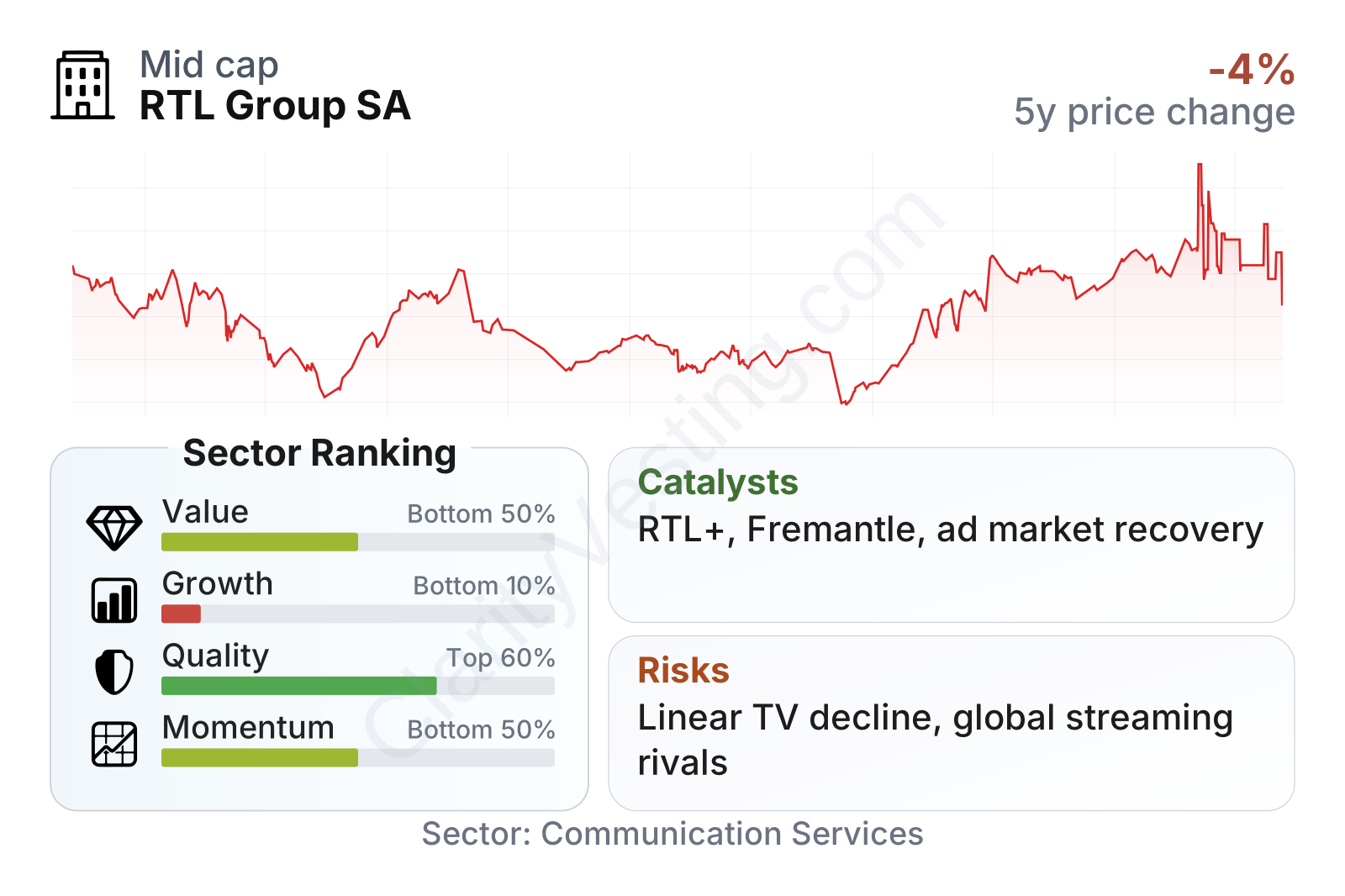
The company sits in a mixed position. Size is meaningful, with a market value around $6 billion, and the shares have shown relatively low volatility compared with many media names. On quality, leverage looks restrained and profitability remains better than the sector median at the net margin level, even though operating margins are below many peers. The weak area is growth: sales have been declining rather than expanding, and longer-term revenue and cash flow trends rank poorly within the sector. Momentum has improved recently, which suggests the market has been responding to stabilization and strategic updates, but the underlying operating picture remains more defensive than dynamic.
Growth
RTL operates in a sector that is growing in some segments and shrinking in others. Streaming, digital advertising, and owned intellectual property remain attractive areas over the long run. Traditional linear TV advertising, by contrast, is mature and cyclical, and audience fragmentation continues to push viewers toward on-demand platforms. That makes RTL’s growth outlook less about the industry as a whole and more about whether it can shift revenue toward digital products fast enough to offset pressure in legacy broadcasting.
The strategy is understandable. The group has been investing in national streaming platforms, especially RTL+ in Germany, while relying on Fremantle to provide international exposure through content production. The logic is sound: local broadcasters with strong brands can still attract audiences if they package live TV, entertainment, news, and streaming into one ecosystem, while content ownership adds a second route to monetization. For a long-term view, this dual approach is more credible than depending only on broadcast advertising.
Recent growth, however, has been underwhelming. Revenue has slightly contracted year over year, and the five-year trend is negative relative to the broader communication services sector. That does not mean the franchise is disappearing, but it does mean the transition is not yet producing broad top-line expansion.
Cash generation remains one of the more supportive elements in the case. Free cash flow is still substantial in absolute terms, even after declining from stronger prior levels. This matters because a business with solid cash conversion has more flexibility to fund content, technology, restructuring, and shareholder distributions while navigating a difficult media cycle.
A notable recent opportunity comes from continued streaming development and platform consolidation in Europe. RTL has been pushing bundling, advertising-supported digital offerings, and broader cross-platform use of its brands. In addition, any improvement in the advertising market after a weak cycle could have a visible impact because the company still has large exposure to ad-funded media. The combination of digital scaling and cyclical ad recovery is the clearest operational catalyst, even if it has not yet fully translated into strong reported growth.
Risks
This article is for informational purposes only and does not constitute financial advice. Some content is AI-generated. See Disclaimer