Stock Analysis · Remitly Global Inc (RELY)
Overview
Remitly Global Inc operates a digital financial services platform focused on cross-border money transfers. In simple terms, it helps people send money internationally, mainly to family and friends, through a mobile app and website. The service is built around speed, convenience, transparent pricing, and a broad network of payout options such as bank deposits, cash pickup, mobile wallets, and debit cards. The company primarily serves migrants and other customers who need to move relatively small amounts of money across borders.
Its business model is straightforward: a customer pays Remitly to deliver money to a recipient in another country, and the company earns revenue from transaction fees and foreign exchange spreads embedded in the transfer. Based on company filings, Remitly reports revenue largely as a single stream tied to these transfer services rather than several large reporting segments. A practical breakdown of revenue sources is therefore approximate and based on how the platform works:
- International transfer fees and related transaction revenue: approximately 70% to 85% of revenue. This is the direct fee paid by customers to send money.
- Foreign exchange spread: approximately 15% to 30% of revenue. This is the margin between market currency rates and the rates offered on transfers.
- Other service-related revenue: a small residual share. This can include ancillary items tied to the transfer experience, but it is not a major disclosed line.
Geographically, the company is diversified across many send and receive corridors rather than depending on one single country pair. That matters because remittances are a global need and tend to be more resilient than many discretionary consumer spending categories. The business has also been expanding beyond basic transfers with products aimed at deepening customer relationships, including more financial services for immigrants and globally connected households.
The operating profile has improved meaningfully in recent years. Revenue has scaled from under $500 million in 2021 to over $1.6 billion in 2025, while the company moved from operating losses to positive operating income. That shift suggests the platform is gaining efficiency as transaction volume grows.
The business mix shows a company that is still spending heavily on product development and customer acquisition, but with much better expense absorption than a few years ago. Revenue and gross profit have expanded strongly, while operating losses have narrowed and then turned into operating profit by 2025.
Key Figures
| Metric | Value | Sector ⓘ |
|---|---|---|
| Date | Sep 12, 2026 | |
| Context | ||
| Sector | Technology | |
| Industry | Software - Infrastructure | |
| Market Cap ⓘ | $4.64B | |
| Beta ⓘ | 0.36 | |
Value (Cheapness) | ||
| P/E Ratio ⓘ | 17.27 | 29.51 |
| FCF Yield ⓘ | 9.40% | 4.25% |
| EBIT / EV ⓘ | 3.94% | 2.85% |
| PEG ⓘ | N/A | |
Growth (Business expansion) | ||
| Revenue Growth ⓘ | 20.20% | 15.40% |
| RPS Growth (5Y CAGR) ⓘ | -0.12% | 8.56% |
| EPS Growth (5Y CAGR) ⓘ | N/A | -11.88% |
| Margin Growth (5Y Trend) ⓘ | N/A | 0.46% |
| FCF Growth (5Y CAGR) ⓘ | N/A | 9.80% |
Quality (Business durability) | ||
| ROIC (Latest) ⓘ | 33.28% | 9.44% |
| ROIC (5Y Median) ⓘ | -14.97% | 8.30% |
| Net Debt / EBIT (Latest) ⓘ | -3.64 | 0.54 |
| Net Debt / EBIT (5Y Median) ⓘ | N/A | 0.44 |
| Operating Margin (Latest) ⓘ | 9.70% | 9.58% |
| Operating Margin (5Y Median) ⓘ | -7.95% | 8.25% |
| Debt to Equity (Latest) ⓘ | 3.40% | 33.33% |
| Profit Margin (Latest) ⓘ | 16.86% | 7.14% |
| Free Cash Flow (Latest) ⓘ | $436.17M | |
Momentum (Price trend) | ||
| 3Y Return ⓘ | -13.39% | +45.48% |
| 12M Return (excl. last month) ⓘ | +24.90% | +23.48% |
| 6M Return ⓘ | +41.60% | +20.93% |
| Price vs. 200-Day MA ⓘ | +16.20% | +7.43% |
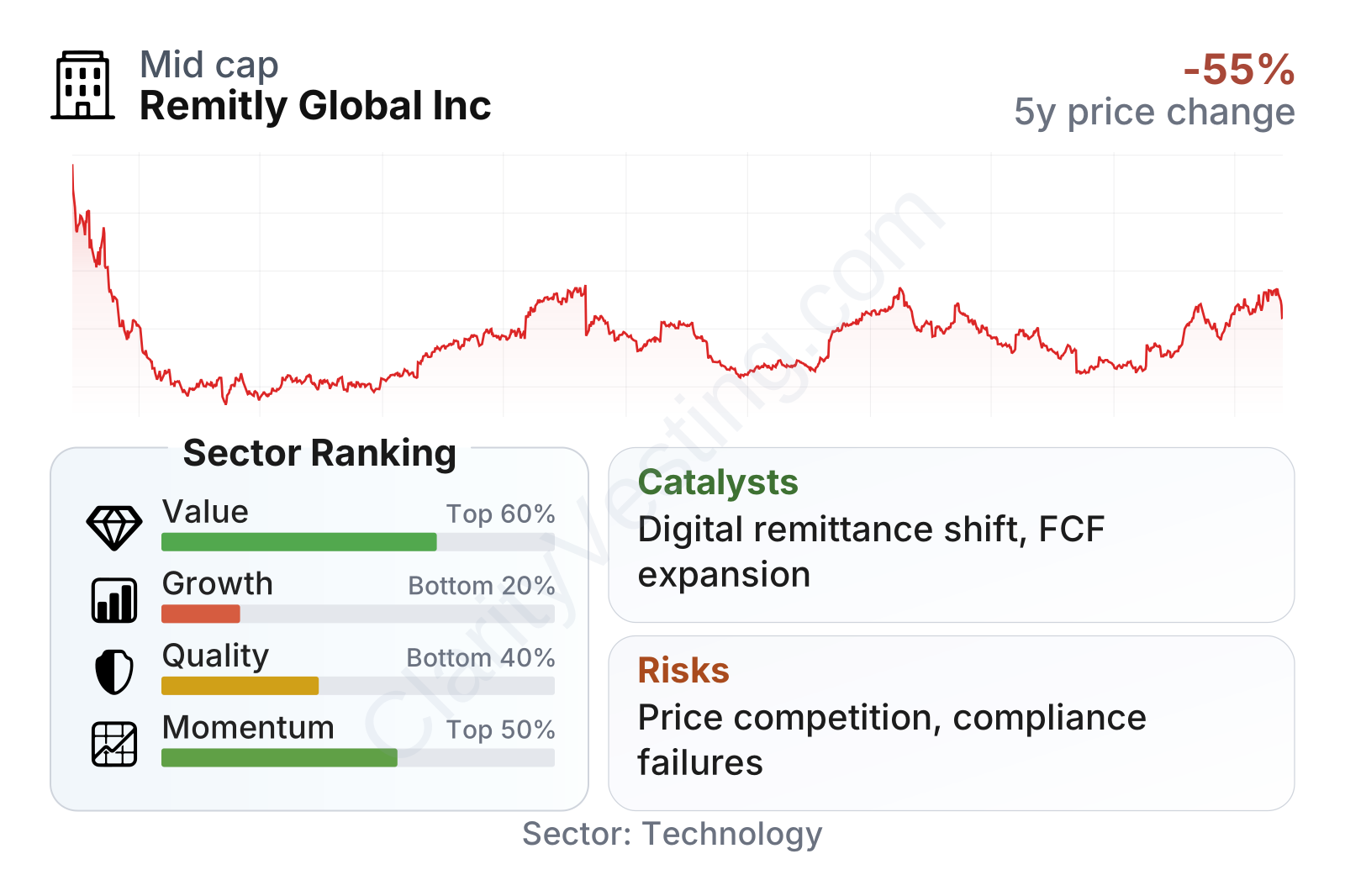
Remitly is now a mid-sized public company with a market value a little above $5 billion. The balance sheet looks conservative, with debt equal to only about 3% to 4% of equity, far below the sector median near 29%. Profitability and cash generation have improved sharply: free cash flow yield and EBIT relative to enterprise value are stronger than typical software-sector levels, while the latest profit margin is well above the sector median. Growth is more mixed. Recent year-over-year revenue growth remains solid at about 20%, above the sector median, but longer-term per-share growth metrics are weaker because the company spent years in heavy expansion mode before reaching more mature economics. Share-price momentum has improved a lot recently, although the stock’s multi-year path remains volatile.
Growth
Remitly operates in a favorable long-term market. Cross-border remittances remain a large and durable global flow, supported by migration, rising smartphone adoption, and the steady shift from cash-based or branch-based transfers toward digital channels. That broader digital remittance trend gives the company room to grow even without dominating the entire market, because many transfers worldwide are still processed through legacy systems.
Its strategy also fits the opportunity well. Remitly emphasizes mobile-first service, fast delivery, broad payout options, local compliance infrastructure, and user experience. These are important competitive factors in remittances because customers care deeply about reliability, total cost, and how quickly the money arrives. The company has also been investing in customer retention rather than only customer acquisition, which can improve economics over time if repeat usage rises.
Growth has slowed from the very high rates seen just after its public listing, but that is normal for a company scaling from a larger base. What stands out is that the pace has remained healthy for several years and is still running around 20%, which is above the broader sector median. In other words, Remitly is no longer in hypergrowth, but it still appears to be outgrowing many software peers.
One of the most important developments is the move from negative cash generation to strong positive free cash flow. That matters because it shows growth is no longer coming only from aggressive spending. The company has reached a stage where scale is starting to produce real cash, which can support further product investment, marketing, and balance-sheet flexibility.
A major catalyst is continued digital migration in remittances. Another is corridor expansion: each new send-receive route can widen Remitly’s addressable market without requiring an entirely new business model. Product expansion is also notable. The company has discussed building a broader financial relationship with customers beyond one-off transfers, including services that can increase engagement and retention. If that strategy works, customer lifetime value could improve materially.
Recent company updates have also highlighted ongoing customer and transaction growth, improving profitability, and increasing scale. That combination is important because it suggests the business is not trading growth for margins, but beginning to achieve both at the same time.
Risks
This article is for informational purposes only and does not constitute financial advice. Some content is AI-generated. See Disclaimer


