Stock Analysis · TheRealReal Inc (REAL)
Overview
TheRealReal is an online marketplace focused on authenticated luxury resale. It helps people sell pre-owned designer goods such as handbags, watches, jewelry, apparel, and home items, then earns revenue by facilitating those transactions and providing related services. The company’s core promise is trust: it handles authentication, pricing support, logistics, and a curated shopping experience in a category where counterfeits and condition disputes matter a great deal.
Its business model is mainly built around consignment rather than owning large amounts of inventory. In simple terms, sellers send in luxury items, TheRealReal lists and sells them, and the company keeps a share of the selling price. It also has some direct revenue from shipping, service fees, and a smaller amount of inventory ownership in certain cases. Based on recent filings, revenue is broadly driven by the following areas:
- Consignment revenue: the largest source by far, likely around 80% to 90% of total revenue in recent periods.
- Direct sales and inventory sales: a smaller contribution, generally tied to items the company owns rather than consigns.
- Shipping and other service revenue: a modest but recurring portion from buyer and seller services.
The company operates in the intersection of luxury retail, e-commerce, and the circular economy. That gives it exposure to consumers seeking premium brands at lower prices, while also benefiting from a broader shift toward resale and reuse. The business is still best understood as a specialized platform where brand trust, authentication capability, and supply of high-value items are the main ingredients.
The financial profile has been improving. Revenue has recovered meaningfully, gross profit has expanded, and losses have narrowed sharply versus earlier years. At the same time, the company is still working through the final stage of proving that stronger sales can consistently translate into durable profitability.
The broad trend is encouraging: revenue and gross profit have moved up over the last few years, while net losses have come down substantially from very deep levels. The main remaining challenge is that operating expenses still absorb most of the gross profit, even though that gap has narrowed considerably.
Key Figures
| Metric | Value | Sector ⓘ |
|---|---|---|
| Date | Jul 18, 2026 | |
| Context | ||
| Sector | Consumer Cyclical | |
| Industry | Luxury Goods | |
| Market Cap ⓘ | $1.37B | |
| Beta ⓘ | 2.67 | |
Value (Cheapness) | ||
| P/E Ratio ⓘ | N/A | 18.58 |
| FCF Yield ⓘ | 0.92% | 7.99% |
| EBIT / EV ⓘ | -2.12% | 5.91% |
| PEG ⓘ | N/A | |
Growth (Business expansion) | ||
| Revenue Growth ⓘ | 18.50% | 5.50% |
| RPS Growth (5Y CAGR) ⓘ | -17.43% | 9.20% |
| EPS Growth (5Y CAGR) ⓘ | -76.32% | -26.43% |
| Margin Growth (5Y Trend) ⓘ | N/A | -0.18% |
| FCF Growth (5Y CAGR) ⓘ | N/A | 5.02% |
Quality (Business durability) | ||
| ROIC (Latest) ⓘ | N/A | 12.03% |
| ROIC (5Y Median) ⓘ | -50.60% | 10.82% |
| Net Debt / EBIT (Latest) ⓘ | N/A | 2.12 |
| Net Debt / EBIT (5Y Median) ⓘ | N/A | 2.25 |
| Operating Margin (Latest) ⓘ | -5.02% | 9.28% |
| Operating Margin (5Y Median) ⓘ | -28.67% | 9.64% |
| Debt to Equity (Latest) ⓘ | -129.26% | 75.23% |
| Profit Margin (Latest) ⓘ | -9.03% | 5.28% |
| Free Cash Flow (Latest) ⓘ | $12.59M | |
Momentum (Price trend) | ||
| 3Y Return ⓘ | +334.50% | +10.68% |
| 12M Return (excl. last month) ⓘ | +120.31% | +5.26% |
| 6M Return ⓘ | -31.31% | -2.41% |
| Price vs. 200-Day MA ⓘ | -7.05% | +1.55% |
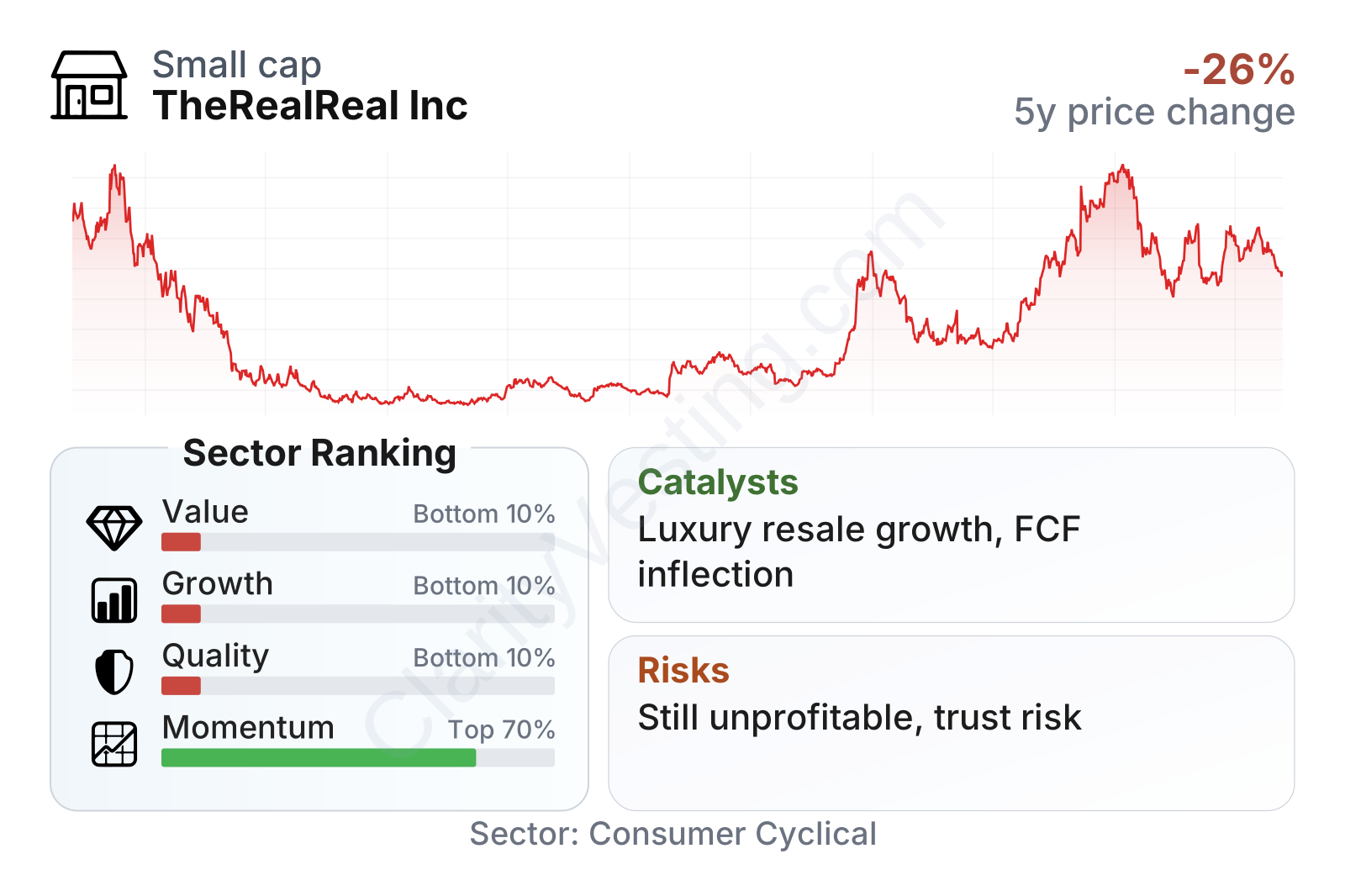
The market value is now in the small-cap range, which often brings higher volatility and sharper market reactions. That is visible here as well: share price momentum over multi-year periods has been very strong, but recent trading has also been choppy. On the fundamentals side, the company stands out for improving top-line growth and newly positive free cash flow, yet it still ranks weakly versus the broader sector on profitability, balance-sheet quality, and conventional valuation measures because earnings remain negative.
Growth
TheRealReal operates in a segment with long-term structural tailwinds. Luxury resale has been expanding as consumers become more comfortable buying secondhand premium goods, especially online. Younger shoppers are generally more open to resale, and higher luxury prices at traditional retailers can push more demand toward pre-owned alternatives. On the supply side, owners of luxury goods increasingly view resale as a normal part of the ownership cycle rather than a niche activity.
The company’s strategy is logical for this market. It is trying to deepen its position with high-value consignors, improve authentication and merchandising, and use physical touchpoints such as stores and consignment offices to source inventory more efficiently. That matters because resale platforms are only as strong as the quality and consistency of the items they can attract. In luxury, a trusted intake and authentication process can be more valuable than simply having traffic.
Revenue growth has clearly reaccelerated after a weak period in 2023. Recent year-over-year growth has been running in the mid-to-high teens, well ahead of the sector median. That suggests the company is not just benefiting from a stable market, but is currently taking part in a meaningful operational recovery.
Another important shift is cash generation. Free cash flow has improved from deeply negative levels to positive territory over the trailing twelve months. For a company that spent years consuming cash, that is one of the most relevant signs that cost discipline and operating improvements are starting to show up beyond revenue growth alone.
A notable catalyst is the company’s push toward higher-value consignments and stronger unit economics. If it keeps attracting more premium inventory such as fine jewelry and watches, the platform can benefit from higher average order values and better contribution margins. Continued progress in repeat consignor activity, marketing efficiency, and fulfillment productivity would also be significant, because these are the levers that can turn a promising marketplace into a self-sustaining one.
Recent company communications have also pointed to improving profitability trends, expanding adjusted EBITDA performance, and ongoing efforts to streamline operations. None of that guarantees a smooth path, but it does indicate that management is now focused less on growth at any cost and more on growth that holds up financially.
Risks
The biggest risk is that TheRealReal still has not established consistent net profitability. Losses have narrowed dramatically, but margins remain negative. That means the business has less room for error if demand softens, expenses rise again, or execution slips. A company can show strong revenue growth and still disappoint if it cannot convert enough of that activity into lasting earnings.
The balance-sheet picture also needs careful interpretation. Debt-to-equity appears unusual because equity has been negative, which typically reflects accumulated losses rather than a simple low-debt structure. The long-term trend has improved from much worse levels, but negative equity remains a sign that the financial base is not as robust as that of stronger peers.
Profit margins tell a similar story. The loss margin is far better than it was a few years ago, but it still remains below sector norms, where many established consumer companies generate positive profitability. The gap has narrowed, yet it has not disappeared.
Competition is another serious issue. TheRealReal faces large horizontal platforms such as eBay and Poshmark, luxury-focused resale specialists such as Fashionphile, and branded or boutique resale channels that operate through stores, websites, and social commerce. It also competes indirectly with traditional luxury retailers and outlet channels when consumers decide between new and pre-owned goods. TheRealReal’s edge is its specialization in authenticated luxury and its service-heavy model, but that model is also more operationally demanding and expensive than a simpler peer-to-peer marketplace.
Leadership is therefore mixed. TheRealReal is one of the best-known names in authenticated online luxury resale in the United States, but calling it the clear leader across the whole resale landscape would be too strong. Its brand is established, especially in luxury consignment, yet the category remains fragmented and highly competitive.
There are also reputational risks that matter more here than in ordinary retail. Trust is central to the brand. Any meaningful authentication failure, dispute over item condition, or negative publicity involving counterfeit goods can damage customer confidence quickly. Because luxury resale depends so heavily on credibility, operational mistakes can have an outsized effect on both buyer demand and seller supply.
A final risk is volatility in the stock itself. With a beta well above the market and a history of dramatic swings, the share price has reacted strongly to changes in sentiment. That does not change the business fundamentals, but it does show that the market still sees the company as a high-uncertainty turnaround rather than a mature, predictable operator.
Valuation
Valuing TheRealReal is not straightforward because traditional earnings-based measures are still limited. The price-to-earnings ratio is not meaningful at the moment since the company remains unprofitable on a net income basis. That removes one of the most common shortcuts investors use when comparing stocks.
Since earnings are still negative, the usual comparison with sector P/E levels does not say much. Instead, the market is effectively valuing the company on the expectation that revenue growth, gross profit expansion, and cash flow improvement will eventually lead to sustainable profitability.
That makes the current valuation a judgment on the turnaround. On one hand, the company’s market capitalization is no longer tiny relative to its recent progress, and the stock has already experienced a major rebound from its lows. On the other hand, revenue has been growing faster than the sector, free cash flow has turned positive, and losses have narrowed sharply, which gives some support to a more optimistic multiple than deeply distressed retailers usually receive.
In practical terms, the shares do not look cheap on current earnings or cash flow metrics compared with the broader consumer sector. They look more like a business priced for continued operational improvement. If that improvement continues, the valuation can appear understandable. If margins stall or reverse, the stock can quickly look demanding.
Conclusion
TheRealReal is no longer just a troubled resale platform trying to stabilize. It has become a more credible turnaround case, supported by renewed revenue growth, stronger gross profit, and a notable swing into positive free cash flow. The company is operating in an attractive niche where luxury resale, online convenience, and consumer interest in circular shopping continue to create long-term demand.
Even so, the business is not yet in the clear. Profitability remains negative, the balance-sheet profile is still fragile, and competition is intense in a category where trust and execution are everything. That leaves the company in an in-between position: operationally much improved, strategically relevant, but still financially short of the consistency that defines stronger long-term compounders.
The current market view appears to reflect that tension. The valuation gives real credit for the turnaround, but not enough to suggest the market sees the business as fully proven. Overall, TheRealReal stands out more as an improving but still high-risk luxury resale platform than as a fully established consumer franchise.
Sources:
- U.S. Securities and Exchange Commission (SEC) — TheRealReal, Inc. Form 10-Q for the quarter ended March 31, 2026
- U.S. Securities and Exchange Commission (SEC) — TheRealReal, Inc. Form 10-K for the year ended December 31, 2025
- TheRealReal Investor Relations — Shareholder letters and quarterly earnings materials
- TheRealReal Investor Relations — Company presentations and earnings webcast materials
- Wikipedia — The RealReal
This article is for informational purposes only and does not constitute financial advice. Some content is AI-generated. See Disclaimer


