Stock Analysis · Radware Ltd (RDWR)
Overview
Radware Ltd is a cybersecurity and application delivery company focused on keeping websites, applications, and networks available, fast, and protected. Its products are used to defend against distributed denial-of-service attacks, web application threats, bot activity, and other forms of malicious traffic. The company also provides tools that help enterprises and service providers manage application performance and traffic across data centers and cloud environments.
For long-term analysis, the important point is that Radware operates in the infrastructure layer of cybersecurity. This is an area where demand is tied to the steady growth of online services, cloud adoption, digital commerce, and the rising cost of outages and cyberattacks. The business is not a broad consumer brand; it is an enterprise-focused vendor selling protection, performance, and reliability.
Based on company disclosures, Radware’s revenue mix is primarily built around recurring security and cloud-related activity, supported by maintenance and professional services, with a smaller contribution from product sales. Exact percentages can shift by year, but the business can be understood through the following structure:
- Subscription and cloud security services: approximately the largest revenue source. This includes cloud DDoS protection, cloud web application and API protection, bot management, and related recurring services.
- Maintenance and support: a significant second source. This covers post-sale support, software updates, and service contracts tied to installed products.
- Products and licenses: the smallest major category. This includes hardware and software sold for on-premises or hybrid deployments, especially application delivery and security appliances.
- Professional services: a smaller component. This includes implementation, training, and consulting tied to customer deployments.
The financial profile has improved after a difficult period in 2023. Revenue recovered in 2024 and continued rising in 2025, while operating profitability moved back into positive territory. Gross profit remains high, which is typical for software and security businesses, and research and development spending stays meaningful, showing that product investment remains a core part of the model.
The business model shows a software-like structure with strong gross margins and relatively moderate direct costs, but operating profit depends heavily on keeping expenses under control. After a revenue dip in 2023, the company rebuilt profitability in 2024 and strengthened it further in 2025, helped by renewed sales growth and better expense discipline.
Key Figures
| Metric | Value | Sector ⓘ |
|---|---|---|
| Date | Sep 12, 2026 | |
| Context | ||
| Sector | Technology | |
| Industry | Software - Infrastructure | |
| Market Cap ⓘ | $1.17B | |
| Beta ⓘ | 0.86 | |
Value (Cheapness) | ||
| P/E Ratio ⓘ | 71.54 | 29.51 |
| FCF Yield ⓘ | 2.86% | 4.25% |
| EBIT / EV ⓘ | 2.87% | 2.85% |
| PEG ⓘ | 30.49 | |
Growth (Business expansion) | ||
| Revenue Growth ⓘ | 10.90% | 15.40% |
| RPS Growth (5Y CAGR) ⓘ | 2.87% | 8.56% |
| EPS Growth (5Y CAGR) ⓘ | -16.03% | -11.88% |
| Margin Growth (5Y Trend) ⓘ | 1.74% | 0.46% |
| FCF Growth (5Y CAGR) ⓘ | -10.98% | 9.80% |
Quality (Business durability) | ||
| ROIC (Latest) ⓘ | 5.78% | 9.44% |
| ROIC (5Y Median) ⓘ | 2.05% | 8.30% |
| Net Debt / EBIT (Latest) ⓘ | -2.54 | 0.54 |
| Net Debt / EBIT (5Y Median) ⓘ | -3.74 | 0.44 |
| Operating Margin (Latest) ⓘ | 8.55% | 9.58% |
| Operating Margin (5Y Median) ⓘ | 4.69% | 8.25% |
| Debt to Equity (Latest) ⓘ | 5.06% | 33.33% |
| Profit Margin (Latest) ⓘ | 5.33% | 7.14% |
| Free Cash Flow (Latest) ⓘ | $33.57M | |
Momentum (Price trend) | ||
| 3Y Return ⓘ | +66.57% | +45.48% |
| 12M Return (excl. last month) ⓘ | +17.34% | +23.48% |
| 6M Return ⓘ | +8.98% | +20.93% |
| Price vs. 200-Day MA ⓘ | +4.95% | +7.43% |
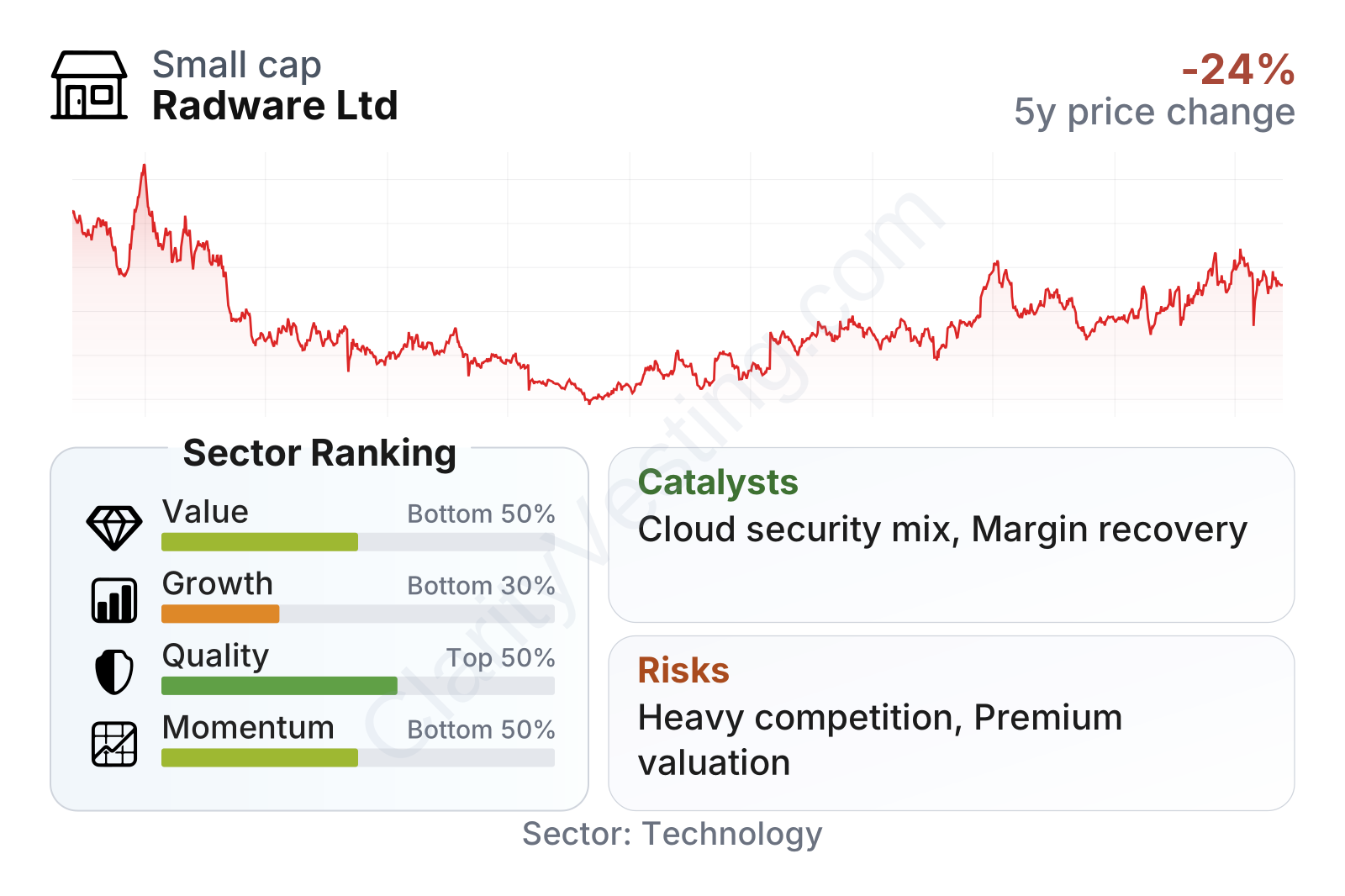
Radware is a small-cap infrastructure software company with relatively low stock volatility compared with many technology names. The overall picture from the latest metrics is mixed: balance-sheet quality is solid, but growth and valuation are less favorable. Profitability has improved from prior lows, yet return on capital still trails many peers. The company also screens weaker on recent momentum, which suggests the market has not fully rewarded the operational recovery.
Growth
Radware operates in cybersecurity, which remains a growing sector over the long run. The specific areas it addresses—DDoS mitigation, application security, API protection, bot defense, and cloud-based traffic management—benefit from durable demand drivers. More business activity is moving online, attacks are becoming more automated, and enterprises increasingly need always-on protection rather than occasional hardware upgrades.
The company’s strategy appears directionally sensible for future growth because it is centered on recurring security services and cloud delivery rather than depending only on one-time equipment sales. That matters because recurring revenue tends to be more predictable and can scale more efficiently over time if customer retention stays healthy. Radware also serves both enterprises and service providers, which broadens its addressable market, although it does not remove execution risk.
Recent revenue trends show a notable turnaround. After contraction in 2023, the company returned to growth in 2024 and maintained a revenue increase around the low-double-digit range into 2025 and early 2026. That is a constructive sign, even if the pace still sits below the median growth level for many software infrastructure peers. In other words, the business has regained forward motion, but it is not growing at the speed of the strongest names in the sector.
Cash generation has also recovered, although it has not moved in a straight line. Free cash flow weakened materially before rebounding, and the latest level remains positive but below the strongest recent peak. For a long-term view, this suggests Radware is capable of producing cash, but it still needs to demonstrate that higher profitability and stronger cash conversion can be sustained across cycles rather than appearing in bursts.
Potential catalysts are tied to the industry backdrop and the company’s positioning. Continued migration toward cloud-native security, rising concern around application and API attacks, and customer demand for integrated protection platforms could all support future expansion. If Radware keeps increasing recurring security revenue while improving margins, the business profile would become more attractive structurally. Recent company communications have also emphasized product expansion in cloud application protection and bot defense, which are categories with active demand across digital businesses.
Risks
This article is for informational purposes only and does not constitute financial advice. Some content is AI-generated. See Disclaimer


