Stock Analysis · Roblox Corp (RBLX)
Overview
Roblox operates an online platform where users can play, create, and share interactive 3D experiences. It is part game platform, part creation toolkit, and part digital social space. Developers build experiences using Roblox Studio, users access them across mobile, PC, console, and other devices, and the company provides the underlying infrastructure, discovery tools, safety systems, payments, and digital economy. For a long-term stock analysis, the key point is that Roblox is not just selling one game title: it is trying to build a large-scale ecosystem where users, creators, and brands all interact inside the same network.
Its business model is centered on virtual currency, digital items, and platform services tied to engagement. Revenue recognition can look different from user spending because Roblox records part of bookings over time as users consume services. That accounting detail matters because bookings, daily active users, and engagement hours often give a clearer view of platform momentum than net income alone.
The company’s main revenue sources are concentrated in a few areas:
- Virtual items and in-experience spending via Robux: the dominant source, estimated at well above 90% of bookings and revenue. This includes avatar items, creator content, and other digital purchases made inside experiences.
- Advertising and brand partnerships: still small compared with the core business, likely in the low single-digit percentage range at most. This includes immersive ads, brand activations, and sponsored experiences.
- Other revenue and platform-related services: a very small share. This can include subscriptions and miscellaneous sources associated with the platform ecosystem.
Geographically, Roblox is broad rather than concentrated in one single country, with the United States and Canada remaining its largest region, followed by Europe and Asia-Pacific. This matters because the company’s growth opportunity is tied not only to monetizing current users better, but also to expanding usage internationally and aging up its audience over time.
Operationally, Roblox still looks like a company prioritizing scale, infrastructure, creator tools, trust and safety, and product development. The business generates substantial gross profit dollars, but it continues to spend heavily on research and development and platform expansion. Over the last several years, revenue and gross profit have risen strongly, while operating losses remained significant because expenses also expanded. Free cash flow has improved much faster than accounting earnings, showing a business that can produce cash even while reported profitability stays negative.
The long-term pattern is clear: revenue has climbed from roughly $1.9 billion in 2021 to nearly $4.9 billion in 2025, and gross profit has also expanded sharply. At the same time, Roblox has kept spending aggressively on product development, creator economics, and infrastructure, which explains why accounting profits have not yet caught up with the platform’s scale.
Key Figures
| Metric | Value | Sector ⓘ |
|---|---|---|
| Date | Sep 12, 2026 | |
| Context | ||
| Sector | Communication Services | |
| Industry | Electronic Gaming & Multimedia | |
| Market Cap ⓘ | $32.06B | |
| Beta ⓘ | 1.47 | |
Value (Cheapness) | ||
| P/E Ratio ⓘ | N/A | 18.61 |
| FCF Yield ⓘ | 5.11% | 13.68% |
| EBIT / EV ⓘ | -3.10% | 4.54% |
| PEG ⓘ | 8.18 | |
Growth (Business expansion) | ||
| Revenue Growth ⓘ | 35.90% | 5.40% |
| RPS Growth (5Y CAGR) ⓘ | 16.93% | 4.62% |
| EPS Growth (5Y CAGR) ⓘ | -26.43% | -18.01% |
| Margin Growth (5Y Trend) ⓘ | N/A | 1.10% |
| FCF Growth (5Y CAGR) ⓘ | 24.78% | 5.88% |
Quality (Business durability) | ||
| ROIC (Latest) ⓘ | -58.85% | 8.38% |
| ROIC (5Y Median) ⓘ | -60.58% | 8.32% |
| Net Debt / EBIT (Latest) ⓘ | N/A | 1.99 |
| Net Debt / EBIT (5Y Median) ⓘ | N/A | 2.94 |
| Operating Margin (Latest) ⓘ | -20.00% | 14.89% |
| Operating Margin (5Y Median) ⓘ | -25.90% | 12.96% |
| Debt to Equity (Latest) ⓘ | 1207.89% | 59.59% |
| Profit Margin (Latest) ⓘ | -17.61% | 8.77% |
| Free Cash Flow (Latest) ⓘ | $1.64B | |
Momentum (Price trend) | ||
| 3Y Return ⓘ | +55.77% | +46.64% |
| 12M Return (excl. last month) ⓘ | -72.56% | +2.16% |
| 6M Return ⓘ | -19.18% | +5.05% |
| Price vs. 200-Day MA ⓘ | -22.76% | +2.88% |
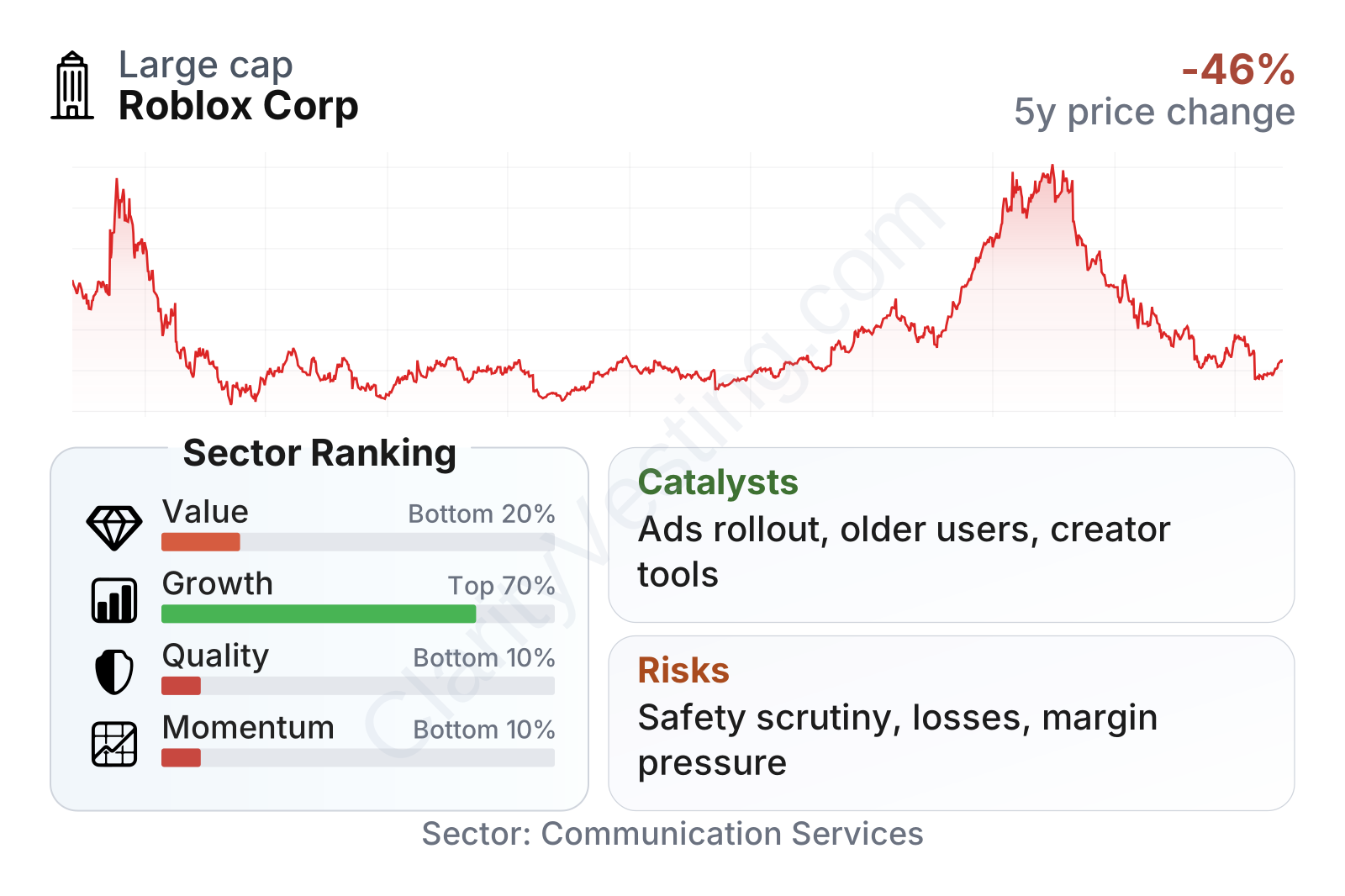
Roblox stands out more for growth than for current profitability. The company sits in the lower end of the sector on valuation and quality measures, largely because earnings remain negative and returns on capital are still weak. Growth is much stronger: recent revenue growth has been far above the sector median, and free cash flow has expanded rapidly over a multiyear period. Market behavior has been volatile, with weak momentum over the last year and a beta above 1, meaning the stock has tended to move more sharply than the broader market.
In simple terms, the market is treating Roblox as a scale platform whose worth depends on future monetization and operating leverage rather than present-day earnings strength. That creates a wider gap than usual between the business trend and the standard valuation metrics many mature companies are judged by.
Growth
Roblox operates in a segment with attractive long-term tailwinds: interactive entertainment, user-generated content, digital goods, online social interaction, and immersive advertising. These areas continue to benefit from more time spent online, increasing acceptance of virtual identities and digital purchases, and the appeal of platforms where content is created by users rather than produced entirely in-house. This is an industry where scale, engagement, and creator incentives can reinforce one another.
Roblox’s strategy for growth is coherent. The company is trying to increase the number of users, broaden the age mix beyond younger players, improve the earnings power of each hour spent on the platform, and attract more developers and brands. That strategy has several moving parts: better discovery, stronger creator tools, advertising products, international expansion, broader device support, and improvements in the in-platform economy. If it works, Roblox can grow not only by adding users, but also by turning a larger share of engagement into spending and ad demand.
Revenue growth has remained strong even after the post-pandemic normalization period. Recent year-over-year growth has been around the mid-30% range, clearly above the sector median, and the trend over the last few years shows that Roblox has regained momentum after the slowdown seen in 2022. That is important because it suggests the platform is not simply living off an earlier surge in popularity.
Free cash flow is another important growth signal. It has improved from modest or even negative levels earlier in the cycle to well above $1.5 billion on a trailing basis. For a company still posting net losses, that matters a great deal. It suggests the platform’s scale is beginning to convert into meaningful cash generation, which can fund product investment without relying as heavily on external financing.
Several catalysts could support the next phase. One is advertising: Roblox has been building immersive ad formats and measurement tools that could make the platform more attractive to major brands. Another is audience aging. If Roblox continues to gain traction with older teens and adults, its spending potential per user could improve because older users typically have greater purchasing power. A third catalyst is creator monetization. Better tools, pricing flexibility, and broader distribution can encourage more high-quality experiences, which in turn can lift engagement and spending.
Recent company updates have also pointed to stronger scale in bookings, users, and engagement, along with continued product efforts around advertising, search and discovery, and the creator ecosystem. None of those developments alone guarantees a step change, but together they reinforce the idea that Roblox is still in expansion mode rather than maturity.
Risks
This article is for informational purposes only and does not constitute financial advice. Some content is AI-generated. See Disclaimer