Stock Analysis · Liveramp Holdings Inc (RAMP)
Stock Analysis · Liveramp Holdings Inc (RAMP)

Overview

LiveRamp Holdings is a software company focused on data collaboration. In simple terms, it helps businesses use customer data from different places in a privacy-aware way so they can better measure advertising, improve marketing campaigns, connect offline and online activity, and share information with partners without directly exposing sensitive personal details.

Its platform is used by brands, retailers, publishers, advertising platforms, agencies, and data partners. The company’s role sits in the middle of a large digital advertising and analytics ecosystem: it helps one party match, organize, and activate data with another party while maintaining controls around consent, identity resolution, and security. This has become more important as cookies are phased out, mobile identifiers have become less accessible, and privacy rules have become stricter.

Revenue is overwhelmingly subscription and platform-based. LiveRamp reports revenue largely as a single operating segment, but public filings and company communications make it possible to describe the business mix at a high level. Approximate revenue sources are:

  • Subscription and usage fees from the LiveRamp data collaboration platform: the clear majority of revenue, likely well above 80%, including customer contracts tied to data connectivity, identity, activation, measurement, and collaboration tools.
  • Implementation, support, and other services: a smaller share, likely in the high-single-digit to low-teens range, related to onboarding, integrations, and customer support work.
  • Legacy or ancillary data-related services: a limited residual contribution compared with the core platform business.

The broad financial flow shows a business with strong gross profit, meaningful spending on product development and sales, and a much better earnings profile than a few years ago. Revenue has kept rising, while operating costs have become more controlled, allowing profitability and cash generation to improve materially.

Key Figures

MetricValueSector
DateJul 18, 2026
Context
SectorTechnology
IndustrySoftware - Infrastructure
Market Cap $2.31B
Beta 1.27
Value
(Cheapness)
P/E Ratio 17.0431.76
FCF Yield 7.27%4.18%
EBIT / EV 4.89%2.56%
PEG 0.59
Growth
(Business expansion)
Revenue Growth 9.20%13.50%
RPS Growth (5Y CAGR) 13.42%8.57%
EPS Growth (5Y CAGR) 44.97%-21.87%
Margin Growth (5Y Trend) 24.18%0.41%
FCF Growth (5Y CAGR) 22.84%9.76%
Quality
(Business durability)
ROIC (Latest) 14.89%8.54%
ROIC (5Y Median) -0.27%8.12%
Net Debt / EBIT (Latest) -3.690.38
Net Debt / EBIT (5Y Median) -8.470.38
Operating Margin (Latest) 11.66%9.58%
Operating Margin (5Y Median) 3.09%8.25%
Debt to Equity (Latest) 3.04%33.52%
Profit Margin (Latest) 17.95%6.96%
Free Cash Flow (Latest) $167.89M
Momentum
(Price trend)
3Y Return +31.57%+30.91%
12M Return (excl. last month) +19.70%+28.90%
6M Return +47.85%+5.38%
Price vs. 200-Day MA +27.16%+7.61%
Better than sector median
Slightly worse than sector median
More than 20% worse than sector median

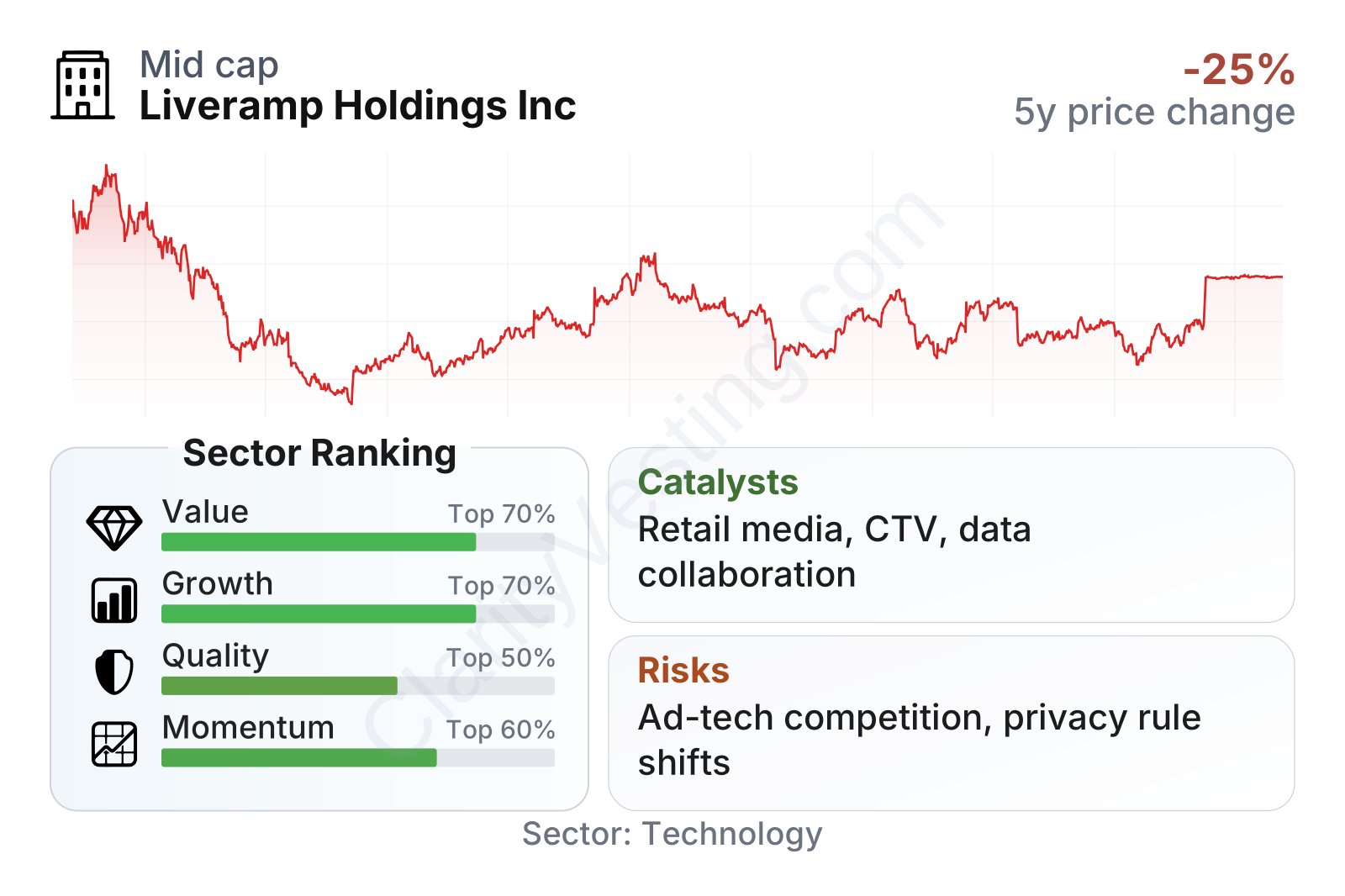
LiveRamp is now a mid-sized software company with a market capitalization around $2.3 billion. The stock has been volatile over the last several years, falling sharply in the 2022 software selloff, then recovering part of that decline as profitability improved. On fundamental measures, the company looks stronger than its size might suggest: growth characteristics rank high versus many sector peers, quality is around the middle to upper half, and valuation metrics look relatively moderate for a technology name. Free cash flow yield and operating returns stand out as better than typical sector levels, while recent price momentum has also improved.

Growth

LiveRamp operates in a sector with durable long-term demand drivers. Companies across advertising, retail media, connected TV, and digital measurement all need better ways to connect data while respecting privacy requirements. That trend is unlikely to disappear. If anything, the move away from older tracking methods makes identity resolution and secure data collaboration more central to how ad campaigns are planned and measured.

The company’s strategy is coherent. Rather than trying to be an ad network or a media owner, LiveRamp positions itself as infrastructure: a neutral layer that helps many different participants work together. That can be attractive because customers often want interoperability. A retailer, brand, publisher, and measurement partner may all use different systems, and LiveRamp’s value comes from connecting those systems.

Growth is not explosive, but it has been consistent enough to matter. Recent year-over-year revenue growth has generally moved in the high-single-digit to mid-teens range, slower than some faster-growing software niches but healthy for a company that is now also improving margins. Over a five-year period, revenue per share growth has been solid, and earnings growth has improved much faster as expenses have become more disciplined.

Cash generation is another positive signal. Free cash flow has risen sharply from earlier levels and is now comfortably positive, which gives the company more flexibility for product investment, acquisitions, or shareholder returns without depending on debt markets. This matters because many software businesses can show revenue growth, but fewer can translate that growth into durable cash.

A notable catalyst is the expansion of retail media and connected TV. These channels depend heavily on first-party data and closed-loop measurement, both areas where LiveRamp’s tools are relevant. Another catalyst is the broader adoption of data clean rooms and collaboration environments, which allow organizations to analyze shared data sets under tighter privacy controls. LiveRamp has been building around this need for several years, so a wider market shift in that direction could support continued platform adoption.

Recent company updates have also pointed to ongoing platform adoption, deeper relationships with large enterprise customers, and a stronger focus on recurring revenue quality. The most important near-term opportunity is not a single headline event, but the continued normalization of privacy-first advertising infrastructure, an area where LiveRamp already has a recognized position.

Risks

LiveRamp’s biggest risk is competitive pressure in a fast-changing market. It is not the only company working on identity, measurement, and privacy-safe data collaboration. Large cloud platforms, ad-tech firms, and walled gardens are all trying to control pieces of the same workflow. If major customers decide they can use internal tools, cloud-native alternatives, or platform-owned solutions instead, LiveRamp’s growth could slow.

Another risk is that the company depends heavily on the health of advertising, marketing, and data-sharing budgets. Even though LiveRamp sells infrastructure rather than media inventory, spending decisions in this part of the economy can still be cyclical. During softer ad markets, customers may delay rollouts, reduce usage, or scrutinize vendor spending more closely.

Balance-sheet risk is limited. Debt levels are very low relative to equity and far below typical sector levels, which gives the company a cushion if operating conditions weaken. In that sense, the main risks are strategic and competitive rather than financial leverage.

Profitability has improved sharply, but investors should recognize that part of the recent strength may not move in a perfectly straight line. The profit margin has gone from negative territory a few years ago to well above the sector median recently. That is encouraging, yet software margin improvement can be sensitive to sales productivity, customer mix, stock-based compensation, and the pace of hiring. The current margin profile is much healthier than before, but it still needs to prove durability across different demand environments.

As for competitive advantages, LiveRamp does have some real strengths. It has an established network of integrations across brands, publishers, retailers, and platforms; this kind of ecosystem can create switching friction because customers value connectivity with many counterparties. It also benefits from trust and neutrality: some market participants may prefer an independent infrastructure provider over a large platform with competing interests. That said, it is not the undisputed leader across all of ad-tech infrastructure. In identity and collaboration it is well known, but it competes with a mix of large diversified players and specialized vendors.

Main competitors and alternatives include large cloud providers offering data-sharing and clean-room tools, advertising technology firms with identity and measurement products, and major digital platforms that keep users and campaign data inside their own systems. Compared with those groups, LiveRamp’s positioning is narrower but more specialized. Its advantage is focus and interoperability; its disadvantage is scale, especially against companies with broader ecosystems and larger research budgets.

No major public red flag stands out recently in the form of scandal or balance-sheet stress. The more relevant watchpoint is execution: whether management can keep converting a respected product position into sustained revenue growth and consistently positive earnings as the market evolves.

Valuation

LiveRamp’s valuation looks moderate relative to many technology peers, especially when set against its recent improvement in profitability and cash flow. The current earnings multiple is below the sector median, while free cash flow yield is stronger than typical software names. That combination is unusual in a market where many software stocks still trade at rich levels despite lower profitability.

The earnings multiple has also become more meaningful only recently because the company moved from inconsistent profits to stronger positive earnings. That means historical valuation readings were often distorted. Today’s lower multiple appears to reflect a market view that LiveRamp is a good but not high-flying software company: steady growth, improving margins, and a useful niche, but without the breakneck expansion that commands premium valuations.

Whether the current price is justified depends mainly on how durable the margin gains are and whether revenue growth can remain healthy as privacy-focused advertising infrastructure matures. On balance, the valuation appears more grounded than stretched. The market is recognizing the business improvement, but it is not pricing LiveRamp like a dominant platform with runaway growth. That leaves the stock looking more like a quality execution case than a speculative one.

Conclusion

LiveRamp stands out as a more disciplined and financially improved software business than it was a few years ago. It operates in an area with real long-term relevance: helping companies connect and use data in a world where privacy rules are tighter and older tracking methods are fading. That gives the company a sensible place in the digital advertising and enterprise data stack.

The most encouraging part of the picture is the combination of rising revenue, much better margins, strong cash generation, and very low debt. This is no longer simply a niche technology name promising future potential; it has become a business with visible operating progress. At the same time, it still faces meaningful competitive pressure and does not have the scale of the largest platforms circling the same opportunity.

Overall, LiveRamp currently looks more like a focused infrastructure company with improving economics than a hypergrowth software name. That distinction matters. The company’s appeal rests on execution, resilience, and relevance in privacy-first data collaboration rather than on dramatic expansion. In that context, the present valuation appears to reflect a business that has earned more credibility, but still needs to keep proving that its stronger profitability and strategic role can persist over time.

Sources:

  • LiveRamp Holdings, Inc. — Annual Report on Form 10-K for fiscal year ended March 31, 2026
  • LiveRamp Holdings, Inc. — Quarterly Report on Form 10-Q filed in 2026
  • LiveRamp Holdings, Inc. — Current Reports on Form 8-K filed in 2026
  • SEC EDGAR — LiveRamp Holdings, Inc. filings database
  • LiveRamp Investor Relations — earnings releases and shareholder materials published in 2026
  • LiveRamp Investor Relations — company-hosted earnings call materials and presentations
  • Wikipedia — LiveRamp

This article is for informational purposes only and does not constitute financial advice. Some content is AI-generated. See Disclaimer


Sign up for exclusive research and insights.

Unsubscribe anytime.
