Stock Analysis · Ralliant Corporation (RAL)
Overview
Ralliant Corporation operates in electronic test, measurement, sensing, and related industrial technology markets. In simple terms, it provides instruments, software, and connected tools that help customers inspect products, monitor equipment, detect faults, and improve reliability in factories, laboratories, utilities, and field operations. The company serves professional and industrial users rather than mass consumer markets, which usually means demand is tied to capital spending, maintenance budgets, and technical compliance needs.
Its revenue base is primarily built around hardware systems, supported by software and recurring service activity. Based on the company’s recent filings and business descriptions, the main sources of revenue can be understood as follows:
- Testing and measurement instruments: the largest source of revenue, covering tools used to diagnose, calibrate, inspect, and validate electrical and electronic systems.
- Sensors, monitoring, and connected industrial solutions: products used for condition monitoring, process visibility, and reliability applications across industrial environments.
- Software, maintenance, and services: a smaller but strategically important stream tied to installed equipment, workflow integration, technical support, and aftermarket relationships.
The company does not provide a clean percentage split in the material reviewed here that would allow a reliable revenue ranking by exact segment share. What is clear is that product sales remain the core of the business, while software and services add recurring revenue and can deepen customer retention over time.
From a broader financial flow perspective, the business had been relatively stable through 2023 and 2024, with annual revenue around $2.1 billion and solid gross profit generation. However, 2025 stands out as a major break: revenue slipped modestly, but operating income and net income turned sharply negative, pointing to a large one-time or non-routine hit rather than a simple collapse in day-to-day demand. That distinction matters because it changes how the recent losses should be interpreted.
The long-term pattern suggests a business that still produces substantial gross profit, but whose recent earnings picture has been disrupted by charges and higher operating burden, especially through selling, general, and administrative costs and weaker operating leverage.
Key Figures
| Metric | Value | Sector ⓘ |
|---|---|---|
| Date | Aug 22, 2026 | |
| Context | ||
| Sector | Technology | |
| Industry | Electronic Components | |
| Market Cap ⓘ | $7.04B | |
| Beta ⓘ | N/A | |
Value (Cheapness) | ||
| P/E Ratio ⓘ | N/A | 30.63 |
| FCF Yield ⓘ | 4.66% | 4.23% |
| EBIT / EV ⓘ | -14.67% | 2.79% |
| PEG ⓘ | N/A | |
Growth (Business expansion) | ||
| Revenue Growth ⓘ | 12.80% | 15.90% |
| RPS Growth (5Y CAGR) ⓘ | -0.54% | 8.68% |
| EPS Growth (5Y CAGR) ⓘ | N/A | -12.38% |
| Margin Growth (5Y Trend) ⓘ | -79.82% | 0.39% |
| FCF Growth (5Y CAGR) ⓘ | -0.23% | 9.76% |
Quality (Business durability) | ||
| ROIC (Latest) ⓘ | -28.74% | 9.19% |
| ROIC (5Y Median) ⓘ | N/A | 8.21% |
| Net Debt / EBIT (Latest) ⓘ | N/A | 0.46 |
| Net Debt / EBIT (5Y Median) ⓘ | N/A | 0.42 |
| Operating Margin (Latest) ⓘ | -53.36% | 9.23% |
| Operating Margin (5Y Median) ⓘ | 20.46% | 8.19% |
| Debt to Equity (Latest) ⓘ | 74.87% | 32.74% |
| Profit Margin (Latest) ⓘ | -56.39% | 7.01% |
| Free Cash Flow (Latest) ⓘ | $327.70M | |
Momentum (Price trend) | ||
| 3Y Return ⓘ | N/A | +46.51% |
| 12M Return (excl. last month) ⓘ | +50.93% | +18.95% |
| 6M Return ⓘ | +45.55% | +18.99% |
| Price vs. 200-Day MA ⓘ | +17.71% | +9.57% |
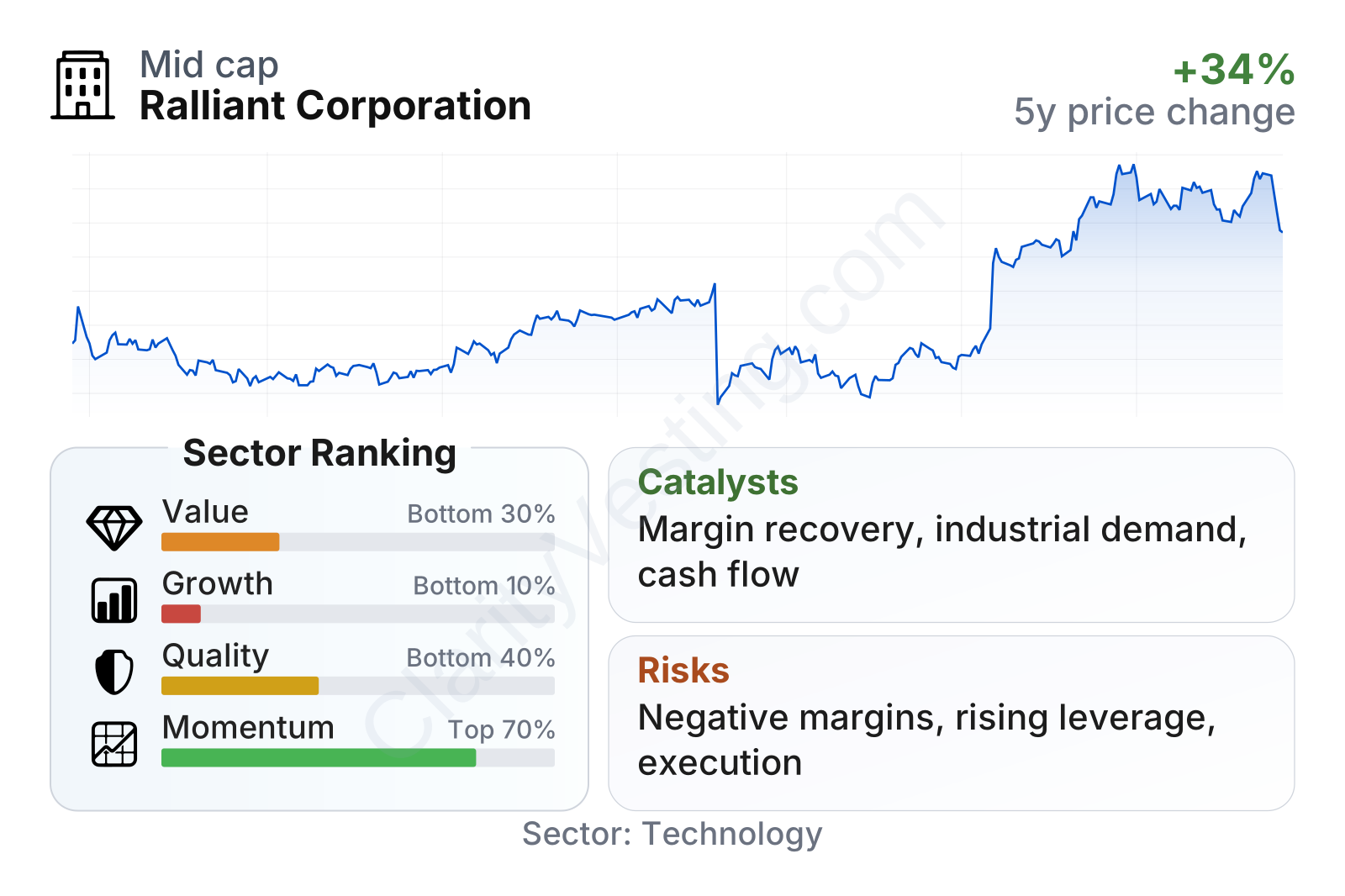
Ralliant is a mid-sized technology company by market value. Recent share-price momentum has been strong, with the stock rising sharply over the last six to twelve months, including a clear rebound from early 2026 levels. That market strength contrasts with weaker underlying quality and growth rankings versus the broader technology sector.
The metrics table points to a mixed profile. Valuation is not obviously cheap on traditional earnings measures because current earnings are distorted, and operating profitability is currently negative. Free cash flow remains positive and roughly in line with sector norms on yield, which is one of the more constructive elements in the financial profile. Growth and quality indicators, however, rank toward the lower end of the sector, reflecting weak five-year per-share growth, deteriorated margins, and a balance sheet that has become more leveraged.
Growth
Ralliant operates in a sector that still has durable long-term demand drivers. Industrial digitization, predictive maintenance, electrical reliability, factory automation, energy infrastructure upgrades, and tighter safety and quality standards all support continued need for test and sensing equipment. These are not fad-driven markets; they are tied to how companies keep assets running, reduce downtime, and manage increasingly complex systems.
The company’s strategy also makes sense in principle. Hardware installed in customer workflows can create follow-on opportunities in calibration, repair, software, subscriptions, and replacement cycles. That kind of installed base can support recurring revenue over time and can make growth less dependent on winning entirely new accounts every year.
Recent top-line performance shows that the business is still expanding, with year-over-year revenue growth running in the low-teens in recent quarters. That is a healthier signal than the headline earnings figures suggest. It indicates that customer demand has not fallen apart, even if profitability has been under pressure.
Cash generation is another important piece. Free cash flow remains positive at a few hundred million dollars on a trailing basis, although it has softened from late 2025 into early 2026. Positive cash flow gives the company more flexibility to manage through restructuring, integration work, or temporary profit disruption. For a business coming off a very weak earnings period, that is a meaningful stabilizer.
A key catalyst is the possibility that the severe 2025 earnings damage was driven largely by unusual charges rather than a permanent erosion of the business model. If that is the case, future reported margins could improve materially without requiring extraordinary revenue growth. Another potential catalyst is continued demand from industrial and infrastructure customers that need reliability, maintenance, and compliance tools regardless of short-term economic noise.
Recent corporate communications and filings also matter here because they help clarify whether management is simplifying the portfolio, reshaping costs, or emphasizing more recurring and higher-value offerings. If execution improves, the gap between decent revenue growth and weak accounting earnings could narrow.
Risks
This article is for informational purposes only and does not constitute financial advice. Some content is AI-generated. See Disclaimer