Stock Analysis · Quantum Computing Inc (QUBT)
Overview
Quantum Computing Inc. is a small technology company focused on building hardware, software, and services tied to quantum computing and related high-performance computing applications. In simple terms, it is trying to provide tools that could help customers solve specialized computing problems that are difficult for traditional systems, while also expanding into quantum-ready products such as photonic and reservoir computing technologies. The company has also been positioning itself as a commercial platform rather than a pure research venture, which means management is trying to turn advanced computing concepts into products and contracts.
At this stage, the business is still very early. Public filings show that revenue remains small compared with operating costs, so the company is better understood as a development-stage business than as a mature technology supplier. Its long-term appeal depends much more on whether it can scale commercial demand than on its current earnings profile.
The company’s revenue disclosure is limited, and recent filings do not provide a broad, stable segment breakdown with dependable percentages across multiple mature business lines. Based on company reporting, revenue appears to come mainly from a narrow set of activities:
- Quantum and advanced computing products, software, and services: likely the dominant source of revenue. This includes access to the company’s computing platforms, software tools, technical services, and development work tied to customer engagements.
- Custom projects, contracts, and collaborations: a meaningful but uneven contribution when the company signs development agreements, government-related work, or strategic partnerships.
- Other emerging commercial activity: smaller contributions tied to newly introduced hardware and technology offerings, where revenue can vary sharply from quarter to quarter.
The broader financial picture is more important than the exact mix: revenue has been growing from a very low base, but expenses on research, engineering, and corporate infrastructure remain far above sales. Over the last several years, the flow of the business has shown a familiar pattern for an early-stage deep-tech company: very limited revenue, rising research spending, and persistent net losses while the company tries to build commercial traction.
The operating structure remains heavily tilted toward spending rather than sales. Revenue has improved versus earlier years, but gross profit is still small and operating expenses have expanded much faster, especially in research and general overhead. That means the company’s business model has not yet demonstrated the scale needed to absorb its cost base.
Key Figures
| Metric | Value | Sector ⓘ |
|---|---|---|
| Date | Sep 12, 2026 | |
| Context | ||
| Sector | Technology | |
| Industry | Computer Hardware | |
| Market Cap ⓘ | $1.81B | |
| Beta ⓘ | 3.77 | |
Value (Cheapness) | ||
| P/E Ratio ⓘ | N/A | 29.51 |
| FCF Yield ⓘ | -2.85% | 4.25% |
| EBIT / EV ⓘ | -1.77% | 2.85% |
| PEG ⓘ | N/A | |
Growth (Business expansion) | ||
| Revenue Growth ⓘ | 9000.00% | 15.40% |
| RPS Growth (5Y CAGR) ⓘ | 40.25% | 8.56% |
| EPS Growth (5Y CAGR) ⓘ | -47.67% | -11.88% |
| Margin Growth (5Y Trend) ⓘ | N/A | 0.46% |
| FCF Growth (5Y CAGR) ⓘ | N/A | 9.80% |
Quality (Business durability) | ||
| ROIC (Latest) ⓘ | -0.82% | 9.44% |
| ROIC (5Y Median) ⓘ | -41.87% | 8.30% |
| Net Debt / EBIT (Latest) ⓘ | N/A | 0.54 |
| Net Debt / EBIT (5Y Median) ⓘ | N/A | 0.44 |
| Operating Margin (Latest) ⓘ | -151.11% | 9.58% |
| Operating Margin (5Y Median) ⓘ | -17706.70% | 8.25% |
| Debt to Equity (Latest) ⓘ | 1.47% | 33.33% |
| Profit Margin (Latest) ⓘ | -152.45% | 7.14% |
| Free Cash Flow (Latest) ⓘ | -$51.48M | |
Momentum (Price trend) | ||
| 3Y Return ⓘ | +524.22% | +45.48% |
| 12M Return (excl. last month) ⓘ | -46.27% | +23.48% |
| 6M Return ⓘ | +7.46% | +20.93% |
| Price vs. 200-Day MA ⓘ | -15.44% | +7.43% |
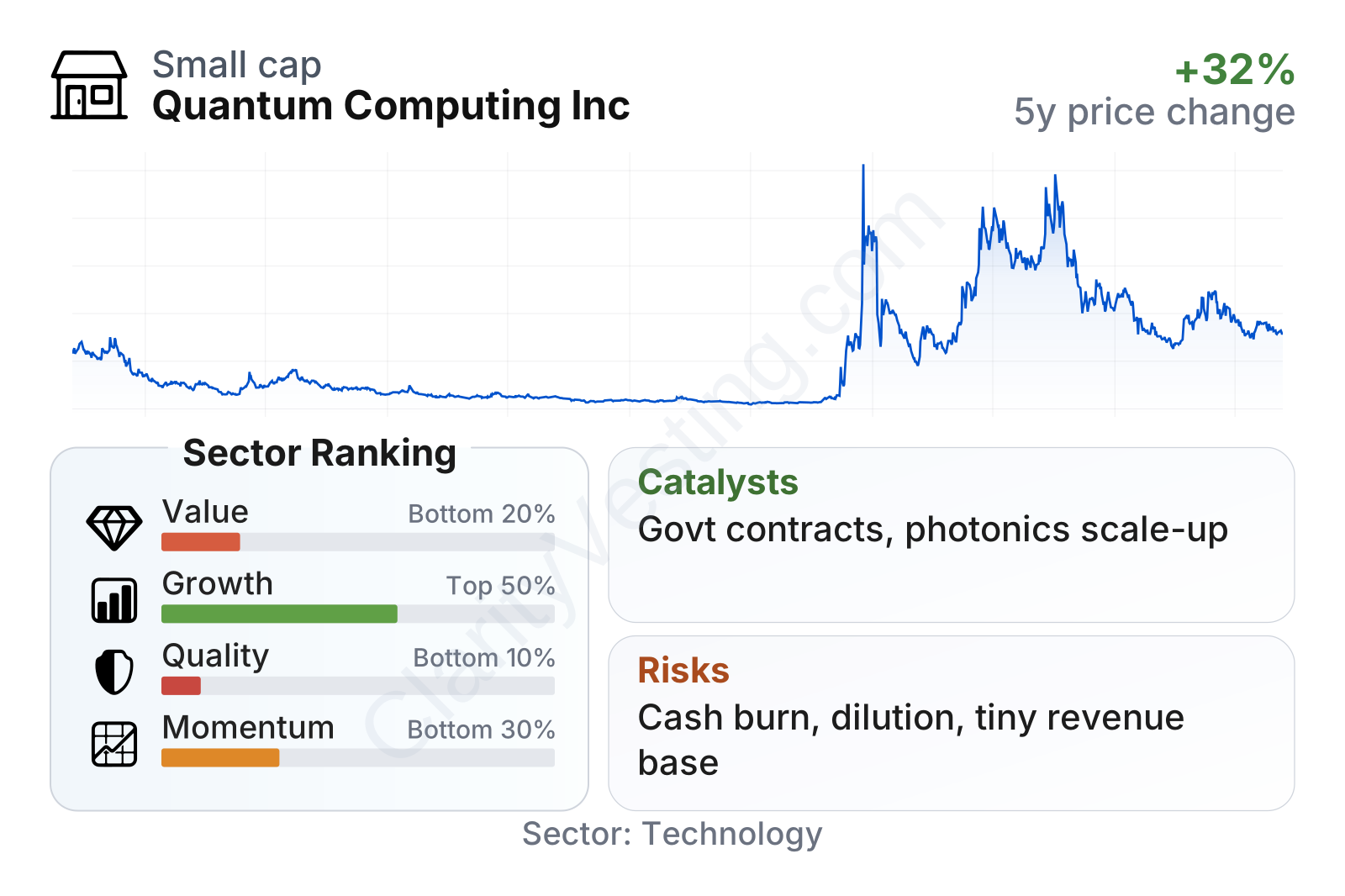
Quantum Computing Inc. sits in an unusual position: growth metrics are strong relative to much of the technology sector, but quality and valuation measures are weak. Revenue growth has been far above the sector median, yet profitability, returns on capital, and cash generation remain deeply negative. The company also has a very high beta, which helps explain why the share price has been extremely volatile. In short, the market has treated QUBT as a high-expectation, high-uncertainty company rather than a financially established one.
The stock’s history reinforces that point. The shares fell sharply for a long period, then rebounded dramatically, and have continued to swing widely. That pattern usually reflects shifting expectations around future commercialization rather than steady business execution.
Growth
Quantum computing is widely considered a growing field because governments, large technology companies, and industrial groups continue investing in next-generation computing. The long-term opportunity is real: if quantum and adjacent architectures become practical for more use cases, the market could expand well beyond research labs into logistics, cybersecurity, materials science, optimization, and artificial intelligence workflows.
Quantum Computing Inc.’s strategy broadly makes sense in that context. Instead of competing only on a single pure-quantum architecture, the company has been building a broader portfolio across software, hardware access, photonics, and optimization tools. That gives it more than one path to relevance if the industry develops unevenly. For a smaller company, that flexibility can matter because the winning commercial model in quantum remains unsettled.
Recent revenue growth has been very high on a year-over-year basis, with latest growth around 90%, far ahead of the technology sector median. That said, the growth should be interpreted carefully because it comes from a very small base. In practical terms, strong percentage expansion shows the company is finding more commercial activity, but it does not yet prove that demand is broad, recurring, or large enough to support the current cost structure.
Cash flow is the key reality check. Free cash flow has remained negative and has worsened over time, with trailing twelve-month cash burn now in the tens of millions of dollars. That means growth is currently being purchased with spending rather than funded by the business itself. For long-term analysis, this is one of the most important points: future upside depends on the company eventually turning technical progress into revenue at a much faster pace than expenses grow.
Potential catalysts do exist. The company has continued to announce new technical milestones, partnerships, product launches, and infrastructure expansion through its investor communications. If those efforts translate into commercial contracts, especially with enterprise or government customers, the market could view the company differently. Another meaningful catalyst would be clearer proof that its hardware and software offerings can address practical customer problems rather than mainly serving as demonstration platforms.
Risks
This article is for informational purposes only and does not constitute financial advice. Some content is AI-generated. See Disclaimer


