Stock Analysis · Q2 Holdings (QTWO)
Overview
Q2 Holdings is a financial technology company that provides cloud-based software to banks, credit unions, alternative finance providers, and other financial institutions. Its products help these organizations run digital banking services such as mobile apps, online account access, payments, lending, onboarding, fraud controls, and customer engagement tools. In simple terms, Q2 sells the software infrastructure that lets regional and community financial institutions offer digital experiences that can compete with larger banks.
The business is built mostly on recurring software and service relationships. Based on the company’s recent annual reporting structure, revenue is primarily split into subscription-based software and transaction or service activity, with a smaller contribution from professional and implementation services.
- Subscription and transaction-based revenue: about 84% of total revenue in 2025. This includes recurring platform subscriptions, digital banking access, and usage-based activity tied to payments, lending, account opening, and other banking workflows.
- Services and other revenue: about 16% of total revenue in 2025. This mainly includes implementation, consulting, and support work that helps customers deploy and expand Q2’s products.
That mix matters because recurring software revenue tends to be more stable and usually carries better margins than one-time project work. Over the last several years, Q2 has also shown improving cost discipline: revenue has grown steadily, gross profit has expanded faster than cost of revenue, and the company moved from operating losses to operating profit in 2025.
The long-term pattern points to a healthier business model: sales have risen from roughly $500 million in 2021 to nearly $800 million in 2025, while operating expenses have grown much more slowly recently and profitability has turned positive.
Key Figures
| Metric | Value | Sector ⓘ |
|---|---|---|
| Date | Sep 12, 2026 | |
| Context | ||
| Sector | Technology | |
| Industry | Software - Application | |
| Market Cap ⓘ | $3.80B | |
| Beta ⓘ | 1.33 | |
Value (Cheapness) | ||
| P/E Ratio ⓘ | 42.58 | 29.51 |
| FCF Yield ⓘ | 5.33% | 4.25% |
| EBIT / EV ⓘ | 2.67% | 2.85% |
| PEG ⓘ | 8.94 | |
Growth (Business expansion) | ||
| Revenue Growth ⓘ | 12.60% | 15.40% |
| RPS Growth (5Y CAGR) ⓘ | 8.39% | 8.56% |
| EPS Growth (5Y CAGR) ⓘ | N/A | -11.88% |
| Margin Growth (5Y Trend) ⓘ | N/A | 0.46% |
| FCF Growth (5Y CAGR) ⓘ | 144.21% | 9.80% |
Quality (Business durability) | ||
| ROIC (Latest) ⓘ | 10.25% | 9.44% |
| ROIC (5Y Median) ⓘ | -4.32% | 8.30% |
| Net Debt / EBIT (Latest) ⓘ | -0.60 | 0.54 |
| Net Debt / EBIT (5Y Median) ⓘ | N/A | 0.44 |
| Operating Margin (Latest) ⓘ | 11.68% | 9.58% |
| Operating Margin (5Y Median) ⓘ | -8.98% | 8.25% |
| Debt to Equity (Latest) ⓘ | 6.36% | 33.33% |
| Profit Margin (Latest) ⓘ | 10.87% | 7.14% |
| Free Cash Flow (Latest) ⓘ | $202.51M | |
Momentum (Price trend) | ||
| 3Y Return ⓘ | +80.63% | +45.48% |
| 12M Return (excl. last month) ⓘ | -16.76% | +23.48% |
| 6M Return ⓘ | +24.90% | +20.93% |
| Price vs. 200-Day MA ⓘ | +7.46% | +7.43% |
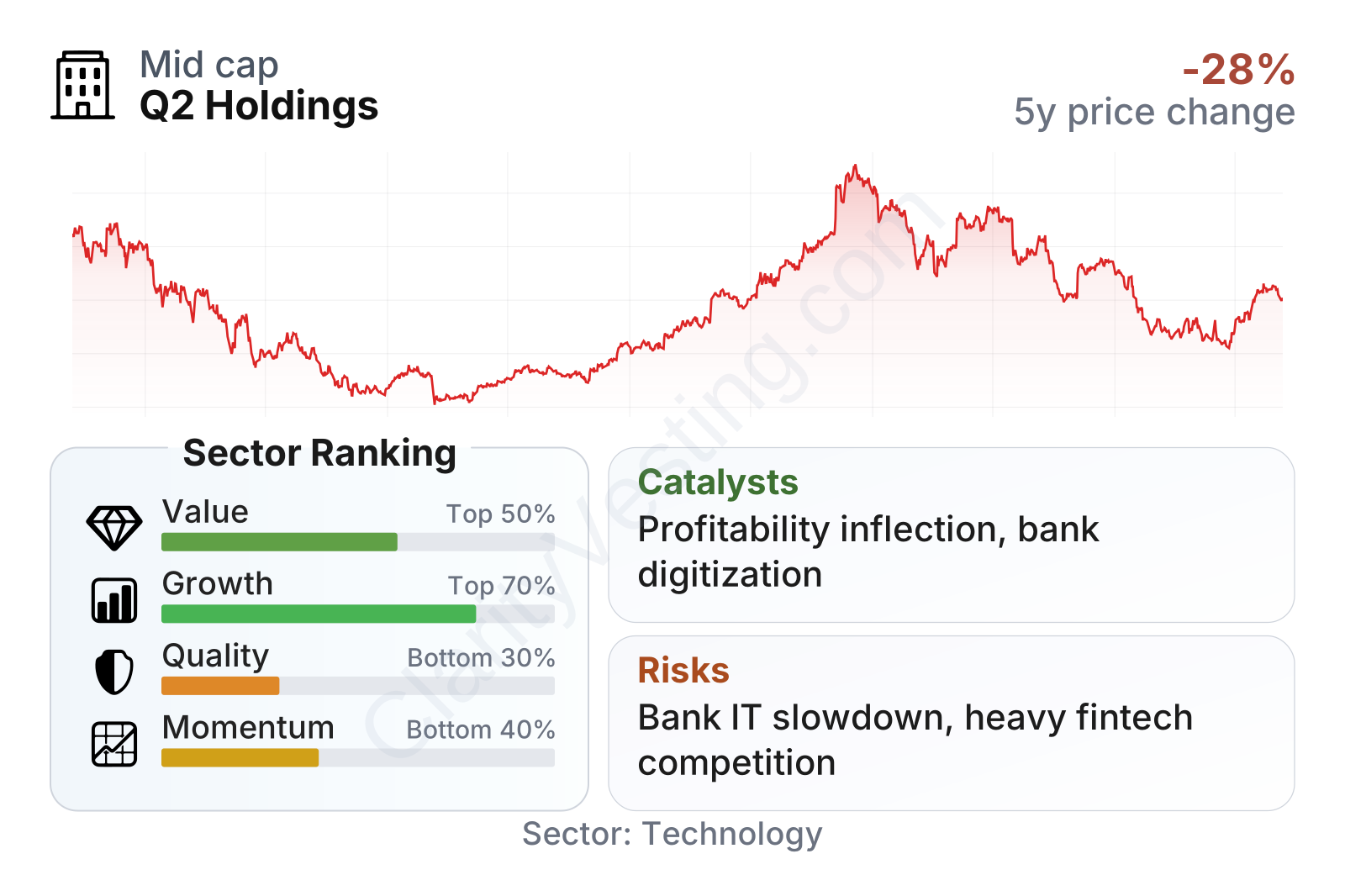
Q2 is a mid-sized software company with above-average share price volatility, which is common for profitable-but-still-re-rating technology names. The factor profile is mixed but informative: valuation is around the sector middle despite a P/E above the software median, growth is positive but not exceptional versus peers, and quality looks uneven because current profitability and balance sheet strength are solid while longer-term return metrics still reflect earlier years of losses. Momentum has weakened over the last year even after a strong multi-year rebound, showing that market sentiment has cooled faster than the underlying business has deteriorated.
Growth
Q2 operates in a sector with durable long-term demand. Banks and credit unions continue shifting customer activity toward digital channels, and smaller institutions still need modern software to keep up with national banks and fintech challengers. That creates an ongoing need for cloud banking platforms, digital account opening, embedded payment capabilities, and data-driven customer engagement tools. Q2’s focus on regional and community financial institutions gives it exposure to a part of the market that still needs technology upgrades but often prefers a specialist partner rather than building everything in-house.
The company’s strategy appears coherent for future expansion because it is not relying on a single product. It offers a broader platform that can deepen relationships over time: once a customer adopts digital banking, Q2 can add lending, onboarding, payments, fraud, and other modules. This creates room for cross-selling and makes the customer relationship more valuable. The company has also been emphasizing higher-value recurring revenue and operational efficiency, which is showing up in better margins and stronger cash generation.
Revenue growth has moderated from the 20% range seen earlier in the decade, but it has remained consistently positive and has largely held in the low-teens range more recently. That is slower than some software peers, yet it suggests the company still has expansion capacity without depending on aggressive acquisitions.
One of the clearest improvements is cash generation. Free cash flow has climbed from a very small base in 2022 to roughly $200 million on a trailing basis by 2026. For a company that only recently crossed into sustained profitability, that is a meaningful shift. It suggests Q2 is becoming more self-funding and less dependent on external capital to support growth.
A major catalyst is the continued modernization of digital banking by financial institutions that cannot afford to fall behind on user experience, payments, or onboarding. Another is Q2’s move from losses to profit, because software companies often receive more market credit once recurring growth is paired with positive earnings and cash flow. Recent company communications have also highlighted ongoing customer wins, product launches, and platform expansion efforts, which support the case that demand remains tied to structural digitization rather than a short-lived spending cycle.
Risks
This article is for informational purposes only and does not constitute financial advice. Some content is AI-generated. See Disclaimer