Stock Analysis · QuantumScape Corporation (QS)
Overview
QuantumScape Corporation is a battery technology company focused on solid-state lithium-metal batteries for electric vehicles. The company’s goal is to develop cells that can charge faster, improve driving range, and enhance safety compared with today’s conventional lithium-ion batteries. Rather than operating today as a large-scale battery seller, QuantumScape is still in the development and pre-commercialization stage. Its business is centered on research, engineering, prototype development, and preparing manufacturing processes that could eventually support commercial production with automotive partners.
At this stage, QuantumScape has not yet established a recurring commercial revenue base from mass battery sales. Based on recent public filings, revenue remains minimal and irregular, which means the business is still funded mainly by its balance sheet rather than by product sales. Revenue sources, where present, are limited and not yet representative of a mature operating model.
- Collaboration and development-related revenue: historically the main reported source when recognized, tied to work performed under joint development or licensing-type arrangements with strategic partners.
- Product revenue from commercial battery shipments: currently 0% of a mature revenue mix because the company has not yet reached large-scale commercial sales.
- Other revenue sources: not meaningful at this point based on current public reporting.
The important point for long-term readers is that QuantumScape should be viewed less like a traditional auto-parts company and more like an early-stage industrial technology developer. The business model could become attractive if its battery platform reaches commercial scale, but today it remains largely a company investing heavily ahead of revenue.
The cost structure highlights that nearly all of the company’s economic activity still flows into research, development, and operating expenses rather than sales. Research spending has risen materially over the past several years, showing a clear priority: build the technology first, then pursue commercialization.
Key Figures
| Metric | Value | Sector ⓘ |
|---|---|---|
| Date | Aug 22, 2026 | |
| Context | ||
| Sector | Consumer Cyclical | |
| Industry | Auto Parts | |
| Market Cap ⓘ | $3.51B | |
| Beta ⓘ | 2.69 | |
Value (Cheapness) | ||
| P/E Ratio ⓘ | N/A | 18.08 |
| FCF Yield ⓘ | -7.78% | 8.40% |
| EBIT / EV ⓘ | -14.55% | 6.20% |
| PEG ⓘ | N/A | |
Growth (Business expansion) | ||
| Revenue Growth ⓘ | N/A | 5.80% |
| RPS Growth (5Y CAGR) ⓘ | N/A | 9.06% |
| EPS Growth (5Y CAGR) ⓘ | -26.75% | -17.87% |
| Margin Growth (5Y Trend) ⓘ | N/A | -0.31% |
| FCF Growth (5Y CAGR) ⓘ | N/A | 4.91% |
Quality (Business durability) | ||
| ROIC (Latest) ⓘ | -28.23% | 12.33% |
| ROIC (5Y Median) ⓘ | -26.00% | 10.78% |
| Net Debt / EBIT (Latest) ⓘ | N/A | 2.16 |
| Net Debt / EBIT (5Y Median) ⓘ | N/A | 2.31 |
| Operating Margin (Latest) ⓘ | 5748.60% | 9.14% |
| Operating Margin (5Y Median) ⓘ | N/A | 9.64% |
| Debt to Equity (Latest) ⓘ | 6.40% | 75.06% |
| Profit Margin (Latest) ⓘ | N/A | 5.30% |
| Free Cash Flow (Latest) ⓘ | -$272.88M | |
Momentum (Price trend) | ||
| 3Y Return ⓘ | -12.32% | +20.19% |
| 12M Return (excl. last month) ⓘ | -57.46% | +0.43% |
| 6M Return ⓘ | -16.60% | -2.19% |
| Price vs. 200-Day MA ⓘ | -29.56% | +2.39% |
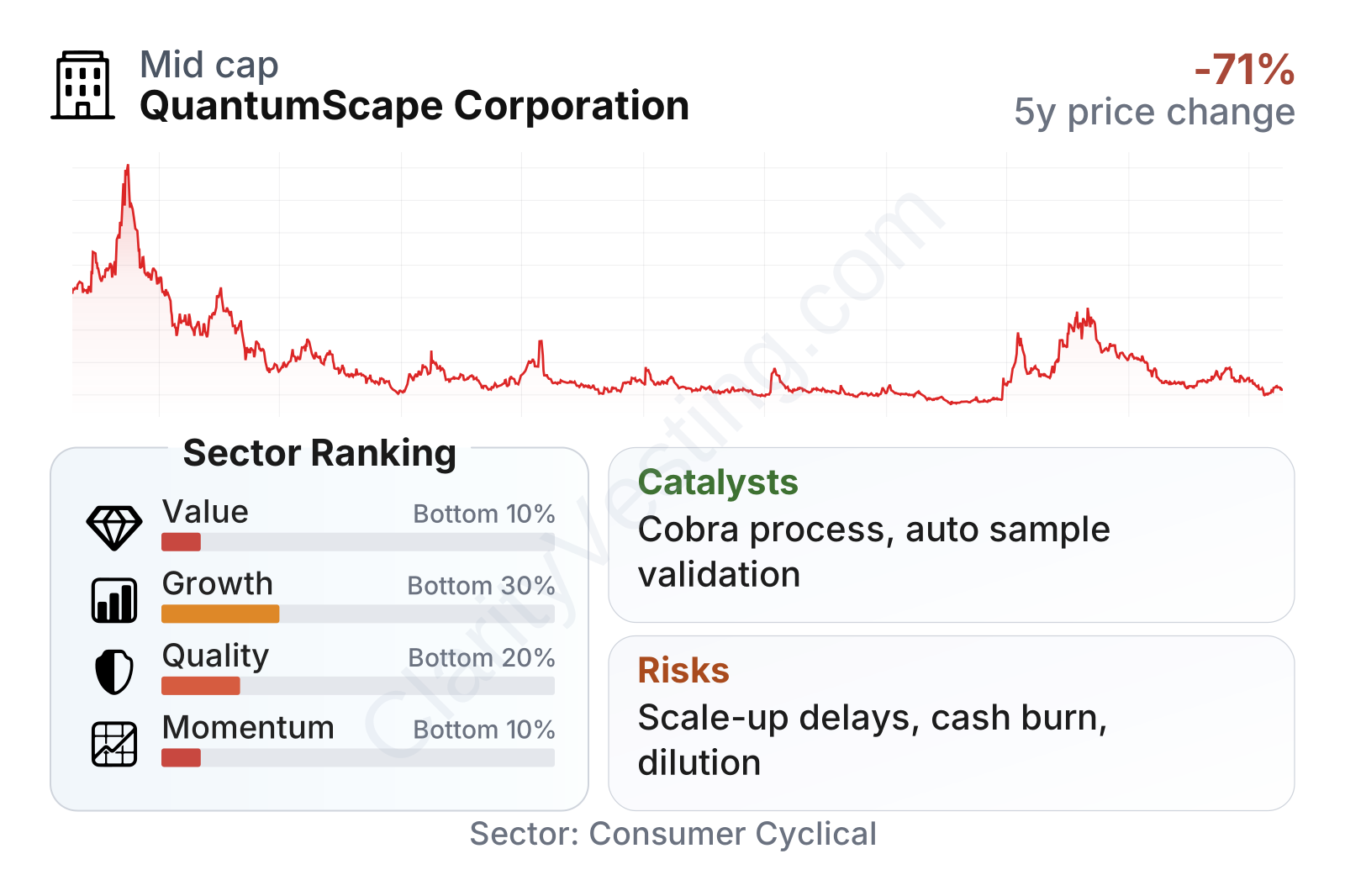
QuantumScape is a mid-sized public company by market value, but its market behavior is much more volatile than the typical stock in its sector, with a beta above 2.5. The share price history also shows how sentiment has swung sharply as expectations around battery breakthroughs and commercialization timelines changed.
The broader financial profile remains weak by conventional operating standards. Value, quality, and growth rankings all sit near the bottom of the sector because the company is still loss-making, has negative free cash flow, and does not yet have a stable revenue engine. On the positive side, the balance sheet is lightly levered, with debt to equity around 6%, far below the sector median near 86%. That low leverage gives the company more financial flexibility than many industrial peers, even though cash consumption remains substantial.
Growth
The sector QuantumScape is targeting is unquestionably a growth market. Electric vehicles continue to require better batteries, and automakers want improvements in charging speed, range, safety, and cost. If solid-state batteries become commercially viable, they could represent one of the most important technology upgrades in the EV supply chain. That makes QuantumScape’s addressable market potentially very large, even though its current revenue base is still negligible.
The company’s strategy is logically aligned with that opportunity. It has spent years developing a solid-state separator and lithium-metal cell architecture, while working with automotive partners to validate performance and prepare manufacturing methods. In simple terms, the company is trying to solve two problems at once: proving that the battery works well enough in real conditions, and proving that it can be built repeatedly at industrial scale. Those are the right priorities, because advanced battery technologies often fail not only in the lab, but also in manufacturing.
Reported revenue growth is not yet very informative because the base is too small and inconsistent. Short-term changes can look dramatic or weak without saying much about the real business trajectory. For QuantumScape, the more meaningful growth indicators are technical milestones, customer validation, production readiness, and expansion of partner programs rather than near-term sales figures.
Free cash flow remains deeply negative, although recent trailing-twelve-month cash burn has improved somewhat from earlier periods. That does not mean the business is close to self-funding; it means spending is still heavy, but the pace has become somewhat less severe than at prior peaks. For a pre-revenue industrial technology company, that distinction matters because it affects how long existing capital may last.
A major catalyst in recent years has been progress toward higher-volume sample production and tighter integration with automotive partners. QuantumScape has emphasized its Cobra separator process and advancing sample deliveries as key steps toward commercialization. If those efforts continue to translate into better throughput, lower manufacturing complexity, and successful customer testing, the company’s long-term opportunity could become materially more credible. The strongest opportunity is not a single quarter of revenue growth, but the possibility of moving from promising prototypes to validated commercial cells.
Risks
This article is for informational purposes only and does not constitute financial advice. Some content is AI-generated. See Disclaimer