Stock Analysis · Fabrinet (FN)
Overview
Fabrinet is a contract manufacturer focused on complex optical, electro-mechanical, and electronic products. In simple terms, it helps other technology companies build highly precise components and systems rather than selling a broad consumer brand of its own. Its manufacturing base is centered in Thailand, with additional operations serving customers in communications, data centers, industrial lasers, automotive, medical equipment, and other advanced technology markets.
The company’s business model is built around producing difficult-to-manufacture products at scale for customers that want reliable quality, engineering support, and efficient global manufacturing. That positioning has made Fabrinet especially important in optical communications, where precision and consistency matter a great deal.
Revenue is concentrated in a few end markets, with optical communications remaining the largest contributor. Based on recent company disclosures, the mix is approximately the following:
- Optical communications: about 78% of revenue. This includes products used in telecom networks, cloud infrastructure, and data center connectivity.
- Automotive: about 9% of revenue. This mainly reflects advanced components and systems supplied into vehicle-related programs.
- Industrial lasers, sensors, and other advanced industrial products: about 7% of revenue. These programs support industrial manufacturing and specialized equipment.
- Medical and other: about 6% of revenue. This includes selected healthcare and diversified precision-manufacturing applications.
The broad takeaway is that Fabrinet is still primarily an optical communications manufacturer, but it has been expanding into adjacent categories that can reduce dependence on one single market over time.
The operating profile has improved noticeably over the last several years. Revenue has climbed strongly, while operating expenses have grown much more slowly than sales. That suggests scale benefits: Fabrinet is not only getting bigger, it is also converting a larger share of revenue into operating profit than before.
Key Figures
| Metric | Value | Sector ⓘ |
|---|---|---|
| Date | Sep 12, 2026 | |
| Context | ||
| Sector | Technology | |
| Industry | Electronic Components | |
| Market Cap ⓘ | $14.86B | |
| Beta ⓘ | 1.21 | |
Value (Cheapness) | ||
| P/E Ratio ⓘ | 30.96 | 29.51 |
| FCF Yield ⓘ | 0.02% | 4.25% |
| EBIT / EV ⓘ | 4.08% | 2.85% |
| PEG ⓘ | 1.19 | |
Growth (Business expansion) | ||
| Revenue Growth ⓘ | 44.60% | 15.40% |
| RPS Growth (5Y CAGR) ⓘ | 20.61% | 8.56% |
| EPS Growth (5Y CAGR) ⓘ | 22.76% | -11.88% |
| Margin Growth (5Y Trend) ⓘ | 1.22% | 0.46% |
| FCF Growth (5Y CAGR) ⓘ | -45.18% | 9.80% |
Quality (Business durability) | ||
| ROIC (Latest) ⓘ | 21.01% | 9.44% |
| ROIC (5Y Median) ⓘ | 17.95% | 8.30% |
| Net Debt / EBIT (Latest) ⓘ | -0.62 | 0.54 |
| Net Debt / EBIT (5Y Median) ⓘ | -0.84 | 0.44 |
| Operating Margin (Latest) ⓘ | 11.96% | 9.58% |
| Operating Margin (5Y Median) ⓘ | 10.14% | 8.25% |
| Debt to Equity (Latest) ⓘ | 0.16% | 33.33% |
| Profit Margin (Latest) ⓘ | 10.19% | 7.14% |
| Free Cash Flow (Latest) ⓘ | $3.04M | |
Momentum (Price trend) | ||
| 3Y Return ⓘ | +178.62% | +45.48% |
| 12M Return (excl. last month) ⓘ | +64.18% | +23.48% |
| 6M Return ⓘ | -19.15% | +20.93% |
| Price vs. 200-Day MA ⓘ | -22.70% | +7.43% |
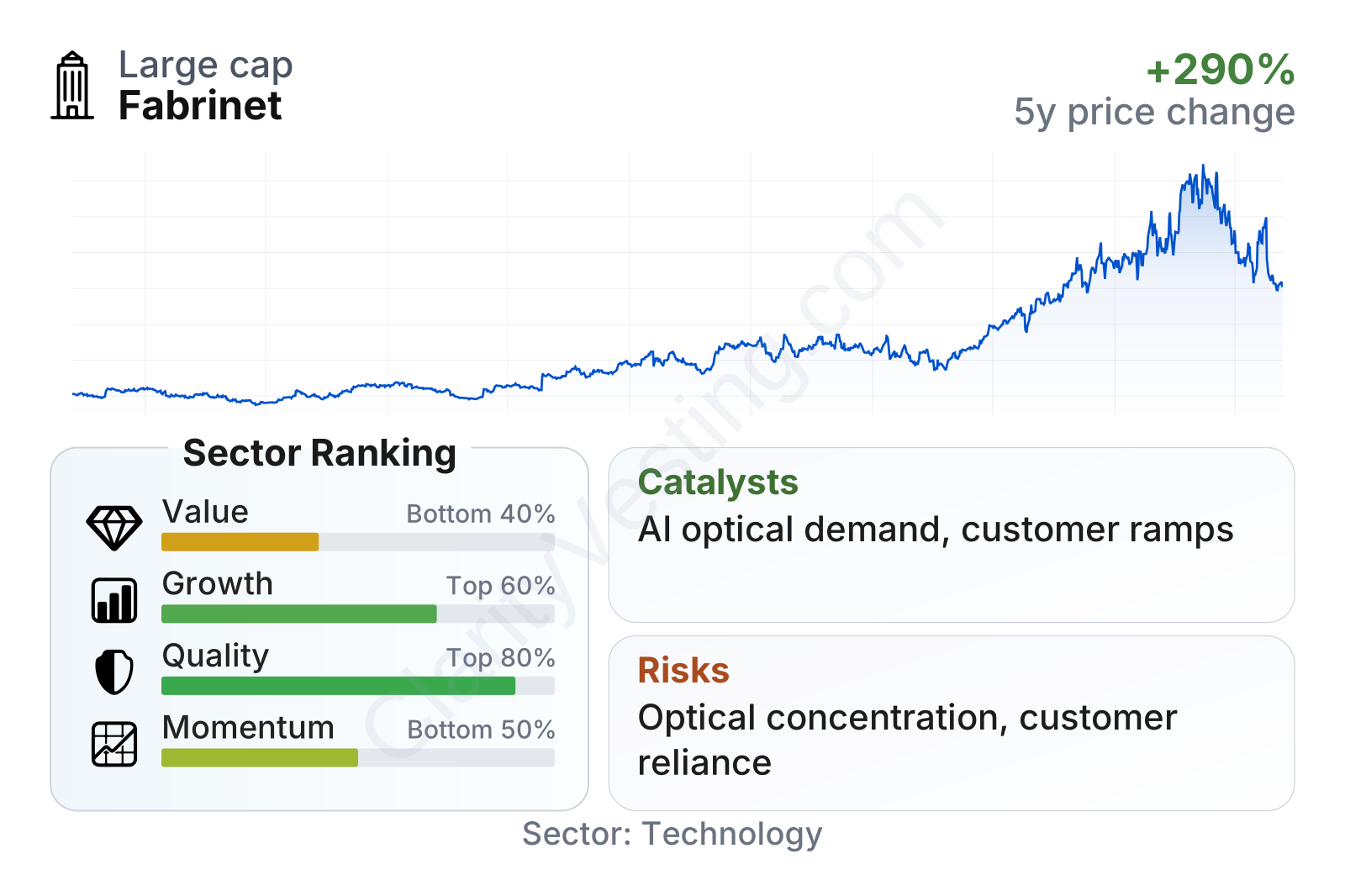
Fabrinet stands out for business quality more than for traditional cheapness. Profitability, returns on invested capital, and balance-sheet strength all compare favorably with much of the technology hardware sector. Debt is almost nonexistent, and the company currently carries net cash rather than meaningful net leverage.
Growth metrics are also solid, with recent revenue growth well above the sector median and strong multi-year expansion in revenue per share and earnings per share. The weaker point in the table is valuation: the earnings multiple is above the sector median, and free cash flow yield looks very low at the moment, which reflects a stock price that has risen much faster than near-term cash generation.
The stock’s long-term price trend has been exceptional, but recent momentum has cooled after a very strong run. That mix usually describes a company the market already recognizes as high quality, while also showing that expectations have become more demanding.
Growth
Fabrinet operates in a part of the technology market with durable long-term tailwinds. Demand for faster data transmission continues to rise as cloud computing, artificial intelligence workloads, video traffic, and enterprise networking all require more optical components and higher-capacity links. This does not guarantee smooth year-to-year growth, but it does place the company in a segment with real structural demand.
The strategy also makes sense. Fabrinet focuses on manufacturing complexity rather than commodity volume. That matters because difficult products tend to create stickier customer relationships, better margins, and longer production runs once a program is qualified. In optical communications especially, customers often prefer experienced manufacturing partners because changing suppliers can be disruptive and risky.
Recent growth has clearly accelerated. Year-over-year revenue expansion moved from more moderate levels in 2023 and 2024 to roughly 35% to 45% in the most recent periods, which is far ahead of the broader sector median. That kind of acceleration suggests Fabrinet is benefiting from a strong product cycle and rising customer demand rather than merely treading water in a stable market.
Cash generation has been more uneven than revenue and earnings. Free cash flow surged earlier, then dropped sharply in the latest trailing period. For a manufacturer, that often reflects working-capital needs such as inventory and receivables growing alongside demand. It does not automatically mean the business model is deteriorating, but it does show that rapid expansion is currently absorbing more cash than income statement profits alone would suggest.
A major catalyst is the continued buildout of high-speed optical connectivity tied to AI clusters and large-scale data centers. Fabrinet has exposure to the suppliers enabling these upgrades, and that gives it a way to participate in infrastructure growth without having to design the end chips or branded networking systems itself. Another positive factor is customer diversification beyond pure telecom, particularly in automotive and industrial applications, which can gradually broaden the earnings base.
Recent company updates have also pointed to expanding demand in advanced optical products and capacity support for customer ramps. For a manufacturer with Fabrinet’s reputation, successful execution during these ramps can strengthen long-term customer relationships and open the door to additional programs.
Risks
This article is for informational purposes only and does not constitute financial advice. Some content is AI-generated. See Disclaimer


