Stock Analysis · Quantum Corporation (QMCO)
Overview
Quantum Corporation is a data storage company focused on helping organizations keep, protect, and manage large volumes of digital content. Its products are used for backup, archiving, video and media workflows, cyber recovery, and long-term storage of unstructured data such as video files, surveillance footage, research data, and corporate records. The company is best known for its tape-based systems, scale-out file storage, and software that helps customers move and protect data across different environments.
Its customer base includes enterprises, government agencies, media and entertainment companies, research institutions, and organizations with very large archives. In simple terms, Quantum operates in the part of technology that deals with storing information for a long time at a reasonable cost, especially when the amount of data is too large or too expensive to keep only on high-performance systems.
Based on recent company filings, revenue mainly comes from product sales, subscription and software-related activity, and services. Quantum’s reporting has changed over time, but the broad revenue mix can be summarized as follows:
- Secondary storage systems and devices: approximately 50% to 60% of revenue. This includes tape automation, disk systems, appliances, and related hardware used for backup and archive workloads.
- Service revenue: approximately 25% to 35% of revenue. This includes support, maintenance, installation, and other customer service agreements tied to deployed systems.
- Software, subscriptions, and other recurring or hybrid offerings: approximately 10% to 20% of revenue. This includes software licenses, subscription arrangements, data protection tools, and related platform capabilities.
The larger business pattern is clear: Quantum still depends heavily on hardware-linked infrastructure, but it is trying to increase the role of software, subscriptions, and recurring support relationships. That shift matters because recurring revenue is typically more stable than one-time equipment sales, although it has not yet been large enough to offset the pressure on profitability.
Over the last several years, revenue has shrunk materially from earlier levels, while gross profit has also narrowed. The cost base has been reduced, especially in research and development and selling expenses, but losses remain substantial. That combination shows a company in restructuring mode rather than one already operating from a position of financial strength.
Key Figures
| Metric | Value | Sector ⓘ |
|---|---|---|
| Date | Sep 12, 2026 | |
| Context | ||
| Sector | Technology | |
| Industry | Computer Hardware | |
| Market Cap ⓘ | $1.03B | |
| Beta ⓘ | 3.00 | |
Value (Cheapness) | ||
| P/E Ratio ⓘ | N/A | 29.51 |
| FCF Yield ⓘ | -2.03% | 4.25% |
| EBIT / EV ⓘ | -22.43% | 2.85% |
| PEG ⓘ | 0.77 | |
Growth (Business expansion) | ||
| Revenue Growth ⓘ | 25.70% | 15.40% |
| RPS Growth (5Y CAGR) ⓘ | -33.55% | 8.56% |
| EPS Growth (5Y CAGR) ⓘ | N/A | -11.88% |
| Margin Growth (5Y Trend) ⓘ | N/A | 0.46% |
| FCF Growth (5Y CAGR) ⓘ | -0.30% | 9.80% |
Quality (Business durability) | ||
| ROIC (Latest) ⓘ | N/A | 9.44% |
| ROIC (5Y Median) ⓘ | N/A | 8.30% |
| Net Debt / EBIT (Latest) ⓘ | N/A | 0.54 |
| Net Debt / EBIT (5Y Median) ⓘ | N/A | 0.44 |
| Operating Margin (Latest) ⓘ | -74.46% | 9.58% |
| Operating Margin (5Y Median) ⓘ | -8.18% | 8.25% |
| Debt to Equity (Latest) ⓘ | -31.83% | 33.33% |
| Profit Margin (Latest) ⓘ | -80.76% | 7.14% |
| Free Cash Flow (Latest) ⓘ | -$20.93M | |
Momentum (Price trend) | ||
| 3Y Return ⓘ | +103.98% | +45.48% |
| 12M Return (excl. last month) ⓘ | +19.63% | +23.48% |
| 6M Return ⓘ | +350.95% | +20.93% |
| Price vs. 200-Day MA ⓘ | +203.93% | +7.43% |
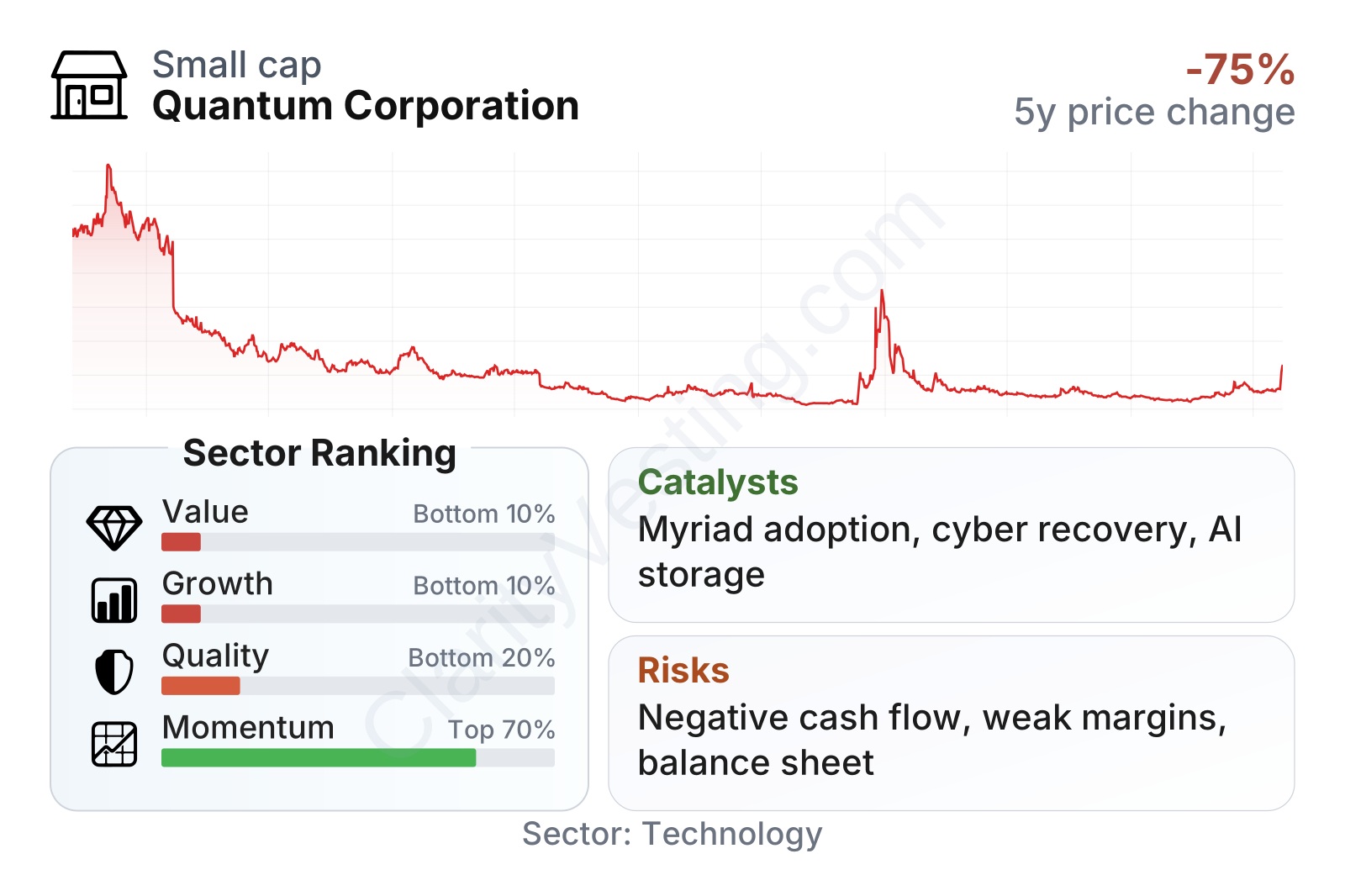
Quantum is a small-cap technology company with a very high share-price volatility profile, as shown by its beta near 3. The stock has experienced a dramatic collapse from 2021 into late 2024, followed by a sharp rebound in 2025 and 2026. That rebound has been much stronger than the sector over the last six months, but the operating picture still looks weak. In the latest factor snapshot, value, growth, and quality rank near the bottom of the sector, while momentum is the only area showing relative strength. In practical terms, the market has recently become more optimistic about the shares, but the underlying business has not yet produced the kind of financial quality that usually supports a durable long-term rerating.
Growth
Quantum operates in a market with real long-term demand drivers. The amount of unstructured data in the world continues to rise, and organizations need more ways to store information cheaply, securely, and for long periods. That is especially relevant for video archives, AI-related data sets, surveillance, compliance records, life sciences, and cyber recovery. Tape storage, which may sound old-fashioned, still has a place because it can be cost-efficient, energy-efficient, and useful for offline protection against ransomware.
The strategic logic therefore makes sense. Quantum is positioned in lower-cost, large-scale storage rather than the most glamorous part of the hardware market. If customers continue to prioritize long-term preservation, cyber resilience, and lower power consumption, the company’s portfolio remains relevant. Its push toward subscription software, recurring services, and integrated data-management solutions also fits where enterprise storage spending is heading.
Recent operating trends show some improvement in top-line momentum after a difficult period. Year-over-year revenue growth turned positive again in late fiscal 2026, with recent quarterly growth running around the mid-20% to low-30% range. That is a notable change after several quarters of contraction, and it suggests that demand and execution may be stabilizing.
There are also company-specific catalysts that could matter if they continue. Quantum has been emphasizing cyber-resilience offerings, the Myriad all-flash file system, and solutions tied to AI data lakes and high-performance workflows. Those products target areas where data volumes are rising quickly and where customers may accept premium functionality if it improves speed, protection, and scalability. Public company communications in 2026 have also pointed to new customer wins, channel activity, and product updates designed to rebuild growth.
That said, growth is not yet broad or fully proven. Over a five-year period, revenue per share has still declined sharply, and cash generation has remained negative. So the current growth case is less about a mature expansion engine and more about whether a turnaround can become durable.
Free cash flow remains a major check on the bullish narrative. Even with signs of revenue recovery, trailing cash flow is still negative and has worsened again over the last year. For long-term analysis, that is important because growth is far more convincing when it starts producing cash rather than consuming more of it.
Risks
This article is for informational purposes only and does not constitute financial advice. Some content is AI-generated. See Disclaimer