Stock Analysis · Qualys Inc (QLYS)
Overview
Qualys is a cybersecurity software company focused on helping organizations find, prioritize, and fix security weaknesses across their IT systems. In simple terms, its platform scans computers, servers, cloud workloads, applications, and connected devices to identify vulnerabilities, check compliance, and support security operations. The company is known for delivering these tools through a cloud-based platform, which gives customers a centralized way to monitor large and complex technology environments.
Its business model is largely subscription-based, which is important for long-term analysis because recurring revenue tends to be more predictable than one-time software sales. Qualys serves enterprises, government bodies, and mid-sized organizations that need continuous visibility into cyber risk. The company has expanded beyond its original vulnerability management roots into broader products such as cloud security, patch management, endpoint detection, and policy compliance.
Qualys does not report a detailed public revenue split for every product line in a way that allows precise percentages each quarter, but the broad revenue picture is clear from company filings: most revenue comes from subscriptions tied to its security and compliance applications, while a much smaller portion comes from related services.
- Subscriptions to cloud security applications: the vast majority of revenue, likely well above 90%
- Professional and related services: a small single-digit share
The broader financial profile is attractive at a high level: revenue has continued to rise, gross margins remain strong, and a large share of sales turns into operating profit and cash flow. Over the last several years, the company has also increased net income meaningfully while keeping debt low.
The long-term pattern shows a business with high gross profit, disciplined operating spending, and improving earnings power. Revenue has climbed steadily from a little over $400 million in 2021 to roughly $670 million in 2025, while net income has grown even faster, suggesting scale benefits in the model.
Key Figures
| Metric | Value | Sector ⓘ |
|---|---|---|
| Date | Jul 18, 2026 | |
| Context | ||
| Sector | Technology | |
| Industry | Software - Infrastructure | |
| Market Cap ⓘ | $5.55B | |
| Beta ⓘ | 0.60 | |
Value (Cheapness) | ||
| P/E Ratio ⓘ | 28.60 | 31.76 |
| FCF Yield ⓘ | 5.24% | 4.18% |
| EBIT / EV ⓘ | 4.88% | 2.56% |
| PEG ⓘ | 6.25 | |
Growth (Business expansion) | ||
| Revenue Growth ⓘ | 9.80% | 13.50% |
| RPS Growth (5Y CAGR) ⓘ | 15.68% | 8.57% |
| EPS Growth (5Y CAGR) ⓘ | -16.93% | -21.87% |
| Margin Growth (5Y Trend) ⓘ | 15.15% | 0.41% |
| FCF Growth (5Y CAGR) ⓘ | 14.85% | 9.76% |
Quality (Business durability) | ||
| ROIC (Latest) ⓘ | 37.15% | 8.54% |
| ROIC (5Y Median) ⓘ | 38.20% | 8.12% |
| Net Debt / EBIT (Latest) ⓘ | -0.90 | 0.38 |
| Net Debt / EBIT (5Y Median) ⓘ | -0.98 | 0.38 |
| Operating Margin (Latest) ⓘ | 36.96% | 9.58% |
| Operating Margin (5Y Median) ⓘ | 29.41% | 8.25% |
| Debt to Equity (Latest) ⓘ | 9.17% | 33.52% |
| Profit Margin (Latest) ⓘ | 29.41% | 6.96% |
| Free Cash Flow (Latest) ⓘ | $290.49M | |
Momentum (Price trend) | ||
| 3Y Return ⓘ | +20.90% | +30.91% |
| 12M Return (excl. last month) ⓘ | -19.99% | +28.90% |
| 6M Return ⓘ | +19.16% | +5.38% |
| Price vs. 200-Day MA ⓘ | +34.76% | +7.61% |
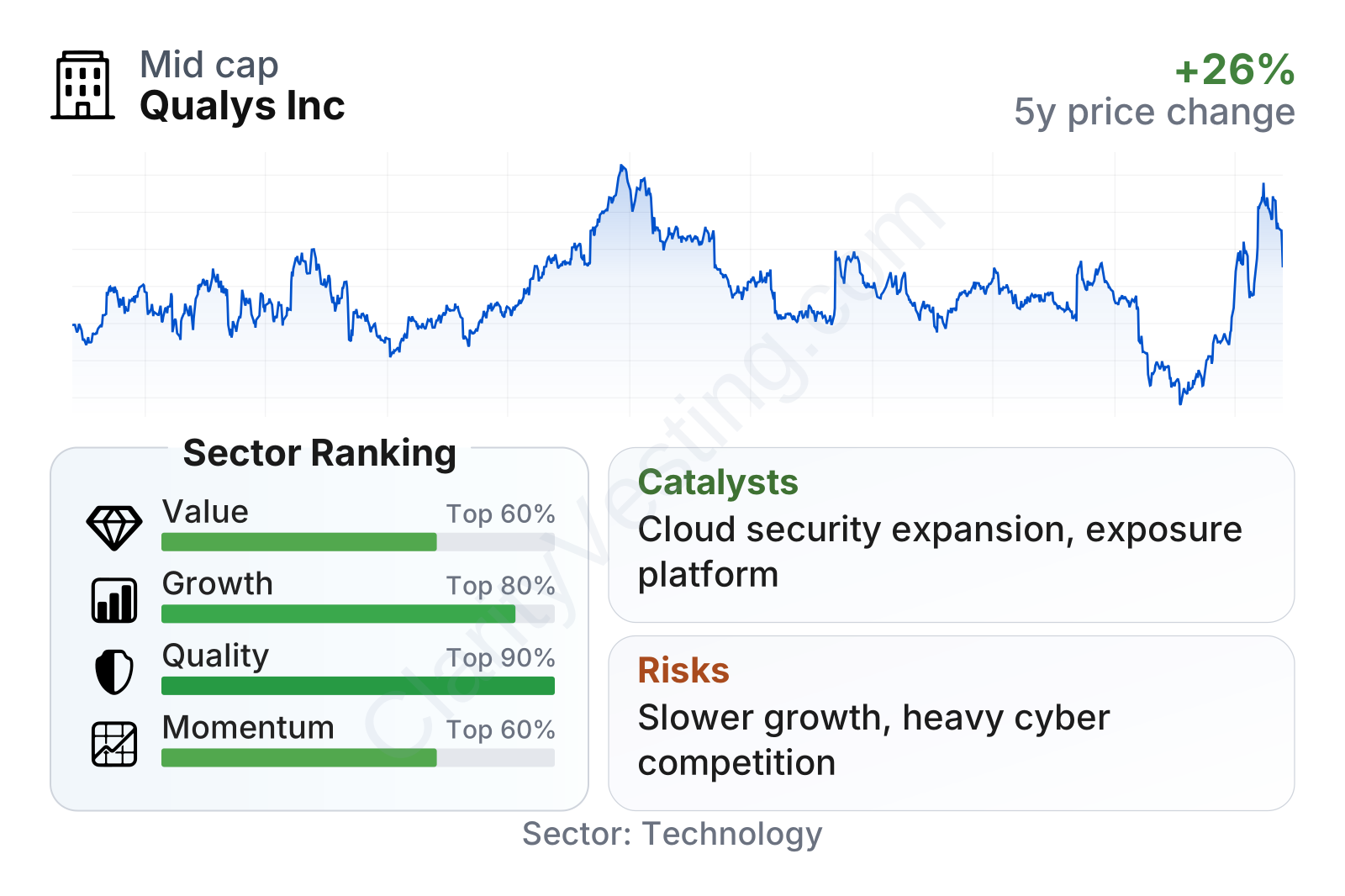
Qualys stands out more for business quality than for headline growth or market enthusiasm. Profitability, returns on invested capital, and balance-sheet strength all rank very well versus much of the software infrastructure sector. Growth is still positive, but it is no longer in the rapid expansion phase seen in younger cybersecurity names. Market performance has also been uneven, which helps explain why valuation measures now look less stretched than in earlier years.
At roughly a $5.2 billion market value, Qualys sits in the mid-cap range. Its stock volatility has been relatively modest, with a beta well below 1, meaning the shares have historically moved less than the broader market. That lower-volatility profile is consistent with a company that combines recurring revenue, healthy margins, and a conservative balance sheet.
Growth
Cybersecurity remains a growing sector over the long run because the attack surface keeps expanding. Companies now need to protect traditional networks, remote devices, cloud infrastructure, software development pipelines, and machine identities at the same time. That trend supports ongoing demand for continuous monitoring and risk management, which is closely aligned with Qualys’s core capabilities.
Qualys’s strategy for growth is logical, even if it is not the most aggressive in the industry. The company continues to build around its core platform, aiming to cross-sell more modules into existing customers instead of relying only on new logo wins. This approach can be efficient because once a customer already depends on Qualys for vulnerability management, adding adjacent tools such as patch management, cloud detection, or compliance products can be easier than starting from scratch with a new vendor.
Revenue growth has clearly moderated from the high-teens and 20% range seen earlier in the decade to around 10% more recently. That slowdown matters, but it does not necessarily undermine the long-term case. It suggests Qualys is maturing into a steadier, more cash-generative software business rather than a hyper-growth name. The key question is whether the company can keep expanding wallet share per customer and remain relevant as security budgets shift toward integrated platforms.
Free cash flow has generally moved upward over time and recently reached close to $300 million on a trailing basis. That is an important sign of business durability. Strong cash generation gives the company room to fund product development, pursue acquisitions if management chooses, and return capital to shareholders without leaning heavily on debt.
One of the more meaningful catalysts is the continued rise of cloud security and unified exposure management. Organizations increasingly want fewer separate tools and more integrated visibility across vulnerabilities, assets, configurations, and remediation workflows. Qualys is positioning itself around that need. Another potential growth driver is the pressure on enterprises to automate patching and reduce response times, which plays into the company’s broader platform strategy.
Recent company updates have also pointed to ongoing product expansion in areas tied to cyber risk prioritization, cloud-native environments, and operational efficiency for security teams. None of these developments alone transforms the growth outlook overnight, but together they support the view that Qualys is trying to deepen its role inside customer environments rather than remain a single-product vendor.
Risks
The main business risk is that Qualys operates in one of the most competitive segments of enterprise software. Cybersecurity spending is growing, but many vendors are chasing the same budgets. Customers increasingly prefer broad platforms that combine vulnerability management, endpoint protection, cloud security, identity controls, and analytics. Larger rivals with wider product suites may have an advantage when buyers consolidate vendors.
Another risk is the company’s growth profile. Qualys is profitable and disciplined, but recent revenue expansion has been slower than the sector median. If that gap persists, the market may continue to treat the company as a stable but less strategically dynamic player. In cybersecurity, being seen as innovative matters because security leaders often prioritize tools that evolve quickly with new threats and architectures.
Qualys does have competitive advantages. It has a long-established brand in vulnerability management, a cloud-based delivery model that was ahead of many legacy approaches, high switching friction once embedded in customer workflows, and unusually strong margins for the sector. Its returns on capital and profit margin are far above typical software infrastructure peers, which suggests real economic strength. Still, it is better described as a strong specialist than as the undisputed leader across all of cybersecurity.
Main competitors include:
- Tenable: a close peer in exposure and vulnerability management
- Rapid7: active in vulnerability management and security operations
- Palo Alto Networks: broader cybersecurity platform with major scale
- CrowdStrike: strong endpoint and expanding cloud/security platform
- Microsoft: powerful enterprise security bundle within its ecosystem
- Wiz and other cloud-native security vendors: especially relevant in cloud posture and exposure management
Compared with these companies, Qualys is financially stronger than many smaller peers on margins and balance-sheet discipline, but it does not have the same scale, market attention, or product breadth as the largest platform vendors. That creates a strategic balancing act: it must innovate enough to stay essential while preserving the profitability that makes it distinctive.
The balance-sheet risk is low. Debt to equity has stayed around 10% or below most of the time and remains far under the sector median. Net debt relative to earnings is negative, meaning cash exceeds debt on that measure. This gives Qualys resilience if growth slows or the industry becomes more turbulent.
Profit margin is one of the clearest strengths. The company’s net margin is close to 30%, far above the sector norm, and the trend has improved meaningfully over the past several years. The risk here is less about weak profitability today and more about whether maintaining such high margins could become harder if competition forces heavier spending on sales, product development, or pricing incentives.
There does not appear to be any widely reported recent issue pointing to an exceptional governance, scandal, or reputation event of the type that would overshadow the core business. For this company, the more important risks are execution, competition, and the possibility of falling behind faster-moving cybersecurity categories.
Valuation
Qualys currently looks much less expensive than it did in prior years. The stock’s price-to-earnings ratio has fallen dramatically from levels that were once well above the sector median to a level now below the sector median. That shift is partly explained by weaker stock performance, but it also reflects a company that kept increasing earnings while the market became more selective about software multiples.
On current metrics, valuation is supported by profitability and cash generation more than by rapid expansion. A P/E in the mid-20s would not look especially cheap for a slower-growing software business in isolation, but Qualys is not an average software company. It produces strong free cash flow, has very high operating margins, and carries limited financial leverage. Those features justify a healthier multiple than lower-quality peers.
At the same time, the PEG ratio suggests the market is not paying for a high-growth profile anymore. That is appropriate given revenue growth around 10%, which trails many cybersecurity names. In other words, the valuation appears to sit in a middle ground: no longer inflated, but also not deeply discounted if one assumes growth stays moderate. The present price seems more consistent with a durable, high-margin compounder than with a breakout growth platform.
Conclusion
Qualys presents a notably disciplined version of a cybersecurity company. It operates in an attractive sector with enduring demand, sells a recurring software product that addresses a real and persistent problem, and converts a large share of revenue into profit and cash. The financial profile is the strongest part of the picture: high margins, excellent returns on capital, low leverage, and steady free cash flow make the business stand out in a crowded software landscape.
The tradeoff is that growth is solid rather than exceptional, and that matters in cybersecurity, where market leadership can shift quickly toward broader or faster-moving platforms. Qualys appears well positioned as a profitable specialist with room to deepen customer relationships, but it faces real pressure from larger vendors and ambitious cloud-native competitors. The valuation now looks more grounded than it was in the past, which makes the company easier to analyze on business fundamentals rather than on market excitement. Overall, the current picture is favorable on quality and resilience, but less compelling on speed and strategic dominance.
Sources:
- Qualys, Inc. — Annual Report on Form 10-K for the fiscal year ended December 31, 2025
- Qualys, Inc. — Quarterly Report on Form 10-Q for the quarter ended March 31, 2026
- SEC EDGAR — Qualys, Inc. filings database
- Qualys Investor Relations — earnings releases and shareholder materials
- Qualys Investor Relations — company-hosted earnings call materials
- Wikipedia — Qualys basic company background
This article is for informational purposes only and does not constitute financial advice. Some content is AI-generated. See Disclaimer