Stock Analysis · Qualcomm Incorporated (QCOM)
Overview
Qualcomm is a semiconductor and wireless technology company best known for the chips and communications systems used in smartphones. Its business combines two attractive features: it sells physical products such as mobile processors and connectivity chips, and it also earns high-margin licensing revenue from its large portfolio of cellular technology patents. In simple terms, Qualcomm helps devices connect to mobile networks and process data efficiently, while also collecting royalties from many companies that use core wireless standards.
The company’s revenue is mainly split between chip sales and technology licensing. Based on the latest annual filing, the largest sources are:
- Handsets: about 75% of total revenue. This includes smartphone application processors, modem chips, RF front-end components, and related mobile platform products sold mainly through Qualcomm CDMA Technologies.
- Automotive: about 5% of total revenue. This covers digital cockpit, connectivity, telematics, driver-assistance, and vehicle networking solutions.
- Internet of Things: about 5% of total revenue. This includes chips and platforms for industrial devices, networking, consumer electronics, wearables, PCs, and edge computing products.
- Technology licensing: about 16% of total revenue. This comes from royalties and license fees tied to Qualcomm’s wireless intellectual property, mainly through Qualcomm Technology Licensing.
This mix matters because licensing typically carries much stronger margins than chip sales, while the chip business gives Qualcomm scale, customer reach, and exposure to fast-growing device categories. Over the last several years, the company has also been trying to reduce its dependence on smartphones by expanding more aggressively into cars, connected devices, and AI-enabled computing at the edge.
The broader financial pattern shows a business that remains very profitable even when revenue moves up and down with handset demand. Revenue climbed strongly from 2021 to 2022, fell in 2023 during a smartphone downturn, then recovered in 2024 and 2025. Research and development spending has stayed high throughout, which is important in semiconductors because product leadership depends on constant design improvement.
The operating structure is notable for two reasons: gross profit remains substantial relative to revenue, and research spending has consistently stayed near the high single-digit billions of dollars annually. That supports Qualcomm’s position in advanced wireless and computing chips, but it also means execution must remain strong to keep earning attractive returns on that investment.
Key Figures
| Metric | Value | Sector ⓘ |
|---|---|---|
| Date | Sep 12, 2026 | |
| Context | ||
| Sector | Technology | |
| Industry | Semiconductors | |
| Market Cap ⓘ | $194.35B | |
| Beta ⓘ | 1.68 | |
Value (Cheapness) | ||
| P/E Ratio ⓘ | 20.77 | 29.51 |
| FCF Yield ⓘ | 5.36% | 4.25% |
| EBIT / EV ⓘ | 6.08% | 2.85% |
| PEG ⓘ | 0.79 | |
Growth (Business expansion) | ||
| Revenue Growth ⓘ | -4.00% | 15.40% |
| RPS Growth (5Y CAGR) ⓘ | 8.22% | 8.56% |
| EPS Growth (5Y CAGR) ⓘ | -12.24% | -11.88% |
| Margin Growth (5Y Trend) ⓘ | -2.18% | 0.46% |
| FCF Growth (5Y CAGR) ⓘ | 10.34% | 9.80% |
Quality (Business durability) | ||
| ROIC (Latest) ⓘ | 24.93% | 9.44% |
| ROIC (5Y Median) ⓘ | 27.71% | 8.30% |
| Net Debt / EBIT (Latest) ⓘ | 0.90 | 0.54 |
| Net Debt / EBIT (5Y Median) ⓘ | 0.85 | 0.44 |
| Operating Margin (Latest) ⓘ | 27.00% | 9.58% |
| Operating Margin (5Y Median) ⓘ | 30.09% | 8.25% |
| Debt to Equity (Latest) ⓘ | 55.21% | 33.33% |
| Profit Margin (Latest) ⓘ | 21.01% | 7.14% |
| Free Cash Flow (Latest) ⓘ | $10.42B | |
Momentum (Price trend) | ||
| 3Y Return ⓘ | +74.33% | +45.48% |
| 12M Return (excl. last month) ⓘ | +8.31% | +23.48% |
| 6M Return ⓘ | +40.02% | +20.93% |
| Price vs. 200-Day MA ⓘ | +9.32% | +7.43% |
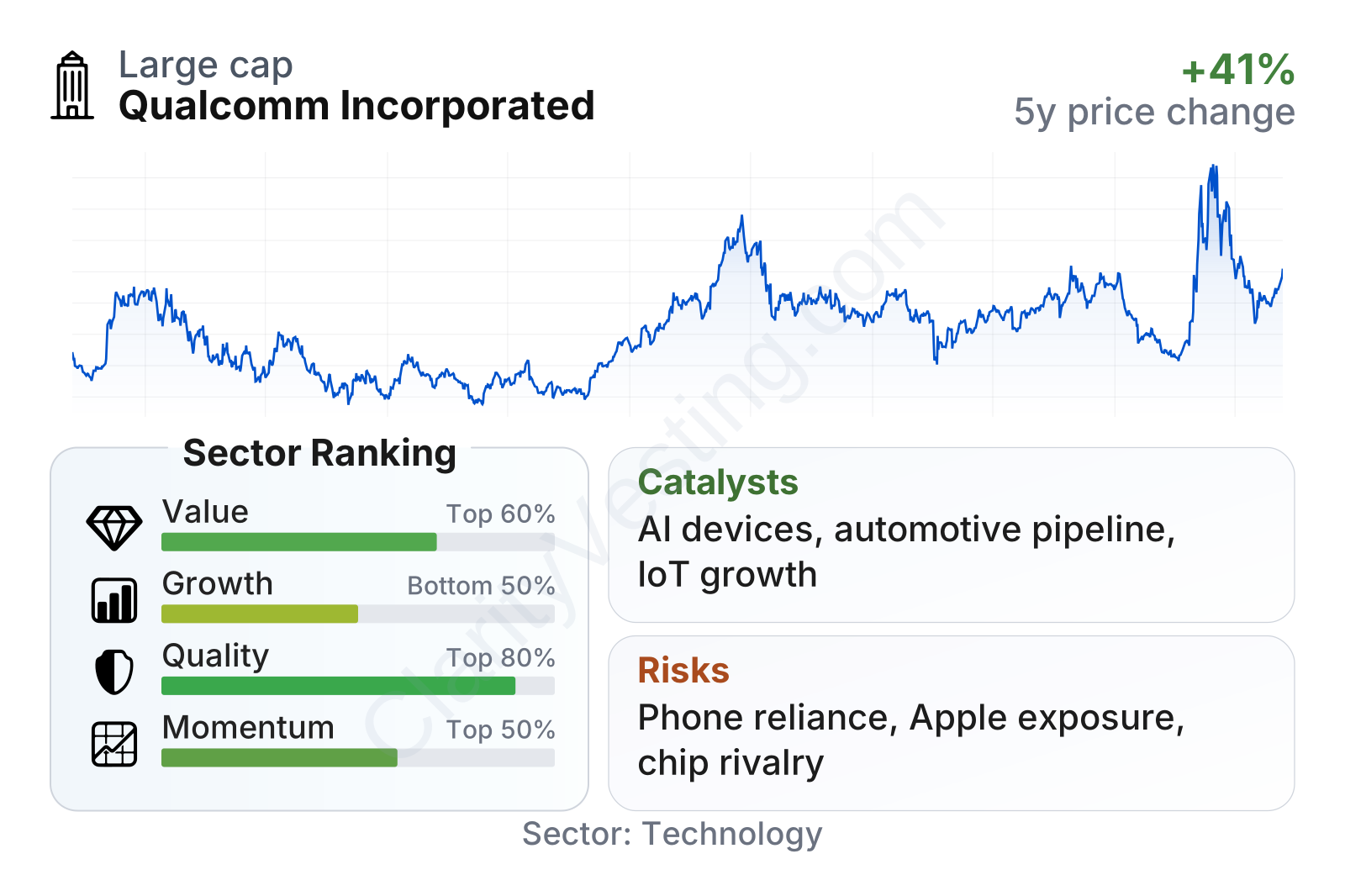
Qualcomm is a very large semiconductor company with above-average share price volatility, as shown by a beta around 1.6. In valuation and cash generation, the company stands out positively: its earnings multiple is well below the sector median, while its free cash flow yield and operating earnings relative to enterprise value are stronger than many peers. Quality metrics are also a clear strength, with returns on invested capital, operating margin, and profit margin comfortably ahead of the typical technology company in its sector. The weaker area is growth: recent year-over-year revenue has turned slightly negative, and share-price momentum has lagged the broader semiconductor group.
Growth
Qualcomm operates in several long-term growth markets: 5G, connected devices, automotive electronics, and on-device artificial intelligence. Even though the smartphone market is mature in many regions, the underlying need for better connectivity, more efficient processing, and AI capability at the device level continues to expand. That gives Qualcomm a path to growth beyond simply waiting for global phone shipments to rise.
The company’s strategy makes sense because it builds on existing strengths rather than trying to enter unrelated markets. Qualcomm already has deep expertise in wireless modems, low-power processing, connectivity, and system-level integration. Those same capabilities can be adapted for cars, industrial equipment, networking hardware, PCs, and AI edge devices. This is one of the more credible diversification efforts in the semiconductor industry because it extends a familiar technology base.
Revenue growth has been cyclical rather than smooth. After very strong gains in 2021 and 2022, Qualcomm went through a sharp correction during the handset inventory downturn in 2023, then returned to growth before softening again more recently. That pattern shows the business is still exposed to consumer electronics cycles, but it also shows Qualcomm can recover when demand normalizes and new product cycles arrive.
Free cash flow remains one of the company’s strongest indicators. It has stayed above $10 billion on a trailing basis in recent periods and has generally improved from 2022 levels. That gives Qualcomm meaningful flexibility for research spending, acquisitions, dividends, and share repurchases while still supporting the balance sheet.
A major catalyst is the rise of AI processing directly on devices rather than only in the cloud. Qualcomm has been positioning its Snapdragon platforms for AI-enabled smartphones, PCs, and edge devices where power efficiency matters. Another catalyst is automotive design wins, which typically convert into revenue over many years rather than quarters. Qualcomm has also been pushing further into Windows-based AI PCs, a category where efficient battery life and local AI performance can become differentiators if adoption broadens.
Recent company updates have also highlighted expanding Snapdragon adoption beyond flagship phones, continued automotive pipeline growth, and ongoing interest in AI-capable consumer devices. None of these opportunities removes cyclicality, but together they increase the number of engines that can support future growth.
Risks
This article is for informational purposes only and does not constitute financial advice. Some content is AI-generated. See Disclaimer


