Stock Analysis · D-Wave Quantum Inc (QBTS)
Overview
D-Wave Quantum Inc. is a quantum computing company focused on building and selling quantum systems, cloud access to those systems, and related professional services. In simple terms, it develops specialized computers designed to solve certain optimization and complex calculation problems that can be difficult or time-consuming for traditional machines. Its technology has historically centered on quantum annealing, which is aimed at practical business use cases such as scheduling, logistics, manufacturing, routing, and resource allocation. The company has also been expanding into broader quantum computing tools, including gate-model development efforts and software that helps customers build applications.
D-Wave’s business model combines hardware, cloud usage, and services. Based on company reporting, revenue is still relatively small and can vary sharply from quarter to quarter because contract timing matters a lot. The main revenue sources appear to be the following:
- Quantum computing systems: sales of on-premise quantum computers and related equipment. This can be a large contributor in years with system transactions, but it is uneven and not recurring in a smooth pattern.
- Cloud and subscription access: access to D-Wave’s quantum computers through its Leap quantum cloud service, including usage-based and subscription arrangements. This is strategically important because it is more repeatable than hardware sales.
- Professional services and support: consulting, application development, training, maintenance, and customer support tied to deployments and experimentation.
- Government and research-related work: contracts and collaborations with public-sector, academic, and research organizations, often bundled with systems, access, or development services.
For a long-term reader, the important point is that D-Wave is still in an early commercialization phase rather than a mature software or hardware company. Revenue composition can shift materially from one period to another depending on whether the company closes a major system sale, expands cloud usage, or signs development contracts. In recent years, the business has also shown that gross profit can improve meaningfully when revenue scales, but operating expenses remain far above revenue.
The broader financial picture shows a company with modest revenue, very high research and operating spending, and losses that have grown as it tries to establish a leadership position in commercial quantum computing. That makes the business easier to understand as a frontier technology platform than as a conventional stable hardware supplier.
The long-term pattern shows that revenue has risen from very low levels, and gross profit improved sharply in 2025, but operating costs remain much larger than sales. Research and development is consistently one of the biggest uses of cash, which fits the company’s stage and strategy.
Key Figures
| Metric | Value | Sector ⓘ |
|---|---|---|
| Date | Sep 12, 2026 | |
| Context | ||
| Sector | Technology | |
| Industry | Computer Hardware | |
| Market Cap ⓘ | $6.26B | |
| Beta ⓘ | 2.14 | |
Value (Cheapness) | ||
| P/E Ratio ⓘ | N/A | 29.51 |
| FCF Yield ⓘ | -1.90% | 4.25% |
| EBIT / EV ⓘ | -4.78% | 2.85% |
| PEG ⓘ | N/A | |
Growth (Business expansion) | ||
| Revenue Growth ⓘ | -0.60% | 15.40% |
| RPS Growth (5Y CAGR) ⓘ | 11.18% | 8.56% |
| EPS Growth (5Y CAGR) ⓘ | -24.78% | -11.88% |
| Margin Growth (5Y Trend) ⓘ | N/A | 0.46% |
| FCF Growth (5Y CAGR) ⓘ | N/A | 9.80% |
Quality (Business durability) | ||
| ROIC (Latest) ⓘ | -22.02% | 9.44% |
| ROIC (5Y Median) ⓘ | -164.33% | 8.30% |
| Net Debt / EBIT (Latest) ⓘ | N/A | 0.54 |
| Net Debt / EBIT (5Y Median) ⓘ | N/A | 0.44 |
| Operating Margin (Latest) ⓘ | -2197.55% | 9.58% |
| Operating Margin (5Y Median) ⓘ | -944.03% | 8.25% |
| Debt to Equity (Latest) ⓘ | 1.21% | 33.33% |
| Profit Margin (Latest) ⓘ | N/A | 7.14% |
| Free Cash Flow (Latest) ⓘ | -$119.08M | |
Momentum (Price trend) | ||
| 3Y Return ⓘ | +1600.40% | +45.48% |
| 12M Return (excl. last month) ⓘ | +12.05% | +23.48% |
| 6M Return ⓘ | -5.78% | +20.93% |
| Price vs. 200-Day MA ⓘ | -21.58% | +7.43% |
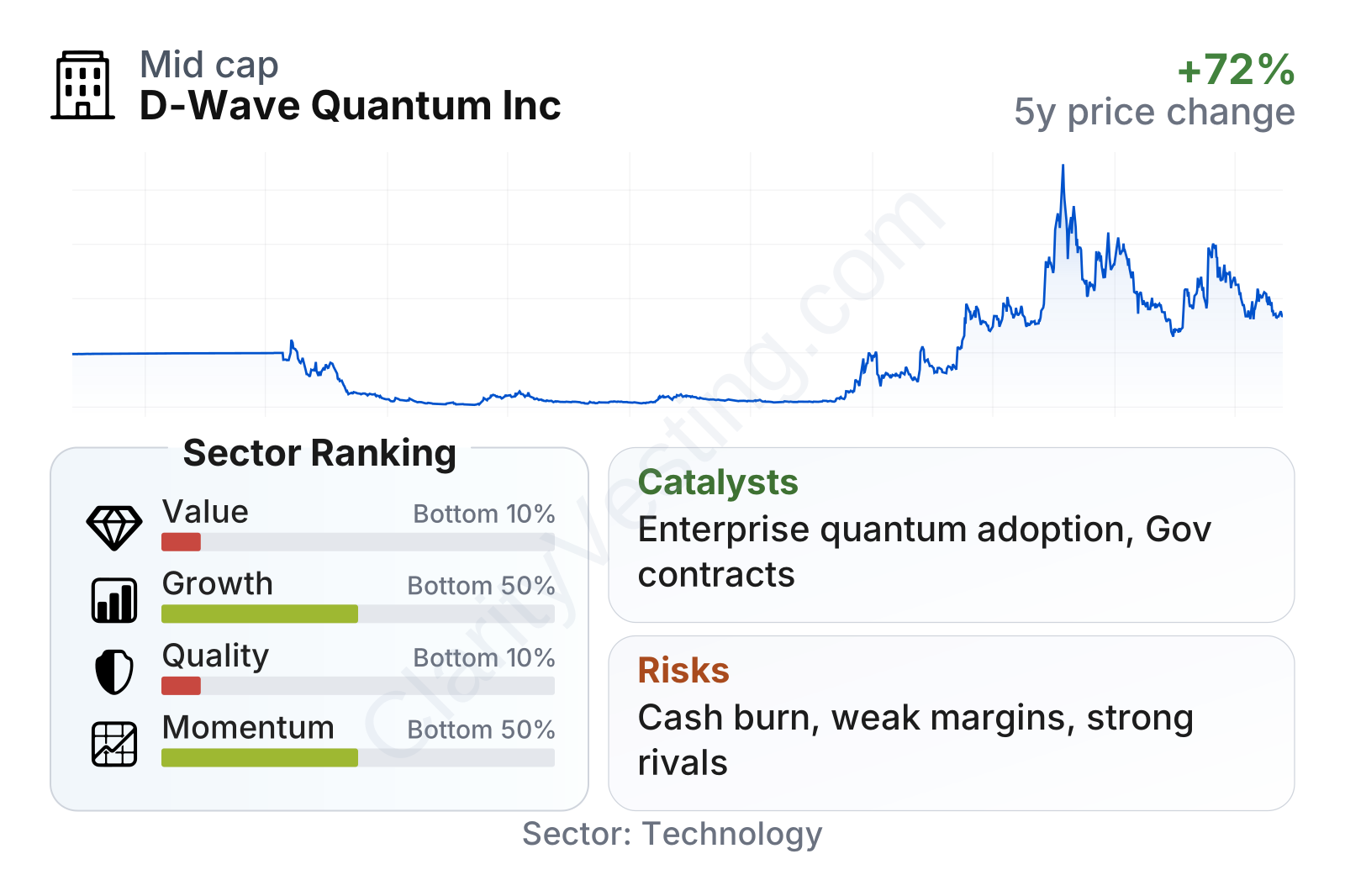
The overall profile is unusual even within technology. D-Wave’s market value has become much larger after a strong stock run, yet the operating business still scores weakly on value and quality measures because profitability and cash generation remain deeply negative. Growth indicators are mixed: the longer-term revenue-per-share trend is respectable for a company at this stage, but recent year-over-year sales have been inconsistent. Momentum has been much stronger than fundamentals, which helps explain why the stock has been very volatile.
The share price history reflects that volatility clearly. After collapsing in 2022 and 2023, the stock rebounded dramatically through 2025 before cooling somewhat in 2026. That kind of move usually signals that expectations are being driven not only by current revenue but also by future market potential, strategic announcements, and shifts in sentiment around quantum computing.
Growth
D-Wave operates in a sector with very large theoretical potential. Quantum computing is still early, but it sits in an attractive part of the technology landscape because it promises computing advantages in optimization, simulation, and certain advanced analytical workloads. If commercial adoption broadens, the market could become much larger over time. That said, the path is unlikely to be straight, and real-world revenue often develops more slowly than the excitement around the technology.
D-Wave’s strategy makes sense in one important way: it has chosen to focus on practical applications rather than waiting only for distant scientific breakthroughs. Its quantum annealing systems are positioned for optimization problems that businesses already care about today. This can give D-Wave a clearer commercial narrative than some peers that are more heavily centered on long-range research milestones. The cloud access model also lowers friction for customers that want to test the technology without purchasing a machine outright.
Revenue growth has been highly uneven. There were periods of very strong expansion, including an exceptional spike in 2025, but recent comparisons turned weak again, with the latest year-over-year figure roughly flat to slightly negative. For a company at this stage, that suggests commercial traction exists, but it is not yet stable enough to support a predictable growth profile.
Cash consumption remains a central issue. Free cash flow has stayed negative and worsened materially over time, reaching a level that shows the company is still spending heavily ahead of revenue scale. This does not invalidate the growth case, but it means future progress needs to come from larger contracts, rising cloud usage, and stronger operating leverage rather than from cost control alone.
Recent company announcements and public updates have continued to emphasize product progress, customer collaborations, and technical milestones. Those developments matter because quantum computing is a credibility-driven industry: partnerships, published results, customer proofs of concept, and system launches can influence future contract wins. A meaningful catalyst for D-Wave is any evidence that experimental usage is turning into recurring enterprise spending rather than isolated pilot projects.
Another potential opportunity comes from government interest in advanced computing, national technology capabilities, and research infrastructure. Public-sector demand can help validate the platform, support funding visibility, and create reference customers. For a business of D-Wave’s size, even a small number of larger contracts can make a noticeable difference to revenue growth.
Risks
This article is for informational purposes only and does not constitute financial advice. Some content is AI-generated. See Disclaimer


