Stock Analysis · Papa John's International Inc (PZZA)
Overview
Papa John’s International is a global pizza restaurant company built around a mostly franchised model. It sells pizzas, sides, desserts, and beverages through delivery, carryout, and digital ordering channels. The brand operates in the United States and many international markets, with revenue coming both from restaurants it runs directly and from fees and supply-chain services tied to franchised locations.
Its business is easier to understand if separated into its main revenue streams. Based on recent annual filings, the mix is centered on supply chain sales, then company-owned restaurant sales, then franchise-related income. Approximate shares can vary by year, but the ranking is consistent.
- Supply chain sales: about 65% to 75% of revenue. This includes food and paper products sold to franchised restaurants, especially dough, cheese, meats, vegetables, and packaging.
- Company-owned restaurant sales: about 15% to 25% of revenue. This is the money collected at stores operated directly by Papa John’s rather than by franchisees.
- Franchise royalties and fees: about 8% to 12% of revenue. This includes royalty payments based on franchise sales and some development and other franchise-related fees.
- Advertising and other revenue: a small portion depending on accounting classification and period. This can include technology-related items and other miscellaneous business activity.
The attraction of this model is that franchise royalties can be relatively asset-light, while the supply-chain business helps Papa John’s stay closely connected to restaurant operations. That said, the supply-chain segment is large in dollars but lower margin than royalty income, so headline revenue does not automatically translate into equally strong profits.
Over the last several years, total revenue has stayed around the same general level, but the internal mix has become more pressured. Gross profit improved in 2024 and 2025, yet net income weakened sharply in 2025 as operating costs remained elevated and interest expense stayed meaningful. That contrast matters: the company still generates sizable sales, but turning those sales into earnings has become more difficult.
The business shows a large supply-driven revenue base with a much smaller amount flowing through to final profit. A recent improvement in gross profit did not carry through to net income, which highlights the importance of cost control and margin recovery rather than revenue scale alone.
Key Figures
| Metric | Value | Sector ⓘ |
|---|---|---|
| Date | Sep 12, 2026 | |
| Context | ||
| Sector | Consumer Cyclical | |
| Industry | Restaurants | |
| Market Cap ⓘ | $785.18M | |
| Beta ⓘ | 1.09 | |
Value (Cheapness) | ||
| P/E Ratio ⓘ | 30.58 | 17.10 |
| FCF Yield ⓘ | 4.36% | 8.53% |
| EBIT / EV ⓘ | 8.52% | 6.46% |
| PEG ⓘ | 1.78 | |
Growth (Business expansion) | ||
| Revenue Growth ⓘ | -8.80% | 5.75% |
| RPS Growth (5Y CAGR) ⓘ | 1.59% | 9.14% |
| EPS Growth (5Y CAGR) ⓘ | -31.58% | -18.21% |
| Margin Growth (5Y Trend) ⓘ | -3.89% | -0.23% |
| FCF Growth (5Y CAGR) ⓘ | -14.76% | 4.91% |
Quality (Business durability) | ||
| ROIC (Latest) ⓘ | 32.42% | 12.61% |
| ROIC (5Y Median) ⓘ | 37.88% | 10.72% |
| Net Debt / EBIT (Latest) ⓘ | 1.31 | 2.10 |
| Net Debt / EBIT (5Y Median) ⓘ | 6.29 | 2.32 |
| Operating Margin (Latest) ⓘ | 7.41% | 9.25% |
| Operating Margin (5Y Median) ⓘ | 6.89% | 9.64% |
| Debt to Equity (Latest) ⓘ | -49.93% | 75.78% |
| Profit Margin (Latest) ⓘ | 1.40% | 5.33% |
| Free Cash Flow (Latest) ⓘ | $34.24M | |
Momentum (Price trend) | ||
| 3Y Return ⓘ | -67.46% | +14.53% |
| 12M Return (excl. last month) ⓘ | -25.30% | +3.08% |
| 6M Return ⓘ | -29.37% | +0.55% |
| Price vs. 200-Day MA ⓘ | -33.07% | -0.54% |
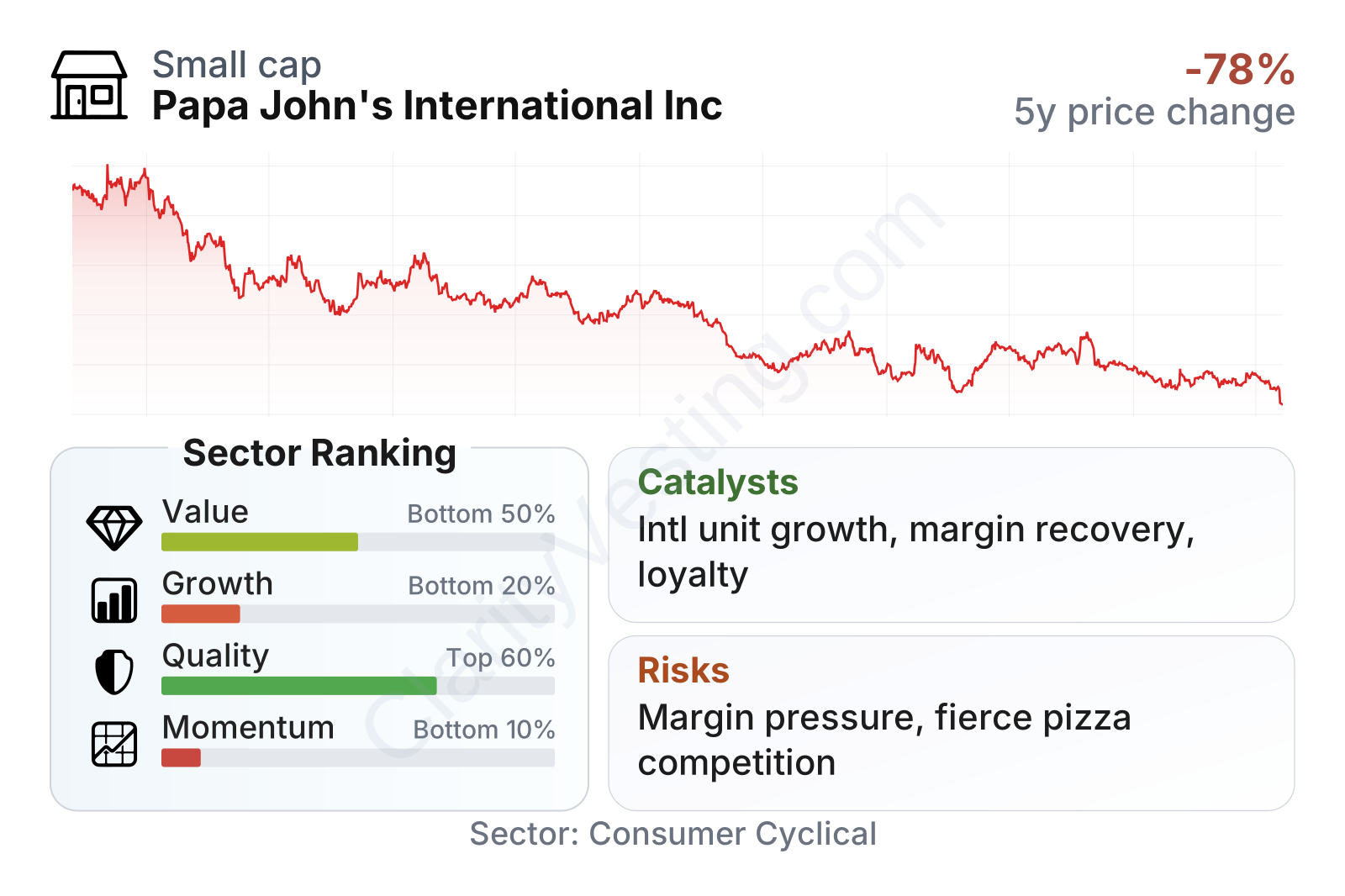
Papa John’s is a small public restaurant company by market value, and its recent profile is mixed. Quality measures are better than they first appear, with return on invested capital well above the sector median and current net debt relative to EBIT looking manageable. However, growth and share-price momentum are both weak, and the valuation metrics do not look obviously cheap compared with the broader restaurant group. The combination suggests a business with real operating strengths, but one that is currently out of favor because recent growth, earnings, and cash flow trends have disappointed.
Growth
The company operates in a large, durable segment of the restaurant industry: quick-service pizza. This category benefits from familiar consumer habits, strong delivery demand, and repeat purchasing. It is not a fast-changing technology market, but it can still grow through unit expansion, digital ordering, loyalty programs, menu innovation, and better franchise execution. International markets remain an important long-term opportunity because pizza travels well across borders and franchising allows expansion without owning every store.
Papa John’s current growth case depends less on dramatic industry expansion and more on operational improvement. Management has emphasized strengthening North America traffic, improving value offerings, expanding loyalty engagement, and accelerating international restaurant openings. The company has also continued working on its technology platform and order experience, which matters because digital channels are central to modern pizza demand.
The challenge is that recent revenue trends have been soft. Year-over-year growth was positive earlier in the cycle, then turned uneven, and the latest readings show contraction. Relative to the sector, Papa John’s has been lagging clearly, which means the growth debate is really about whether stabilization and a return to modest expansion are achievable rather than whether the company is already in a strong uptrend.
Cash generation tells a similar story. Free cash flow remains positive, which is important, but it has moved down from earlier levels. For a franchised restaurant business, sustained cash flow matters because it supports debt service, technology investment, and shareholder returns. A recovery here would be one of the clearer signs that the company’s strategy is translating into better economics.
Recent company updates have pointed to menu innovation, customer value initiatives, and international development as notable opportunities. None of these on their own transform the business overnight, but together they form a sensible path: protect demand in a pressured consumer environment, support franchisees, and keep expanding where the brand still has room to grow. If comparable sales improve and international units continue rising, the company would have a more credible growth profile than recent headline numbers suggest.
Risks
This article is for informational purposes only and does not constitute financial advice. Some content is AI-generated. See Disclaimer