Stock Analysis · PVH Corp (PVH)
Overview
PVH Corp is a global apparel company best known for owning Calvin Klein and TOMMY HILFIGER. It designs, markets, and sells clothing, underwear, footwear, accessories, and related products through wholesale partners, company-operated stores, licensing arrangements, and digital channels. The business has been reshaped over the last several years to focus more heavily on these two global brands and to simplify the portfolio.
That brand concentration matters for long-term analysis. PVH is no longer a broad collection of many labels; it is increasingly a focused fashion group built around two names with worldwide recognition. This can help management direct marketing, product development, and supply chain resources more efficiently, but it also makes results more dependent on the health of those two brands.
Based on recent company reporting, PVH’s revenue mix is concentrated in a few major buckets:
- TOMMY HILFIGER: approximately 53% of revenue. This includes apparel and accessories sold through wholesale, direct-to-consumer stores, e-commerce, and selected licensed categories.
- Calvin Klein: approximately 46% of revenue. This includes underwear, apparel, accessories, and other brand extensions sold across wholesale, owned retail, online, and licensing channels.
- Other/heritage activities: approximately 1% or less. This reflects residual business lines and corporate items after PVH’s strategic portfolio simplification.
Geographically, PVH is diversified across North America, Europe, and Asia-Pacific, which gives it broad consumer exposure but also leaves it sensitive to regional fashion trends, tourism flows, foreign exchange movements, and different economic cycles. The company’s annual revenue has recently stayed around the high single-digit billions of dollars, placing it in the mid-sized range among public consumer discretionary companies.
Profit conversion has become less stable than the brand names alone might suggest. Revenue has remained relatively resilient over time, but operating income and net income have been much more volatile, showing that PVH’s earnings power depends heavily on execution, discounting discipline, and cost control.
The business mix has stayed fairly steady, but profit flow has become much thinner. Revenue and gross profit have held up better than net income, while selling and administrative costs rose meaningfully in the latest annual period, which helps explain why earnings fell much faster than sales.
Key Figures
| Metric | Value | Sector ⓘ |
|---|---|---|
| Date | Sep 12, 2026 | |
| Context | ||
| Sector | Consumer Cyclical | |
| Industry | Apparel Manufacturing | |
| Market Cap ⓘ | $3.26B | |
| Beta ⓘ | 1.72 | |
Value (Cheapness) | ||
| P/E Ratio ⓘ | 23.80 | 17.10 |
| FCF Yield ⓘ | 21.94% | 8.53% |
| EBIT / EV ⓘ | 5.88% | 6.46% |
| PEG ⓘ | 0.05 | |
Growth (Business expansion) | ||
| Revenue Growth ⓘ | -3.20% | 5.75% |
| RPS Growth (5Y CAGR) ⓘ | 10.06% | 9.14% |
| EPS Growth (5Y CAGR) ⓘ | -13.31% | -18.21% |
| Margin Growth (5Y Trend) ⓘ | -9.04% | -0.23% |
| FCF Growth (5Y CAGR) ⓘ | -9.52% | 4.91% |
Quality (Business durability) | ||
| ROIC (Latest) ⓘ | N/A | 12.61% |
| ROIC (5Y Median) ⓘ | 9.60% | 10.72% |
| Net Debt / EBIT (Latest) ⓘ | 8.50 | 2.10 |
| Net Debt / EBIT (5Y Median) ⓘ | 3.29 | 2.32 |
| Operating Margin (Latest) ⓘ | 4.22% | 9.25% |
| Operating Margin (5Y Median) ⓘ | 9.27% | 9.64% |
| Debt to Equity (Latest) ⓘ | 86.87% | 75.78% |
| Profit Margin (Latest) ⓘ | -1.89% | 5.33% |
| Free Cash Flow (Latest) ⓘ | $715.00M | |
Momentum (Price trend) | ||
| 3Y Return ⓘ | -10.55% | +14.53% |
| 12M Return (excl. last month) ⓘ | +10.67% | +3.08% |
| 6M Return ⓘ | +15.49% | +0.55% |
| Price vs. 200-Day MA ⓘ | -7.59% | -0.54% |
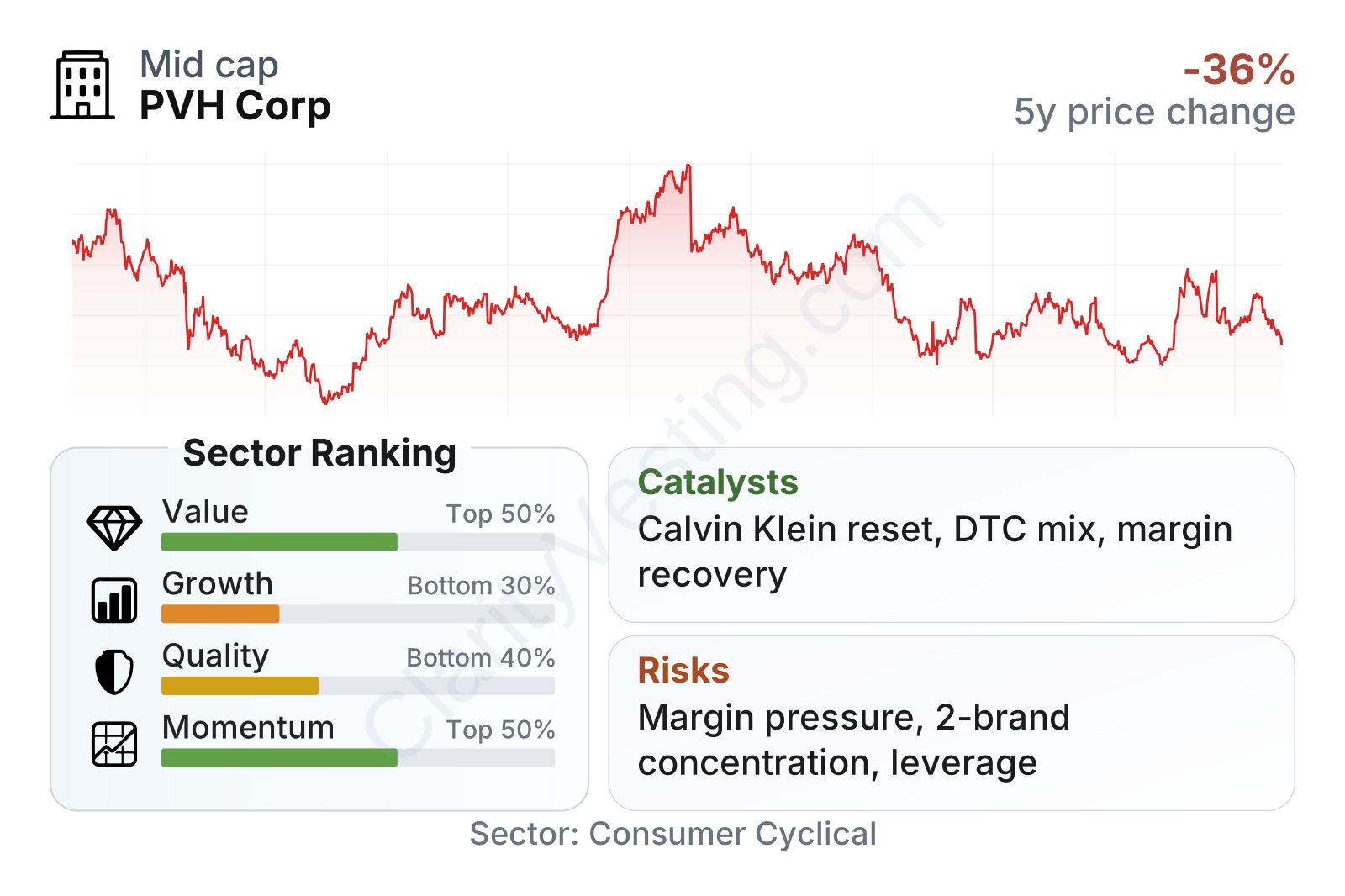
PVH currently combines a mixed fundamental profile with a more favorable cash generation picture. On one hand, growth and profitability rank below much of the sector, and leverage looks elevated when compared with operating earnings. On the other hand, free cash flow remains strong relative to the company’s market value, which helps explain why value measures do not look uniformly expensive despite weaker recent margins. Share-price behavior has also been volatile, with a recovery from recent lows but uneven longer-term performance.
The stock has experienced large swings over the last several years, reflecting how quickly the market’s view can change when apparel demand, inventory conditions, or profit expectations move. That volatility is important for long-term readers because PVH is not being treated by the market like a steady consumer staple; it trades more like a cyclical brand owner whose earnings can expand or compress sharply.
Growth
PVH operates in the global branded apparel market, a sector that is mature in developed economies but still offers growth through premiumization, direct-to-consumer sales, digital commerce, product category expansion, and international licensing. This is not a high-growth technology market, yet strong global fashion brands can still compound over time if they keep consumer relevance and pricing power.
PVH’s strategy is sensible in principle. Management has centered the company around Calvin Klein and TOMMY HILFIGER, aiming to support them with better product assortments, stronger marketing, tighter control of distribution, and more consistent brand presentation across regions and channels. In apparel, that focus can be valuable because a diluted brand identity often leads to markdowns and weaker consumer demand.
A key potential growth catalyst is PVH’s effort to deepen direct relationships with consumers. Selling more through owned stores and e-commerce can improve margin mix, increase access to customer data, and strengthen brand control. Another opportunity is category expansion, especially where these brands already have credibility, such as underwear, casualwear, accessories, and selected licensed products.
International reach also remains an important lever. Both Calvin Klein and TOMMY HILFIGER are global names, and that creates room for growth through regional product adaptation, store optimization, digital penetration, and licensing in markets where outright ownership may not be the most efficient route.
Recent revenue momentum has been uneven. After periods of recovery and mid-single-digit growth, the latest year-over-year reading slipped back into a low single-digit decline, which fits the broader picture of a company still searching for consistent top-line traction rather than moving through a clean expansion cycle.
Cash generation has stayed meaningful even with weaker earnings. Free cash flow has remained solidly positive in recent periods, although below earlier peaks. That matters because it suggests the company still has room to fund operations, debt obligations, and shareholder returns without depending entirely on accounting profits.
As for recent developments that could matter, PVH has continued to communicate a brand-led, efficiency-focused plan while working through a tougher demand and margin environment. The major opportunity is straightforward: if brand investments stabilize sales while cost discipline improves, earnings can recover faster than revenue because the company already operates at scale.
Risks
This article is for informational purposes only and does not constitute financial advice. Some content is AI-generated. See Disclaimer


