Stock Analysis · PTC Inc (PTC)
Overview
PTC Inc is an industrial software company. Its products help manufacturers design products, manage product data, support factory and service operations, and connect physical equipment to digital systems. In simple terms, PTC sells software used across the life of a product: from engineering design, to production, to maintenance, and increasingly to digital tools such as augmented reality and industrial connectivity.
The company’s revenue is mostly recurring, which is important for a long-term business profile. Based on recent company filings, the largest source is software subscriptions and cloud-related recurring contracts, followed by support for existing customers, with a smaller contribution from perpetual licenses and professional services. PTC also reports revenue by product family, with computer-aided design and product lifecycle management remaining the core of the business.
A practical way to think about PTC’s revenue mix is the following:
- Subscription revenue: approximately 70% to 75% of total revenue. This includes term software subscriptions and cloud offerings. It is the main engine of the business and reflects PTC’s shift toward recurring contracts.
- Support revenue: approximately 15% to 20%. This comes from maintenance and support services tied to installed software.
- Perpetual license revenue: approximately 5% to 10%. This is the older model where customers pay upfront for software licenses.
- Professional services: approximately 5% to 10%. This includes implementation, consulting, and training.
By product area, the biggest contributors are typically CAD software, led by Creo and Onshape, and PLM software, led by Windchill. PTC also has smaller but strategically important businesses in ALM through Codebeamer, SaaS-native collaboration through Arena, industrial IoT through ThingWorx, and augmented reality through Vuforia. This mix matters because the company is not dependent on a single niche: it serves several layers of industrial digitalization.
The broader financial picture shows a software company with high gross profitability, improving operating leverage, and a revenue base that has become more durable over time as subscriptions grew.
Over the last several years, revenue has moved up steadily while gross profit expanded faster than operating costs. Research and development spending has also increased, showing that PTC is still investing in its platform even as profitability improved materially.
Key Figures
| Metric | Value | Sector ⓘ |
|---|---|---|
| Date | Sep 12, 2026 | |
| Context | ||
| Sector | Technology | |
| Industry | Software - Application | |
| Market Cap ⓘ | $14.19B | |
| Beta ⓘ | 1.00 | |
Value (Cheapness) | ||
| P/E Ratio ⓘ | 12.68 | 29.51 |
| FCF Yield ⓘ | 6.59% | 4.25% |
| EBIT / EV ⓘ | 10.16% | 2.85% |
| PEG ⓘ | 1.21 | |
Growth (Business expansion) | ||
| Revenue Growth ⓘ | -6.80% | 15.40% |
| RPS Growth (5Y CAGR) ⓘ | 10.40% | 8.56% |
| EPS Growth (5Y CAGR) ⓘ | 6.41% | -11.88% |
| Margin Growth (5Y Trend) ⓘ | 11.93% | 0.46% |
| FCF Growth (5Y CAGR) ⓘ | 25.66% | 9.80% |
Quality (Business durability) | ||
| ROIC (Latest) ⓘ | 24.73% | 9.44% |
| ROIC (5Y Median) ⓘ | 22.39% | 8.30% |
| Net Debt / EBIT (Latest) ⓘ | 0.81 | 0.54 |
| Net Debt / EBIT (5Y Median) ⓘ | 2.83 | 0.44 |
| Operating Margin (Latest) ⓘ | 52.38% | 9.58% |
| Operating Margin (5Y Median) ⓘ | 24.47% | 8.25% |
| Debt to Equity (Latest) ⓘ | 46.33% | 33.33% |
| Profit Margin (Latest) ⓘ | 41.43% | 7.14% |
| Free Cash Flow (Latest) ⓘ | $935.48M | |
Momentum (Price trend) | ||
| 3Y Return ⓘ | -6.67% | +45.48% |
| 12M Return (excl. last month) ⓘ | -27.65% | +23.48% |
| 6M Return ⓘ | -16.94% | +20.93% |
| Price vs. 200-Day MA ⓘ | -11.57% | +7.43% |
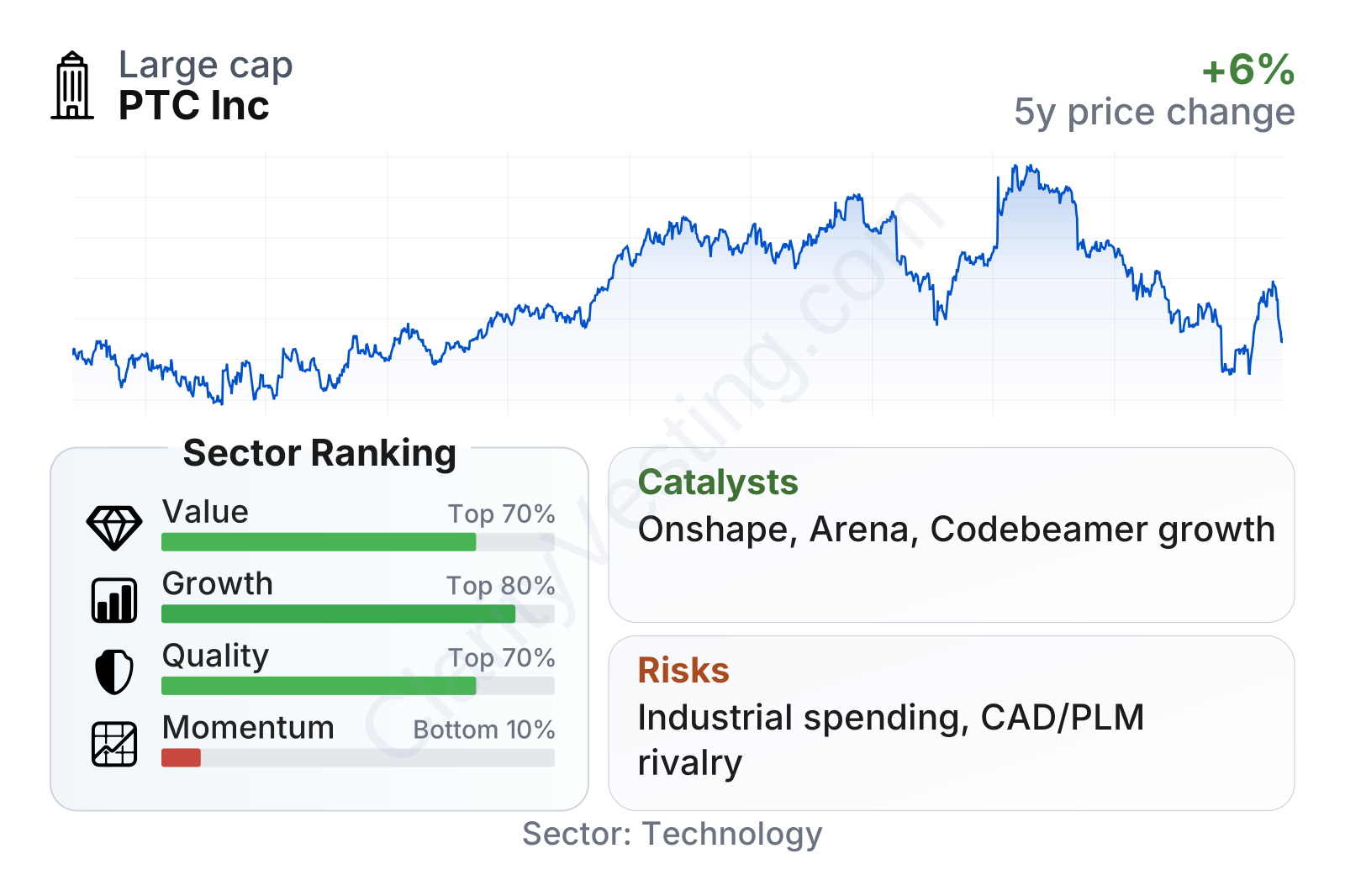
PTC is a mid-to-large software company with stock volatility close to the broader market rather than unusually high for technology. The table points to a business that ranks well on quality and long-term growth efficiency, but much less well on recent share price momentum. Valuation metrics also look less demanding than many software peers, helped by strong cash generation and high operating profitability.
The recent stock-price pattern has been uneven. After a strong run into late 2024 and part of 2025, the shares pulled back noticeably into 2026. That weak market performance contrasts with still-solid underlying profitability, which suggests sentiment has cooled faster than the business fundamentals.
Growth
PTC operates in a part of software that benefits from long-duration industrial trends. Manufacturers are still digitizing engineering workflows, product data management, factory processes, software development for connected products, and service operations. These are not short-lived themes. They are tied to rising product complexity, more software inside industrial equipment, and the need for companies to shorten development cycles while controlling costs.
The company’s strategy is coherent for that environment. PTC has built a portfolio around the digital thread: design tools, lifecycle management, requirements and application lifecycle management, cloud collaboration, and connected-product tools. That gives it a cross-sell opportunity inside existing manufacturing customers. A customer may start with CAD, then add PLM, then ALM, then cloud collaboration or service-related tools. This can support deeper account penetration over time.
Two assets stand out as future growth levers. Onshape is PTC’s cloud-native CAD platform, which is important because software design workflows are gradually moving to browser-based and collaborative environments. Arena adds cloud-native product lifecycle capabilities, especially attractive for companies that want faster deployment than traditional on-premise systems. Together, they strengthen PTC’s relevance if engineering software keeps shifting toward SaaS delivery.
Another important catalyst is the growing connection between mechanical design and software development. Modern industrial products increasingly combine hardware, electronics, and embedded software. PTC’s ALM offering, especially after the Codebeamer acquisition, gives it a better position in this area than a pure CAD vendor. That can matter in sectors such as automotive, aerospace, medical devices, and high-tech manufacturing.
Revenue growth has not been perfectly smooth. The recent year-over-year pattern includes some strong quarters as well as a more recent decline, so the near-term picture is mixed. Even so, the longer view is more favorable: five-year revenue-per-share growth remains above the sector median, suggesting the business has still compounded at a healthy pace despite periodic fluctuations.
Cash generation has been a clearer strength than headline revenue growth. Free cash flow has risen sharply over the past several years and is now close to the $1 billion level on a trailing basis. That matters because it gives PTC flexibility: debt reduction, acquisitions, internal product development, and share repurchases can all be supported without relying heavily on outside financing.
Recent company communications have also emphasized continued enterprise demand for product lifecycle modernization, SaaS adoption, and ALM expansion. Those areas are significant because they align with PTC’s strongest strategic positions rather than requiring the company to build entirely new markets from scratch.
Risks
This article is for informational purposes only and does not constitute financial advice. Some content is AI-generated. See Disclaimer


