Stock Analysis · Polestar Automotive Holding UK PLC ADS (PSNY)
Overview
Polestar Automotive Holding UK PLC is an electric vehicle maker focused on premium cars. The brand is positioned between mass-market EV companies and traditional luxury automakers. Its lineup has included the Polestar 2 sedan-like fastback, the Polestar 3 SUV, and the Polestar 4 coupe-style SUV, with future models such as the Polestar 5 and Polestar 6 presented as part of the longer-term product roadmap. The company sells vehicles in multiple markets across Europe, North America, and Asia, and it uses an asset-light industrial setup with important support from Volvo Cars and Geely for manufacturing, technology, and supply chain capabilities.
Polestar’s revenue is overwhelmingly tied to vehicle sales. Based on recent annual reporting, the business remains much less diversified than larger automakers.
- Vehicle sales: about 95% to 99% of revenue. This includes deliveries of Polestar-branded electric vehicles to retail and fleet customers.
- Services and other automotive-related revenue: about 1% to 5%. This can include items such as software-related services, parts, aftersales activities, and other smaller operating streams.
The main financial pattern so far is clear: revenue has grown from the early launch phase, but costs have remained too high for the company to reach durable profitability. Revenue recovered in 2025 after a difficult 2024, yet gross profit and net income stayed deeply negative, showing that scale alone has not solved the cost structure.
The long-term trend shows a business that has expanded sales faster than many young car brands, but with persistent pressure from production costs, pricing, and financing expense. Revenue rose strongly from 2021 to 2022, softened in 2023 and 2024, then rebounded in 2025, while losses widened rather than narrowed over the full period.
Key Figures
| Metric | Value | Sector ⓘ |
|---|---|---|
| Date | Nov 21, 2026 | |
| Context | ||
| Sector | Consumer Cyclical | |
| Industry | Auto Manufacturers | |
| Market Cap ⓘ | $1.00B | |
| Beta ⓘ | 1.82 | |
Value (Cheapness) | ||
| P/E Ratio ⓘ | N/A | 17.13 |
| P/B Ratio ⓘ | N/A | 2.72 |
| FCF Yield ⓘ | -145.01% | 7.52% |
| Dividend Yield ⓘ | N/A | 2.43% |
| EBIT / EV ⓘ | -16.12% | 7.11% |
| PEG ⓘ | N/A | |
Growth (Business expansion) | ||
| Revenue Growth ⓘ | -4.40% | 5.30% |
| RPS Growth (5Y CAGR) ⓘ | 14.77% | 8.77% |
| EPS Growth (5Y CAGR) ⓘ | N/A | -11.05% |
| BVPS Growth (5Y CAGR) ⓘ | N/A | 5.47% |
| Margin Growth (5Y Trend) ⓘ | N/A | -0.16% |
| FCF Growth (5Y CAGR) ⓘ | N/A | 5.66% |
| DPS Growth (5Y CAGR) ⓘ | N/A | 9.76% |
Quality (Business durability) | ||
| ROIC (Latest) ⓘ | N/A | 11.36% |
| ROA (Latest) ⓘ | -55.39% | 5.53% |
| ROIC (5Y Median) ⓘ | -27.92% | 10.58% |
| ROA (5Y Median) ⓘ | -34.39% | 5.35% |
| Net Debt / EBIT (Latest) ⓘ | N/A | 2.11 |
| Net Debt / EBIT (5Y Median) ⓘ | N/A | 2.24 |
| Net Debt / EBITDA (Latest) ⓘ | N/A | 1.51 |
| Net Debt / Assets ⓘ | 145.85% | 21.74% |
| EBITDA / Interest ⓘ | N/A | 9.63 |
| Operating Margin (Latest) ⓘ | -36.03% | 9.20% |
| Operating Margin (5Y Median) ⓘ | -64.93% | 9.64% |
| Debt to Equity (Latest) ⓘ | -127.15% | 74.26% |
| Profit Margin (Latest) ⓘ | -66.99% | 5.47% |
| Free Cash Flow (Latest) ⓘ | -$1.45B | |
Momentum (Price trend) | ||
| 3Y Return ⓘ | -95.99% | +15.79% |
| 12M Return (excl. last month) ⓘ | -76.77% | -0.63% |
| 6M Return ⓘ | -88.14% | +1.17% |
| Price vs. 200-Day MA ⓘ | -83.95% | +0.36% |
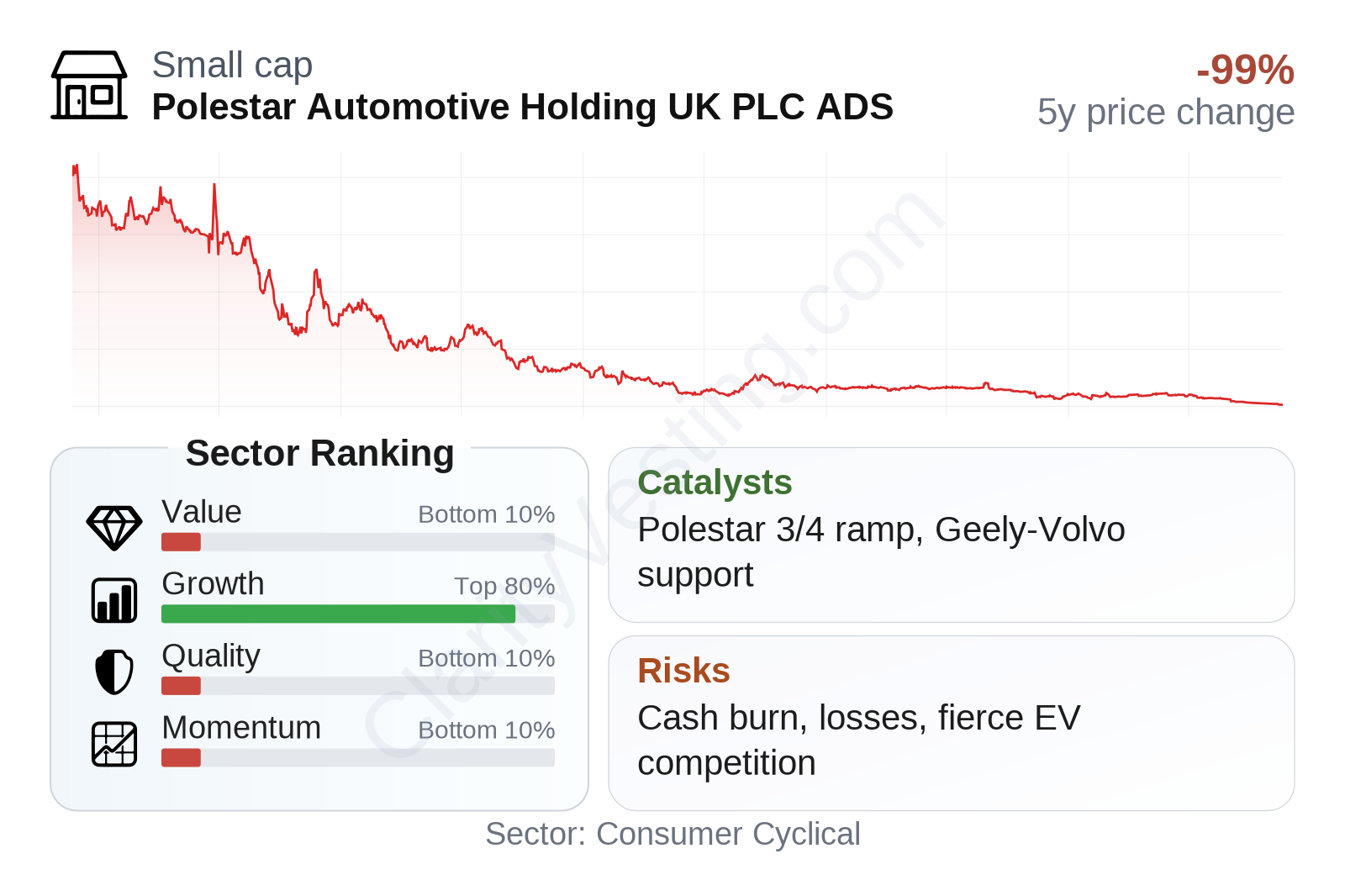
Polestar currently screens as weak on value, quality, and momentum relative to most companies in its sector, while its longer-term growth profile is less poor than those categories suggest. The market capitalization places it in the smaller end of the listed auto universe, and the stock has been highly volatile. That combination usually means the market is assigning a low degree of confidence to future execution.
The share price history reflects that skepticism. After a very high starting valuation following its market debut period, the stock has fallen dramatically over time. That decline matters because it shows a major reset in expectations: the market is no longer pricing Polestar as a fast-scaling EV disruptor, but as a company that still needs to prove demand durability, cost discipline, and funding stability.
Growth
The company operates in a sector with real long-term structural support. Electric vehicles are still gaining relevance as emissions rules tighten, charging networks improve, and more consumers become open to battery-powered alternatives. Premium EVs remain an especially important niche because higher price points can support better unit economics once production and sourcing are under control. In that sense, Polestar is in a market that can still expand over many years.
Its strategy also makes industrial sense on paper. Rather than building everything alone from scratch, Polestar has leaned on the broader Geely and Volvo ecosystem for platforms, manufacturing, engineering, and parts sourcing. That approach can reduce capital intensity compared with a fully standalone carmaker. It also gives the brand a way to launch several models globally without carrying the same factory burden as some younger EV peers.
The growth record, however, has been uneven. Early quarters showed very strong expansion, then 2024 brought clear contraction, and 2025 showed a rebound. That pattern suggests demand is real, but not yet steady enough to support a simple straight-line growth case. The five-year revenue-per-share trend still looks better than the sector median, which indicates that Polestar has built meaningful scale from a low base, even if recent year-over-year performance has been choppy.
Cash generation remains the biggest issue for the growth case. Free cash flow has stayed sharply negative, meaning the company has been consuming cash rather than producing it. For a young automaker this is not unusual, but the size and duration of the outflows are important because they limit flexibility. A business can grow deliveries and still struggle if each stage of that growth requires large external funding.
Recent company updates point to several potential catalysts. Polestar has been broadening its model range beyond the Polestar 2, which is important because a single-model dependence can cap volume. The Polestar 3 and Polestar 4 open larger premium SUV segments, where global demand is much deeper than in compact premium sedans. The company has also emphasized a more active commercial approach, including retail network expansion and efforts to improve mix and distribution. If these newer vehicles scale as planned and manufacturing execution improves, the company could move into a more credible second phase of growth.
Risks
This article is for informational purposes only and does not constitute financial advice. Some content is AI-generated. See Disclaimer