Stock Analysis · Parsons Corp (PSN)
Overview
Parsons Corp is a government-focused technology and engineering contractor. Its work sits at the intersection of national security, cyber defense, infrastructure, space, missile defense, transportation systems, and environmental services. In simple terms, Parsons helps government agencies design, protect, modernize, and operate complex systems that are difficult to replace once they are in use. The company’s customers are primarily U.S. federal agencies, with additional work for state, local, and international government clients.
Parsons reports its business through two main segments. Based on the company’s recent annual reporting, revenue is split roughly as follows:
- Federal Solutions: about 55% to 60% of revenue. This segment includes cyber and intelligence work, missile defense, space-related services, critical infrastructure protection, and other high-priority defense and security programs for U.S. government customers.
- Critical Infrastructure: about 40% to 45% of revenue. This includes transportation engineering, environmental remediation, water and wastewater projects, program management, and infrastructure modernization for civilian government clients.
That mix matters because it gives Parsons exposure to both defense spending and long-cycle infrastructure programs. The defense side tends to benefit from persistent government demand in cyber, intelligence, and missile defense, while the infrastructure side adds diversification through transportation, environmental, and utility-related projects.
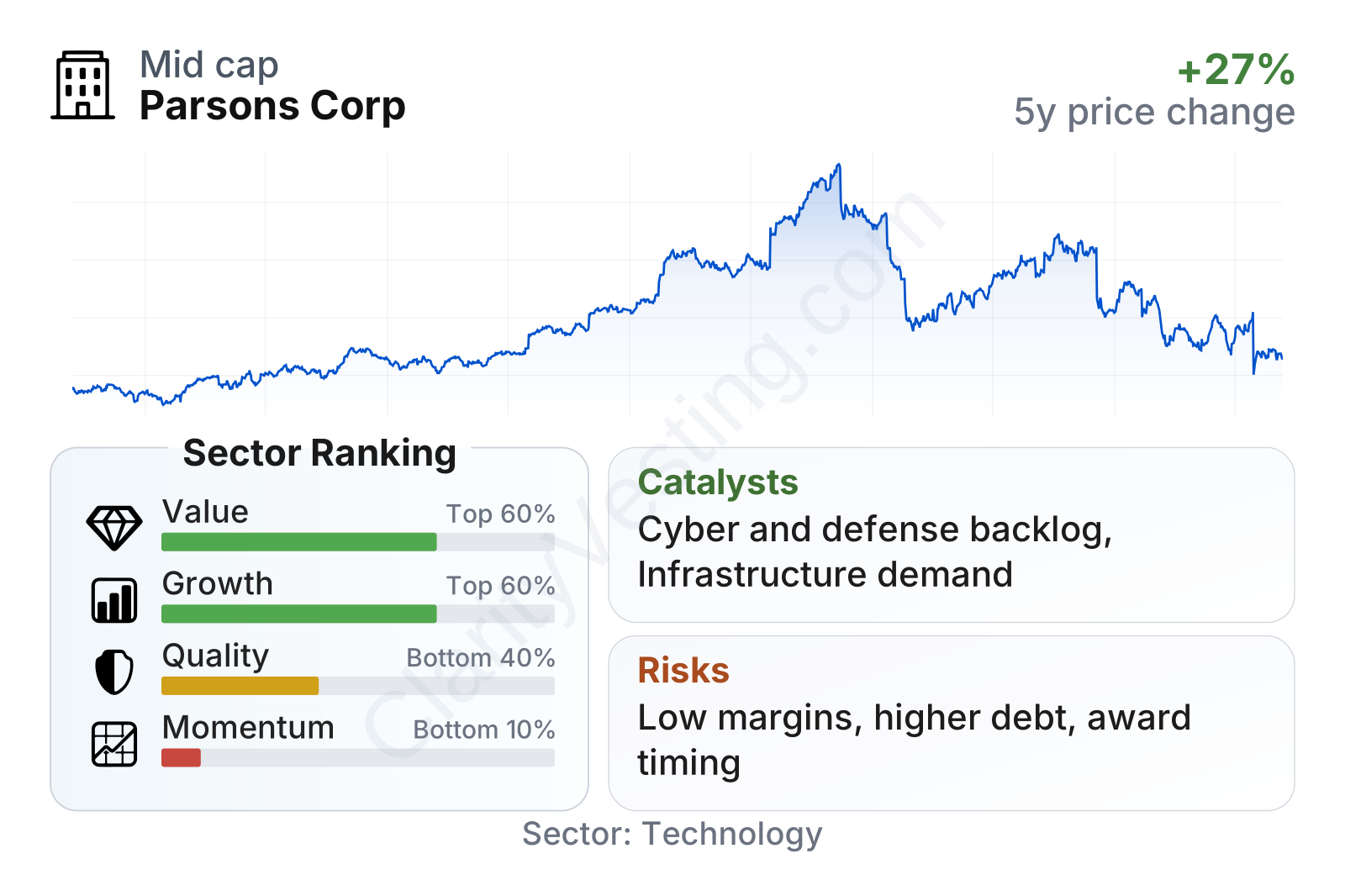
Over the last several years, the business has also become larger and more profitable in absolute dollars. Revenue expanded materially from 2021 through 2024, and although 2025 showed some pullback, gross profit and operating income remained well above earlier levels. That suggests Parsons is not just a small niche contractor, but a mid-sized platform with meaningful scale in specialized government services.
The long-term picture shows a business that has grown revenue strongly since 2021, with gross profit and operating income rising as well. The recent pause in top-line growth stands out, but the company is still operating at a much larger scale than it was a few years ago.
Key Figures
| Metric | Value | Sector ⓘ |
|---|---|---|
| Date | Sep 12, 2026 | |
| Context | ||
| Sector | Technology | |
| Industry | Information Technology Services | |
| Market Cap ⓘ | $4.89B | |
| Beta ⓘ | 0.70 | |
Value (Cheapness) | ||
| P/E Ratio ⓘ | 31.55 | 29.51 |
| FCF Yield ⓘ | 6.31% | 4.25% |
| EBIT / EV ⓘ | 5.37% | 2.85% |
| PEG ⓘ | N/A | |
Growth (Business expansion) | ||
| Revenue Growth ⓘ | -0.50% | 15.40% |
| RPS Growth (5Y CAGR) ⓘ | 15.46% | 8.56% |
| EPS Growth (5Y CAGR) ⓘ | -25.27% | -11.88% |
| Margin Growth (5Y Trend) ⓘ | 3.26% | 0.46% |
| FCF Growth (5Y CAGR) ⓘ | 22.13% | 9.80% |
Quality (Business durability) | ||
| ROIC (Latest) ⓘ | 6.36% | 9.44% |
| ROIC (5Y Median) ⓘ | 8.00% | 8.30% |
| Net Debt / EBIT (Latest) ⓘ | 4.07 | 0.54 |
| Net Debt / EBIT (5Y Median) ⓘ | 2.31 | 0.44 |
| Operating Margin (Latest) ⓘ | 5.35% | 9.58% |
| Operating Margin (5Y Median) ⓘ | 5.43% | 8.25% |
| Debt to Equity (Latest) ⓘ | 62.12% | 33.33% |
| Profit Margin (Latest) ⓘ | 2.50% | 7.14% |
| Free Cash Flow (Latest) ⓘ | $308.14M | |
Momentum (Price trend) | ||
| 3Y Return ⓘ | -17.88% | +45.48% |
| 12M Return (excl. last month) ⓘ | -39.66% | +23.48% |
| 6M Return ⓘ | -19.47% | +20.93% |
| Price vs. 200-Day MA ⓘ | -21.32% | +7.43% |
Parsons is now a mid-cap company with a share price that has been volatile. The stock climbed sharply through 2024, then gave back a large part of those gains into 2025 and 2026. In the latest factor snapshot, valuation looks near the sector middle on earnings, while cash-based measures look stronger than the typical technology services peer. Growth and value both rank around the upper-middle of the sector, but quality and especially recent price momentum are weaker. In short, the market is not treating Parsons like a high-confidence compounder right now, even though cash generation remains solid.
Growth
Parsons operates in areas that still have favorable long-term demand. Defense agencies continue to prioritize cyber operations, intelligence, missile defense, space resilience, and protection of critical systems. On the civilian side, transportation modernization, water infrastructure, and environmental remediation remain multi-year needs. These are not short-lived themes. They are driven by security concerns, aging infrastructure, and public-sector modernization.
The company’s strategy also makes sense for future expansion because it is focused on technically demanding work where contract incumbency and specialized know-how matter. Parsons has steadily built capabilities in cyber, digital transformation, connected infrastructure, and high-end engineering. That combination can be attractive in government procurement, where agencies often prefer contractors with proven performance records and the ability to handle sensitive or regulated programs.
The near-term growth picture is less smooth than the multi-year trend. Year-over-year revenue growth was very strong in 2023 and 2024, at times above 20% and even above 30%, but then turned slightly negative through parts of 2025 and into 2026. That slowdown does not erase the larger expansion of the business over five years, but it does show that Parsons is now working through a tougher comparison period and a more uneven contract timing environment.
Cash generation is one of the more encouraging parts of the profile. Free cash flow improved substantially over the last several years, rising from the low-$200 million range to above $400 million on a trailing basis, even after coming down from a higher peak. That matters because cash flow gives the company room to reduce debt, support acquisitions, and absorb project timing swings without relying too heavily on outside financing.
Recent company communications have also highlighted contract wins and a large backlog, which are important practical catalysts for a government services business. Backlog does not convert into revenue immediately, but it does provide visibility. A healthy pipeline in cyber, defense, and infrastructure programs can support future revenue even when quarterly growth appears uneven.
Another notable opportunity is the continued emphasis by the U.S. government on mission areas where Parsons already has a footprint: missile defense, space systems, border and critical infrastructure security, and cyber resilience. These are budget categories with strategic importance, which can remain resilient even when other spending areas face pressure.
Risks
This article is for informational purposes only and does not constitute financial advice. Some content is AI-generated. See Disclaimer