Stock Analysis · Prosus NV (PROSY)
Overview
Prosus N.V. is a global consumer internet group. It owns and operates digital platforms in areas such as food delivery, classifieds, payments and fintech, education technology, and e-commerce, while also holding a very large stake in Tencent, the Chinese technology company. For many readers, that last point is the key to understanding Prosus: it is partly an operating internet business and partly a listed investment vehicle built around major technology holdings.
The company’s revenue mainly comes from its consolidated e-commerce businesses rather than from Tencent itself, because Tencent is accounted for mostly through investment income rather than as operating revenue. Based on Prosus’s latest annual reporting and segment disclosures, the business mix is broadly centered on the following areas:
- Food Delivery – approximately 35% to 45%: stakes in major platforms such as Delivery Hero, iFood, and Meituan-related exposure in some periods, depending on accounting treatment and portfolio structure. This activity includes ordering platforms, restaurant delivery, and related logistics services.
- Classifieds – approximately 20% to 30%: online marketplaces for autos, real estate, and general goods, mainly through OLX and related brands.
- Payments and Fintech – approximately 10% to 20%: digital payments, online transaction services, credit, and financial tools, with businesses including PayU.
- Etail and other Ventures – approximately 10% to 20%: includes online retail, education technology, software, and smaller growth investments.
- Investment income from associates and fair-value movements – highly material but not a stable revenue line: this is where Tencent and other portfolio investments can strongly influence profit, even when they are not the main source of reported sales.
That structure makes Prosus different from a standard retailer or software company. Revenue reflects the operating subsidiaries, while earnings and net asset value can be heavily affected by portfolio holdings, especially Tencent. The business is therefore a mix of operating execution and capital allocation.
The latest flow of revenue and profit suggests that sales have expanded meaningfully over the last year, but operating profit has become much thinner because spending rose sharply. At the same time, bottom-line profit remains unusually large relative to revenue because investment gains and associate contributions still matter a lot.
Key Figures
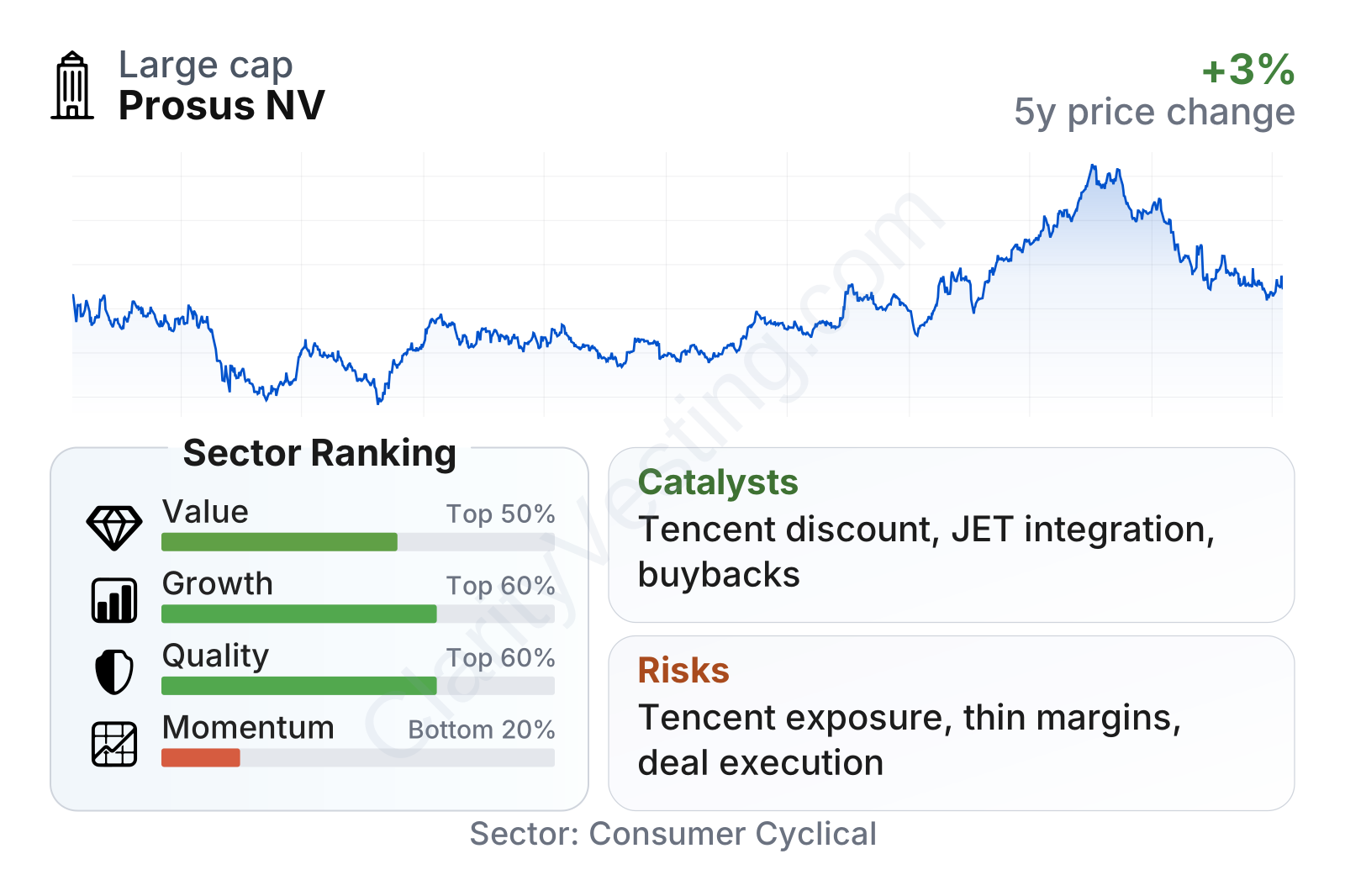
The stock has been volatile over the last several years, with large swings that reflect both operating performance and changing sentiment around Chinese technology assets, especially Tencent. More recently, the share price pulled back after a strong run, which fits with the weak shorter-term momentum visible in the broader metrics.
| Metric | Value | Sector ⓘ |
|---|---|---|
| Date | Jul 20, 2026 | |
| Context | ||
| Sector | Consumer Cyclical | |
| Industry | Internet Retail | |
| Market Cap ⓘ | $94.61B | |
| Beta ⓘ | 0.78 | |
Value (Cheapness) | ||
| P/E Ratio ⓘ | 8.46 | 18.58 |
| FCF Yield ⓘ | 3.57% | 7.99% |
| EBIT / EV ⓘ | 11.08% | 5.91% |
| PEG ⓘ | 4.47 | |
Growth (Business expansion) | ||
| Revenue Growth ⓘ | 22.30% | 5.50% |
| RPS Growth (5Y CAGR) ⓘ | 29.11% | 9.20% |
| EPS Growth (5Y CAGR) ⓘ | 21.99% | -26.43% |
| Margin Growth (5Y Trend) ⓘ | -183.38% | -0.18% |
| FCF Growth (5Y CAGR) ⓘ | N/A | 5.02% |
Quality (Business durability) | ||
| ROIC (Latest) ⓘ | 15.03% | 12.03% |
| ROIC (5Y Median) ⓘ | 8.06% | 10.82% |
| Net Debt / EBIT (Latest) ⓘ | 1.03 | 2.12 |
| Net Debt / EBIT (5Y Median) ⓘ | 1.43 | 2.25 |
| Operating Margin (Latest) ⓘ | 66.22% | 9.28% |
| Operating Margin (5Y Median) ⓘ | 89.09% | 9.64% |
| Debt to Equity (Latest) ⓘ | 32.71% | 75.23% |
| Profit Margin (Latest) ⓘ | 119.92% | 5.28% |
| Free Cash Flow (Latest) ⓘ | $3.37B | |
Momentum (Price trend) | ||
| 3Y Return ⓘ | +29.45% | +10.68% |
| 12M Return (excl. last month) ⓘ | -16.66% | +5.26% |
| 6M Return ⓘ | -28.67% | -2.41% |
| Price vs. 200-Day MA ⓘ | -19.75% | +1.55% |
Prosus stands out as a very large internet platform group with relatively low balance-sheet leverage and strong recent revenue growth. On valuation, its earnings multiple sits well below the sector median, while operating returns and EBIT relative to enterprise value look solid. The weaker areas are market momentum and the uneven trend in operating margins, which shows that rapid expansion has not translated into smooth profitability at the operating-business level.
Growth
Prosus operates in digital markets that still have long-term growth potential. Online food delivery, digital payments, online classifieds, and e-commerce remain structural growth areas in many regions, especially in emerging markets where internet adoption, smartphone penetration, and digital payment usage are still rising. These are not niche activities anymore, but they are also not mature everywhere, which leaves room for transaction volumes and monetization to keep increasing over time.
The company’s strategy broadly makes sense for growth because it combines three engines. First, it owns established platforms that can scale as more users and merchants join. Second, it has exposure to high-growth regions outside the United States. Third, it can recycle capital by trimming investments, simplifying the portfolio, and redirecting resources toward businesses where it sees better returns. Prosus has also spent the last few years trying to improve discipline after a long period when internet groups prioritized scale over profits.
Recent revenue growth has been clearly ahead of the sector median, showing that the underlying portfolio still has expansion capacity. Over a five-year period, revenue per share and earnings per share have also grown faster than the median company in its sector. That is an encouraging sign because it suggests growth has not come only from issuing more shares or from one-time accounting effects.
Free cash flow is another important point. The latest trailing figure is positive and sizable in absolute terms, which matters for a company with a broad investment portfolio and multiple operating businesses. Healthy cash generation gives management more flexibility to support subsidiaries, repurchase shares, reduce debt, or make selective acquisitions.
A meaningful catalyst is Prosus’s ongoing effort to close the discount between its market value and the value of its underlying assets. That includes continued share repurchases linked to the sale of small pieces of Tencent stock, as well as a gradual reshaping of the portfolio toward stronger operating economics. Another catalyst is further margin improvement in food delivery and classifieds, where scale benefits can become more visible once promotional spending moderates.
Recent corporate actions also matter. Prosus completed a major move by acquiring Just Eat Takeaway.com, which significantly increases its food delivery footprint in Europe. If integration is handled well, that could deepen scale, improve network density, and strengthen its position in one of its most important verticals. In addition, management has continued to emphasize simplification, cost control, and cash discipline across the portfolio, which supports the broader shift from pure growth to more durable profitability.
Risks
The biggest risk is concentration. Even though Prosus has many assets, its valuation and market perception are still strongly tied to Tencent. That means regulation, competition, macroeconomic weakness, or market sentiment affecting Chinese technology can spill over directly into Prosus, even if its other operating businesses are doing well.
A second risk is that several of Prosus’s industries are competitive and often structurally tough. Food delivery in particular has high customer-acquisition costs, heavy discounting, and constant pressure from logistics expenses. Classifieds and payments can be attractive, but they also require ongoing technology investment and face local competitors in many countries. This helps explain why strong revenue growth has not always produced equally strong and stable operating margins.
Balance-sheet risk looks manageable. Debt to equity is well below the sector median, which gives Prosus more financial room than many peers. Net debt relative to EBIT is also moderate. This does not remove business risk, but it lowers the chance that leverage becomes the central problem during a tougher operating period.
Profitability needs careful interpretation. Reported profit margin is exceptionally high versus the sector, but that figure is influenced by investment-related gains and accounting effects that do not necessarily reflect the economics of the core operating platforms. In contrast, the deterioration in the operating-margin trend over the last five years shows that underlying execution has been less steady than the headline earnings number suggests.
Prosus does have competitive advantages, but they are uneven across the portfolio. Its scale, capital base, experience in building digital marketplaces, and access to high-quality strategic holdings are real strengths. It is not the undisputed global leader across all its businesses, though. In food delivery, it competes with large regional and global players such as DoorDash, Uber, Deliveroo, and Delivery Hero. In classifieds, it faces platforms owned by Adevinta, CoStar, local incumbents, and specialist marketplace operators. In payments, PayPal, Block, Adyen, Stripe, Nu, and many local fintechs create a crowded environment. Prosus is therefore better described as a major portfolio player with leadership in selected markets rather than a single-category global champion.
Another risk is execution around portfolio integration and capital allocation. Large acquisitions can create value, but they can also increase complexity and delay margin improvement if synergies take longer than expected. For Prosus, that matters especially after expanding further in food delivery. Reputation and governance risk should also be monitored, not because of a single standout scandal, but because the group’s multinational structure, cross-holdings, and frequent portfolio actions can make the business harder for the market to assess.
Valuation
Prosus looks inexpensive on a plain earnings multiple. Its P/E ratio is around the high-single-digit range, far below the sector median, and it has usually traded at a discount to peers over the last several years. On EBIT relative to enterprise value, it also screens better than the sector median. Those signals point to a market that is still applying caution despite the company’s scale, asset base, and recent growth.
That discount is not random. The market appears to be pricing in the company’s complexity, its reliance on Tencent for a large share of value, inconsistent operating margins, and the fact that some portfolio businesses remain exposed to competitive sectors where long-term profit pools are still debated. In other words, the low multiple reflects both opportunity and skepticism.
Whether the current price looks justified depends on which part of Prosus carries more weight in the analysis. If the focus is on the asset portfolio, balance-sheet strength, and the gap between market value and underlying holdings, the valuation appears restrained. If the focus is on the operating businesses alone, the case is less straightforward because profitability remains uneven and some segments still require strong execution to earn attractive returns. The current valuation therefore seems to reflect a business with real strategic assets, but also one that has not fully convinced the market that those assets can be translated into consistently clean operating performance.
Conclusion
Prosus is a distinctive long-duration internet group: part operating platform company, part technology holding company, and part capital allocator. That makes it more complex than a typical stock, but also more interesting. It has exposure to large digital categories, a strong financial position, solid recent growth, and a valuation that remains well below much of the sector.
The main tension is clear. Prosus has meaningful assets and credible long-term growth drivers, yet its earnings profile is shaped by investment holdings and its operating businesses still need to prove that scale can translate into steadier margins. The company’s recent strategic moves, especially in food delivery and portfolio simplification, point toward a more focused and potentially more productive structure, but execution remains essential.
Overall, Prosus currently looks like a large and financially capable platform group whose market valuation still carries a noticeable discount for complexity, concentration, and margin uncertainty. The combination creates a setup where underlying business quality appears stronger than market sentiment, but the path to a simpler and more consistently profitable profile is still unfinished.
Sources:
- Prosus Annual Report 2026
- Prosus Results for the year ended 31 March 2026
- Prosus Investor Relations – Annual financial statements 2026
- Prosus Investor Relations – Capital Markets Day and shareholder update materials
- Prosus press release – Recommended cash acquisition of Just Eat Takeaway.com
- SEC EDGAR – Prosus N.V. filings for 2026
- Wikipedia – Prosus
This article is for informational purposes only and does not constitute financial advice. Some content is AI-generated. See Disclaimer