Stock Analysis · Autoliv Inc (ALV)
Overview
Autoliv is a global automotive safety supplier focused on products designed to protect vehicle occupants in crashes. Its business is not about flashy car features; it is about the hardware and systems that become critical in the worst moments. The company develops and manufactures airbags, seatbelts, steering wheels, and related safety electronics, then sells them mainly to major vehicle manufacturers around the world. Because these parts are deeply integrated into vehicle platforms and must meet strict safety standards, Autoliv tends to work closely with automakers over long product cycles.
The company’s revenue mix is led by passive safety products, which are the core items that physically protect people during a collision. Based on company reporting, the business can be understood roughly as follows:
- Airbag and passive safety systems: about 55% to 60% of revenue
- Seatbelts and restraint systems: about 35% to 40% of revenue
- Other safety-related products and services including steering wheels and selected electronics: about 5% or less
Geographically, Autoliv is broadly diversified across the Americas, Europe, and Asia, which reduces dependence on any single car market. Its customer base includes many of the world’s largest automakers, so results are tied more to global vehicle production trends and market share wins than to one brand’s success.
The business model is industrial and volume-driven: large sales are offset by high manufacturing costs, but the recent trend has been encouraging because revenue has been rising faster than overhead and profitability has improved. Gross profit and operating income have expanded meaningfully since 2022, suggesting the company has been managing pricing, product mix, and execution better after a difficult inflationary period.
Key Figures
| Metric | Value | Sector ⓘ |
|---|---|---|
| Date | Jul 18, 2026 | |
| Context | ||
| Sector | Consumer Cyclical | |
| Industry | Auto Parts | |
| Market Cap ⓘ | $8.80B | |
| Beta ⓘ | 1.36 | |
Value (Cheapness) | ||
| P/E Ratio ⓘ | 12.95 | 18.58 |
| FCF Yield ⓘ | 8.59% | 7.99% |
| EBIT / EV ⓘ | 9.73% | 5.91% |
| PEG ⓘ | 0.85 | |
Growth (Business expansion) | ||
| Revenue Growth ⓘ | 6.80% | 5.50% |
| RPS Growth (5Y CAGR) ⓘ | 10.64% | 9.20% |
| EPS Growth (5Y CAGR) ⓘ | 0.45% | -26.43% |
| Margin Growth (5Y Trend) ⓘ | 1.88% | -0.18% |
| FCF Growth (5Y CAGR) ⓘ | 24.67% | 5.02% |
Quality (Business durability) | ||
| ROIC (Latest) ⓘ | 17.02% | 12.03% |
| ROIC (5Y Median) ⓘ | 12.81% | 10.82% |
| Net Debt / EBIT (Latest) ⓘ | 1.80 | 2.12 |
| Net Debt / EBIT (5Y Median) ⓘ | 1.77 | 2.25 |
| Operating Margin (Latest) ⓘ | 9.67% | 9.28% |
| Operating Margin (5Y Median) ⓘ | 8.19% | 9.64% |
| Debt to Equity (Latest) ⓘ | 87.91% | 75.23% |
| Profit Margin (Latest) ⓘ | 6.45% | 5.28% |
| Free Cash Flow (Latest) ⓘ | $756.00M | |
Momentum (Price trend) | ||
| 3Y Return ⓘ | +39.73% | +10.68% |
| 12M Return (excl. last month) ⓘ | +8.91% | +5.26% |
| 6M Return ⓘ | -5.76% | -2.41% |
| Price vs. 200-Day MA ⓘ | +2.38% | +1.55% |
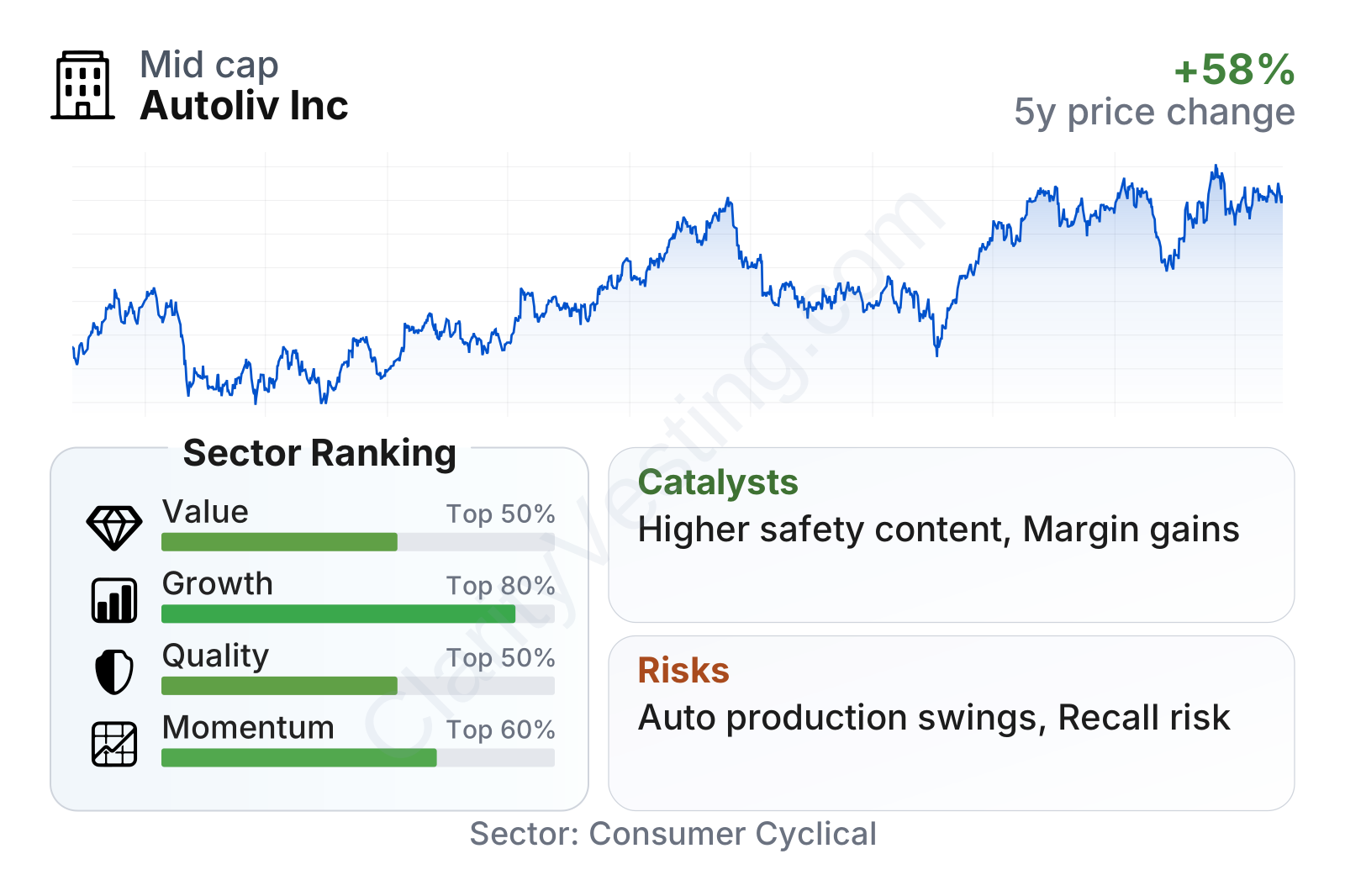
Autoliv sits in the mid-to-upper range of its sector on most broad measures rather than standing out in only one area. The quality profile is solid, supported by returns on invested capital above the sector median and manageable leverage relative to earnings. Growth is respectable rather than explosive, with stronger free cash flow improvement than revenue expansion. The valuation profile looks restrained, especially with an earnings multiple below the sector median, while market performance over the last few years has been clearly better than much of the broader auto parts group. That combination points to a company that has been improving operations without being priced like a high-growth name.
Growth
Autoliv operates in a part of the auto industry that has durable long-term demand. Every new vehicle needs core safety equipment, and regulatory pressure tends to move in one direction: toward more protection, more sensors, and stricter performance standards. That does not make the sector immune to cycles, but it does mean the company serves a category that remains essential regardless of whether consumers prefer gasoline, hybrid, or electric vehicles. Safety content per vehicle can also rise over time, which helps suppliers like Autoliv grow even when total vehicle production is not booming.
Its strategy for future growth is logical. Management has emphasized operational discipline, selective product innovation, and launching business that was already awarded by automakers. In practical terms, that means Autoliv does not need a dramatic industry shift to grow; it mainly needs to keep winning new vehicle programs, execute launches on time, and preserve margins. The company has also continued investing in research and development, which matters in a business where reliability, compliance, and engineering integration are critical to winning contracts.
Revenue growth has been uneven, which is normal for an automotive supplier, but the recent direction has turned positive again after a softer stretch in 2024. The latest year-over-year pace is modestly ahead of the sector median, indicating Autoliv is not just following the market but slightly outperforming it. Over a five-year view, revenue per share growth also compares well with peers, pointing to a business that has compounded steadily despite industry volatility.
Free cash flow is one of the more encouraging parts of the picture. After weakness earlier in the cycle, cash generation recovered sharply and has remained strong, with trailing twelve-month free cash flow near recent highs. That matters because it gives the company more flexibility to fund dividends, buybacks, debt service, and plant investments without depending heavily on outside financing. The company’s multi-year cash flow growth is far stronger than the typical peer in the sector.
One meaningful catalyst is the steady increase in safety requirements and content in vehicles globally. Another is the company’s position with major automakers on awarded programs that convert into production revenue over time. Recent company updates have also highlighted ongoing launch activity and margin-focused execution, which could support earnings growth even if industry vehicle production stays only moderate rather than strong.
Risks
The main risk is that Autoliv is still tied to global vehicle production, which is cyclical and influenced by consumer demand, interest rates, supply chain issues, and trade conditions. Even a well-run supplier can face lower volumes if automakers cut production schedules. That makes the business more sensitive to macroeconomic slowdowns than a typical software or service company.
A second risk is customer concentration and pricing pressure. Large automakers have significant bargaining power, and suppliers are often pushed to deliver cost reductions over time. Since safety products are essential but still manufactured at scale, execution on cost control is crucial. Input cost inflation, labor issues, logistics disruptions, or quality problems can quickly affect margins.
Balance sheet risk appears manageable but should still be watched. Debt to equity has usually stayed within a reasonable band, though it has at times run a bit above the sector median. The more reassuring measure is debt relative to EBIT, which is better than the sector median and suggests earnings coverage is acceptable. In other words, leverage is not a defining weakness, but it also does not leave the company entirely insulated if industry conditions worsen.
Profitability has improved meaningfully from the lower levels seen in 2022 and 2023. More recently, net margin has moved above the sector median, which indicates stronger execution and better recovery from inflation and supply chain stress. Still, this remains a manufacturing business with limited room for error. Margins are healthier than before, but they are not so high that setbacks would be easy to absorb.
Autoliv does have competitive advantages. It is one of the global leaders in automotive occupant safety, with long customer relationships, deep engineering expertise, a worldwide manufacturing footprint, and a high bar for quality certification. In safety-critical products, automakers do not switch suppliers casually because reliability, regulation, and platform integration matter as much as price. That creates a barrier to entry and gives established players staying power.
The main competitors include Joyson Safety Systems, ZF in certain restraint and safety categories, and other auto suppliers with overlapping components or electronics capabilities. Autoliv is generally viewed as one of the leaders in passive safety, especially airbags and seatbelts, where scale and technical know-how are hard to replicate. Compared with many broader auto parts companies, it is more specialized and more directly exposed to safety content growth, although that specialization also concentrates its exposure to one segment of the vehicle bill of materials.
As for recent issues to watch, the most important ones are operational rather than reputational: shifts in global light vehicle production, tariffs and regional trade friction, launch execution, and the possibility that automakers push harder on pricing in a slower demand environment. No major public scandal or governance event stands out as the central current concern; the bigger question is whether improved profitability can hold through a less favorable production cycle.
Valuation
Autoliv’s valuation looks restrained relative to both its own recent history and the broader sector. The current earnings multiple is around the low teens, clearly below the sector median, while the PEG ratio is below 1. That usually suggests the market is not assigning a premium to the company’s growth and margin progress. At the same time, the stock is no longer at the depressed levels seen in earlier years, so the discount is smaller than it once was.
The longer-term pattern shows that the market has often valued Autoliv at a higher earnings multiple than it receives today. More recently, the P/E has stayed consistently below the sector median, even as profitability and cash flow improved. That points to investor caution about the cyclicality of auto production rather than a lack of operating progress. In effect, the market seems to be recognizing the company’s better execution but still limiting the multiple because this is an economically sensitive industrial supplier.
Whether the current price is justified depends largely on how durable the recent margin and cash flow improvement proves to be. If operating performance remains near current levels, the valuation appears undemanding for a market leader with solid returns on capital. If vehicle production weakens or customer pricing pressure intensifies, the modest multiple makes more sense. Overall, the current valuation reflects a business with credible strengths that still carries cyclical baggage.
Conclusion
Autoliv stands out as a focused global leader in an essential part of the automotive value chain. It sells products that are not optional for automakers, operates with meaningful scale, and has shown real progress in profitability, returns on capital, and cash generation. Recent years suggest a company that has come out of a difficult industry period in better shape, with stronger margins and more resilient cash flow than many might expect from an auto supplier.
The challenge is that Autoliv cannot escape the vehicle production cycle, customer bargaining power, and the operational demands of high-volume manufacturing. Those risks are real, and they help explain why the market still values the company conservatively. Even so, the combination of leadership in passive safety, improving financial quality, and a valuation that remains below sector norms gives the company a more constructive profile than a typical cyclical parts supplier. The overall picture is of a disciplined industrial business with genuine competitive depth, where the key debate is less about business relevance and more about how much cyclicality should weigh on the shares.
Sources:
- Autoliv, Inc. — Annual Report 2025
- Autoliv, Inc. — Quarterly Report on Form 10-Q for the quarter ended March 31, 2026
- Autoliv, Inc. — SEC filings available through EDGAR
- Autoliv Investor Relations — press releases and presentation materials
- Autoliv, Inc. — company-hosted earnings materials
- Wikipedia — Autoliv
This article is for informational purposes only and does not constitute financial advice. Some content is AI-generated. See Disclaimer