Stock Analysis · Prosus (PROSF)
Overview
Prosus is a global consumer internet group built around online platforms. The company owns, operates, and invests in digital businesses that serve everyday needs such as food delivery, online shopping, payments, classifieds, education technology, and travel. For many people, Prosus is best understood as a holding company with a mix of mature digital assets, fast-growing businesses, and a very large stake in Tencent, the Chinese technology giant.
Its economic value comes from two broad buckets: the profits and cash generation of the operating businesses it controls, and the value of its investment portfolio, especially Tencent. That structure is important because Prosus is not a single-product company. Its performance can be helped by growth in food delivery or fintech, but it can also be heavily influenced by changes in the market value and earnings contribution of Tencent.
Based on recent annual reporting, Prosus generates revenue mainly from its consolidated operating segments, while earnings and asset value are also materially influenced by equity-accounted investments. At a high level, the main business exposure can be described as follows:
- Food Delivery – the largest operating revenue source, led by iFood and other platforms; roughly around half of consolidated revenue.
- Classifieds – online marketplaces for cars, real estate, and general listings; a meaningful second pillar, often around a mid-teens to 20%-plus share.
- Payments and Fintech – digital payments, credit, and related services; generally a low-teens share and growing quickly.
- E-commerce and Other Ventures – includes areas such as etail, edtech, and travel; smaller individually, but collectively relevant.
- Tencent investment – not the main source of reported consolidated revenue, but still one of the biggest drivers of net asset value, profit contribution, and market perception.
What stands out is the mix: Prosus has direct exposure to digital consumer services across emerging and developed markets, while also retaining a large indirect exposure to one of the world’s largest internet ecosystems through Tencent.
The long-term pattern shows a business that has expanded revenue meaningfully over the past few years, with gross profit also rising. At the same time, operating profit has become much more uneven, which reflects the complexity of a group that combines operating subsidiaries, investment gains, and shifting expense levels across multiple geographies.
Key Figures
| Metric | Value | Sector ⓘ |
|---|---|---|
| Date | Sep 12, 2026 | |
| Context | ||
| Sector | Consumer Cyclical | |
| Industry | Internet Retail | |
| Market Cap ⓘ | $89.33B | |
| Beta ⓘ | 0.78 | |
Value (Cheapness) | ||
| P/E Ratio ⓘ | 8.16 | 17.10 |
| FCF Yield ⓘ | 3.78% | 8.53% |
| EBIT / EV ⓘ | 12.06% | 6.46% |
| PEG ⓘ | 1.66 | |
Growth (Business expansion) | ||
| Revenue Growth ⓘ | 22.30% | 5.75% |
| RPS Growth (5Y CAGR) ⓘ | 62.80% | 9.14% |
| EPS Growth (5Y CAGR) ⓘ | 21.99% | -18.21% |
| Margin Growth (5Y Trend) ⓘ | -183.38% | -0.23% |
| FCF Growth (5Y CAGR) ⓘ | N/A | 4.91% |
Quality (Business durability) | ||
| ROIC (Latest) ⓘ | 15.09% | 12.61% |
| ROIC (5Y Median) ⓘ | 8.06% | 10.72% |
| Net Debt / EBIT (Latest) ⓘ | 1.03 | 2.10 |
| Net Debt / EBIT (5Y Median) ⓘ | 1.43 | 2.32 |
| Operating Margin (Latest) ⓘ | 66.55% | 9.25% |
| Operating Margin (5Y Median) ⓘ | 89.09% | 9.64% |
| Debt to Equity (Latest) ⓘ | 32.71% | 75.78% |
| Profit Margin (Latest) ⓘ | 119.92% | 5.33% |
| Free Cash Flow (Latest) ⓘ | $3.38B | |
Momentum (Price trend) | ||
| 3Y Return ⓘ | -38.01% | +14.53% |
| 12M Return (excl. last month) ⓘ | -20.99% | +3.08% |
| 6M Return ⓘ | -18.59% | +0.55% |
| Price vs. 200-Day MA ⓘ | -15.50% | -0.54% |
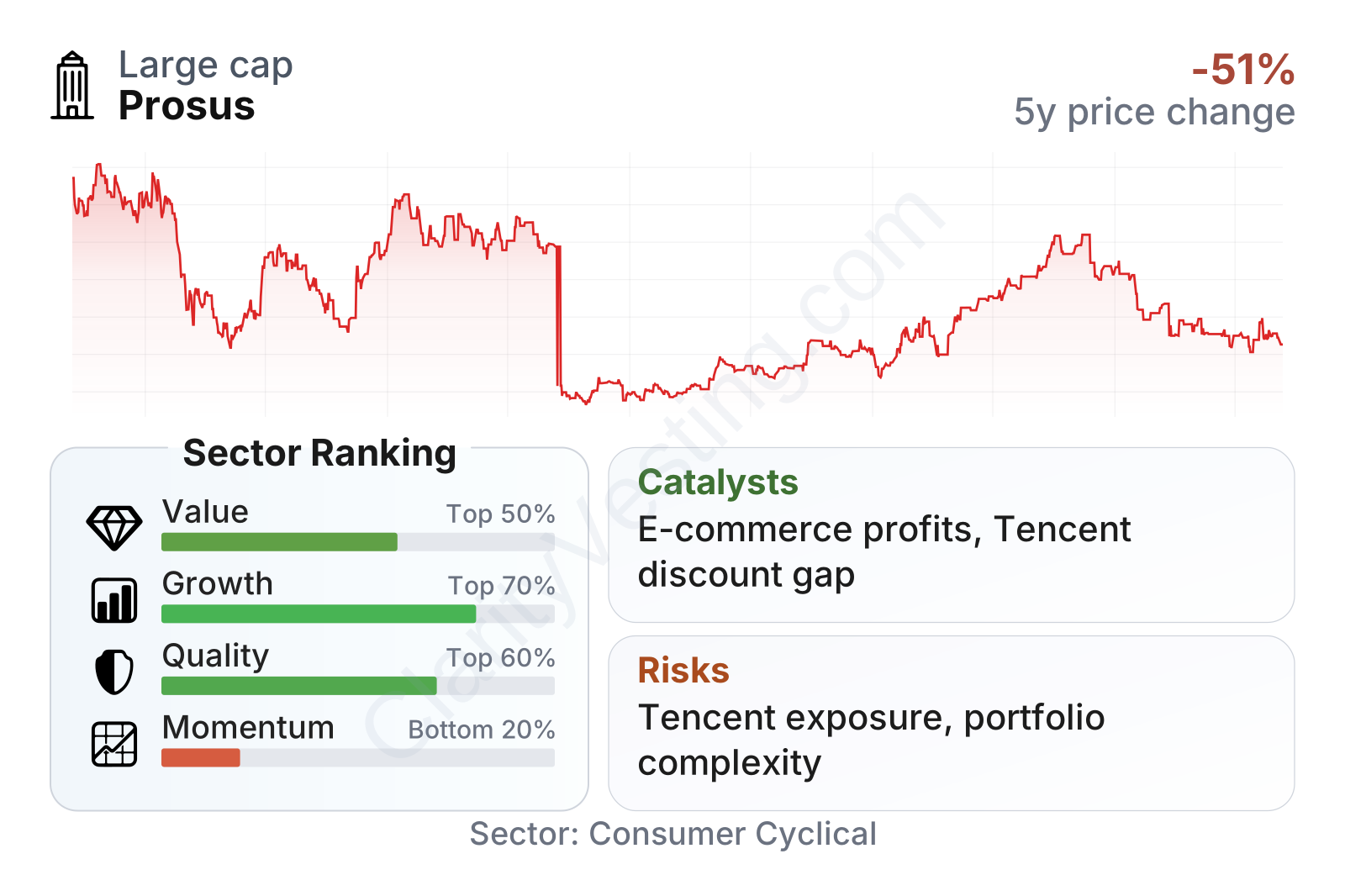
Prosus is a very large company, with a market value close to $100 billion, and its share price has generally moved with less volatility than many internet stocks. The overall profile is mixed but interesting: growth ranks strongly against the sector, quality is above average, value looks favorable on earnings multiples, while recent market momentum has been weak. In simple terms, the business has been producing solid underlying expansion, but the stock has not consistently reflected that progress.
The valuation metrics suggest a lower earnings multiple than the sector median, while operating profitability and returns on invested capital compare reasonably well. Balance sheet leverage also looks restrained relative to many peers. The weaker points are free cash flow yield versus the sector and the share-price trend over the last several years, which suggests that the market still applies a discount for complexity, exposure to investments, and execution risk.
Growth
Prosus operates in digital categories that still have room to expand over the long run. Food delivery, digital payments, online classifieds, and e-commerce are all tied to habits that continue to move online. In many of the regions where Prosus operates, internet adoption, digital payments penetration, and convenience-based consumption still have runway. That gives the company exposure to sectors that are not only large, but still evolving.
The strategy also makes sense in broad terms. Prosus has been simplifying its portfolio, focusing more on businesses where it has operational control and clearer paths to profitability. That matters because investors have often viewed the company as mainly a vehicle for its Tencent stake. The more Prosus can prove that its own operating companies can grow revenue and turn that growth into cash, the stronger its independent investment case becomes.
Recent growth has been strong by sector standards. Revenue growth running in the low-to-mid 20% range is well above the sector median, and the longer-term revenue-per-share trend has also been unusually robust. That indicates real expansion rather than a business simply standing still while waiting for portfolio value to rise elsewhere.
Cash generation is another useful sign. Free cash flow has turned positive on a meaningful scale, and the multi-year trend points to a sharp improvement. For a company with several formerly investment-heavy internet businesses, that shift is important: it suggests some of the portfolio is moving from “growth at a cost” toward self-funded growth.
One of the clearest catalysts is the company’s continued effort to close the gap between its market value and the value of its assets. Prosus has used share repurchase structures tied to its Tencent holdings, and it has continued to recycle capital from mature assets into areas where management sees better long-term returns. Another opportunity is margin improvement in food delivery and fintech, where scale can make economics stronger over time if customer retention stays solid.
Recent company updates have also highlighted continued progress in e-commerce profitability and cost discipline. That does not remove uncertainty, but it does support the idea that Prosus is becoming less dependent on a single asset and more anchored in operating performance.
Risks
This article is for informational purposes only and does not constitute financial advice. Some content is AI-generated. See Disclaimer


