Stock Analysis · Progress Software Corporation (PRGS)
Overview
Progress Software Corporation is an infrastructure software company that sells tools businesses use to build, run, secure, and manage applications. Its products are usually not consumer-facing brands. Instead, they sit behind the scenes inside enterprises, helping customers with application development, data connectivity, file transfer, network monitoring, digital experience, and IT automation.
The business model is built around selling software subscriptions, maintenance, and related services to organizations that need reliable software for core operations. Progress has grown both by developing products internally and by acquiring software businesses that fit its portfolio. That acquisition-led approach has made the company broader and larger over time, while also increasing its dependence on successful integration and debt management.
Based on company filings, Progress reports revenue in two broad categories: software licenses, maintenance and subscriptions; and services. The first category is by far the largest and includes the recurring maintenance and subscription streams that usually make this type of software business more predictable. Services are a much smaller contributor and mainly support implementation, consulting, and training.
An accessible way to think about Progress is as a collection of specialized software products sold to business customers, with most of the money coming from recurring relationships rather than one-time transactions.
- Software licenses, maintenance and subscriptions: roughly 85% to 90% of revenue in recent years, and the core earnings engine.
- Services: roughly 10% to 15% of revenue, a smaller support activity tied to customer deployments and professional assistance.
Within the software category, recurring maintenance and subscription revenue appears to represent the largest share, while perpetual licenses and other transactional software sales are smaller than they once were as the industry shifts toward recurring models.
The operating profile shows a classic software pattern: high gross profit, meaningful spending on research and development, and solid operating income generation. Revenue has expanded materially over the last several years, but interest expense has also climbed, reflecting the heavier use of debt alongside acquisitions.
Key Figures
| Metric | Value | Sector ⓘ |
|---|---|---|
| Date | Sep 12, 2026 | |
| Context | ||
| Sector | Technology | |
| Industry | Software - Infrastructure | |
| Market Cap ⓘ | $1.64B | |
| Beta ⓘ | 0.82 | |
Value (Cheapness) | ||
| P/E Ratio ⓘ | 19.66 | 29.51 |
| FCF Yield ⓘ | 18.64% | 4.25% |
| EBIT / EV ⓘ | 5.55% | 2.85% |
| PEG ⓘ | 1.29 | |
Growth (Business expansion) | ||
| Revenue Growth ⓘ | 6.80% | 15.40% |
| RPS Growth (5Y CAGR) ⓘ | 16.87% | 8.56% |
| EPS Growth (5Y CAGR) ⓘ | -9.67% | -11.88% |
| Margin Growth (5Y Trend) ⓘ | -6.16% | 0.46% |
| FCF Growth (5Y CAGR) ⓘ | 7.18% | 9.80% |
Quality (Business durability) | ||
| ROIC (Latest) ⓘ | 7.31% | 9.44% |
| ROIC (5Y Median) ⓘ | 8.87% | 8.30% |
| Net Debt / EBIT (Latest) ⓘ | 7.63 | 0.54 |
| Net Debt / EBIT (5Y Median) ⓘ | 4.96 | 0.44 |
| Operating Margin (Latest) ⓘ | 15.97% | 9.58% |
| Operating Margin (5Y Median) ⓘ | 16.76% | 8.25% |
| Debt to Equity (Latest) ⓘ | 262.16% | 33.33% |
| Profit Margin (Latest) ⓘ | 8.87% | 7.14% |
| Free Cash Flow (Latest) ⓘ | $305.22M | |
Momentum (Price trend) | ||
| 3Y Return ⓘ | -30.38% | +45.48% |
| 12M Return (excl. last month) ⓘ | -1.67% | +23.48% |
| 6M Return ⓘ | +11.85% | +20.93% |
| Price vs. 200-Day MA ⓘ | +7.88% | +7.43% |
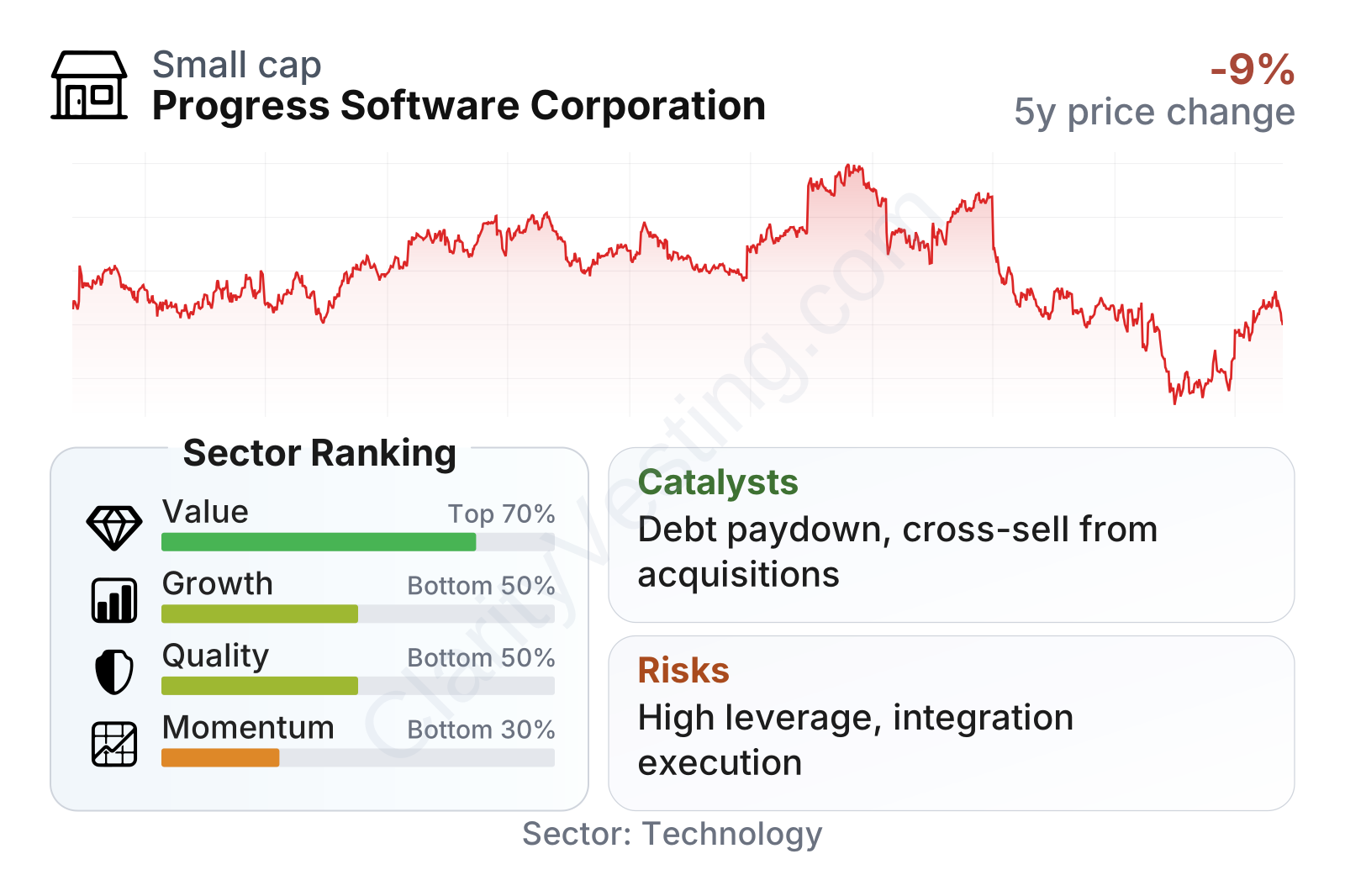
At a high level, Progress stands out for cash generation and a valuation that looks lower than much of the software infrastructure group. The company ranks well on value measures, and free cash flow generation is especially strong relative to its market size. Growth is more mixed: recent yearly expansion is positive but not especially fast for software, while longer-term revenue growth has been much better. Quality is held back by leverage rather than weak margins, because profitability remains healthy. Share price momentum has been poor, which helps explain why valuation multiples have compressed.
The market capitalization is around $1.6 billion, making Progress a mid-sized software company rather than an industry giant. Its beta below 1 suggests the stock has historically moved somewhat less aggressively than the broader market, although company-specific events can still create sharp swings.
Growth
Progress operates in a sector that still benefits from long-term demand for enterprise software, cloud modernization, application development, cybersecurity, and IT automation. Those are durable themes because companies continue to replace legacy systems, connect more data sources, protect digital workflows, and automate internal operations. Progress is not the fastest-growing company in these markets, but it does not need to be if it can keep combining recurring revenue, disciplined acquisitions, and high cash conversion.
The company’s strategy is straightforward: own established software products with sticky customer bases, expand them with cross-selling, and use acquisitions to add adjacent capabilities. This can make sense for long-term growth because many enterprise customers prefer dependable tools embedded in daily workflows, even if those tools are not the newest names in software. The approach is less about chasing hype and more about assembling durable revenue streams.
Revenue growth has been uneven from quarter to quarter, which is common when acquisitions play a major role. There were periods of very strong expansion, then slower patches, and more recently growth in the mid-single digits. That is below the sector median today, but the five-year picture is better than the headline slowdown suggests, as revenue per share has compounded at a healthy pace.
Cash generation is one of the strongest parts of the Progress profile. Free cash flow has moved higher over time and recently accelerated, reaching well above the level seen a few years ago. For a software company, this matters because cash can be used to reduce debt, fund product development, support acquisitions, and return capital to shareholders without depending heavily on outside financing.
A notable catalyst in the current setup is Progress’s ability to digest past acquisitions and convert them into higher recurring revenue and cash flow. If management continues to improve product mix, customer retention, and cross-selling across the portfolio, growth may look steadier than it has in the past. Recent company communications have also emphasized AI-related enhancements and product innovation across parts of the portfolio. For Progress, AI is more likely to be a product feature and efficiency tool than a transformational standalone business, but it can still support customer retention and pricing over time.
Another meaningful opportunity comes from the company’s focus on mission-critical business software. When a product helps run core applications, secure file transfers, or monitor networks, customers tend to be slower to switch vendors. That gives Progress more room to keep monetizing mature products while adding adjacent offerings.
Risks
This article is for informational purposes only and does not constitute financial advice. Some content is AI-generated. See Disclaimer


