Stock Analysis · Prada S.p.A (PRDSF)
Overview
Prada S.p.A. is an Italian luxury group best known for Prada and Miu Miu, but it also owns Church’s, Car Shoe, Marchesi 1824, and Luna Rossa. The company designs, produces, and sells luxury goods including leather handbags, ready-to-wear apparel, footwear, and accessories. Its business model is centered on brand control, direct distribution, and premium positioning, which is typical of the highest-end part of the luxury market.
The group’s revenue is mainly driven by retail sales through directly operated stores and e-commerce, with a smaller contribution from wholesale and royalties. Based on recent annual disclosures, the revenue mix is approximately:
- Retail sales: about 89% to 90% — sales through Prada-operated boutiques, concessions, and digital channels. This is the core of the business and the main source of pricing power and brand presentation.
- Wholesale sales: about 9% to 10% — sales to department stores, specialty retailers, and selected partners.
- Royalties and other revenue: about 1% — mainly licensing-related income and smaller ancillary activities.
By brand, Prada remains the largest contributor, while Miu Miu has become an increasingly important growth engine. Public disclosures indicate Prada typically represents roughly 68% to 70% of retail sales, Miu Miu about 29% to 31%, and the rest comes from the smaller brands. By product category, leather goods and ready-to-wear are the largest segments, with footwear and accessories also contributing meaningfully. Geographically, Asia Pacific and Europe are the most important regions, followed by the Americas, Japan, and the Middle East.
The operating profile has strengthened noticeably over the last several years. Revenue has expanded from roughly €3.4 billion in 2021 to about €5.5 billion in 2025, while net income and operating profit have also risen sharply over that period. That indicates that growth has not relied only on store expansion, but also on stronger brand demand and healthy margins.
The long-term pattern is favorable: revenue and gross profit have climbed materially since 2021, while operating income and net income increased even faster. That usually points to better scale, stronger full-price selling, and tighter cost discipline, although 2025 shows a flatter profit trend than the sharp rise seen in earlier years.
Key Figures
| Metric | Value | Sector ⓘ |
|---|---|---|
| Date | Sep 12, 2026 | |
| Context | ||
| Sector | Consumer Cyclical | |
| Industry | Luxury Goods | |
| Market Cap ⓘ | $12.69B | |
| Beta ⓘ | 0.82 | |
Value (Cheapness) | ||
| P/E Ratio ⓘ | 13.47 | 17.10 |
| FCF Yield ⓘ | 13.58% | 8.53% |
| EBIT / EV ⓘ | N/A | 6.46% |
| PEG ⓘ | 2.13 | |
Growth (Business expansion) | ||
| Revenue Growth ⓘ | 11.20% | 5.75% |
| RPS Growth (5Y CAGR) ⓘ | 13.06% | 9.14% |
| EPS Growth (5Y CAGR) ⓘ | -3.66% | -18.21% |
| Margin Growth (5Y Trend) ⓘ | 8.60% | -0.23% |
| FCF Growth (5Y CAGR) ⓘ | 2.09% | 4.91% |
Quality (Business durability) | ||
| ROIC (Latest) ⓘ | N/A | 12.61% |
| ROIC (5Y Median) ⓘ | 15.16% | 10.72% |
| Net Debt / EBIT (Latest) ⓘ | 1.75 | 2.10 |
| Net Debt / EBIT (5Y Median) ⓘ | 2.33 | 2.32 |
| Operating Margin (Latest) ⓘ | 21.43% | 9.25% |
| Operating Margin (5Y Median) ⓘ | 22.45% | 9.64% |
| Debt to Equity (Latest) ⓘ | 105.30% | 75.78% |
| Profit Margin (Latest) ⓘ | 13.16% | 5.33% |
| Free Cash Flow (Latest) ⓘ | $1.72B | |
Momentum (Price trend) | ||
| 3Y Return ⓘ | -11.24% | +14.53% |
| 12M Return (excl. last month) ⓘ | +6.55% | +3.08% |
| 6M Return ⓘ | +1.99% | +0.55% |
| Price vs. 200-Day MA ⓘ | -4.96% | -0.54% |
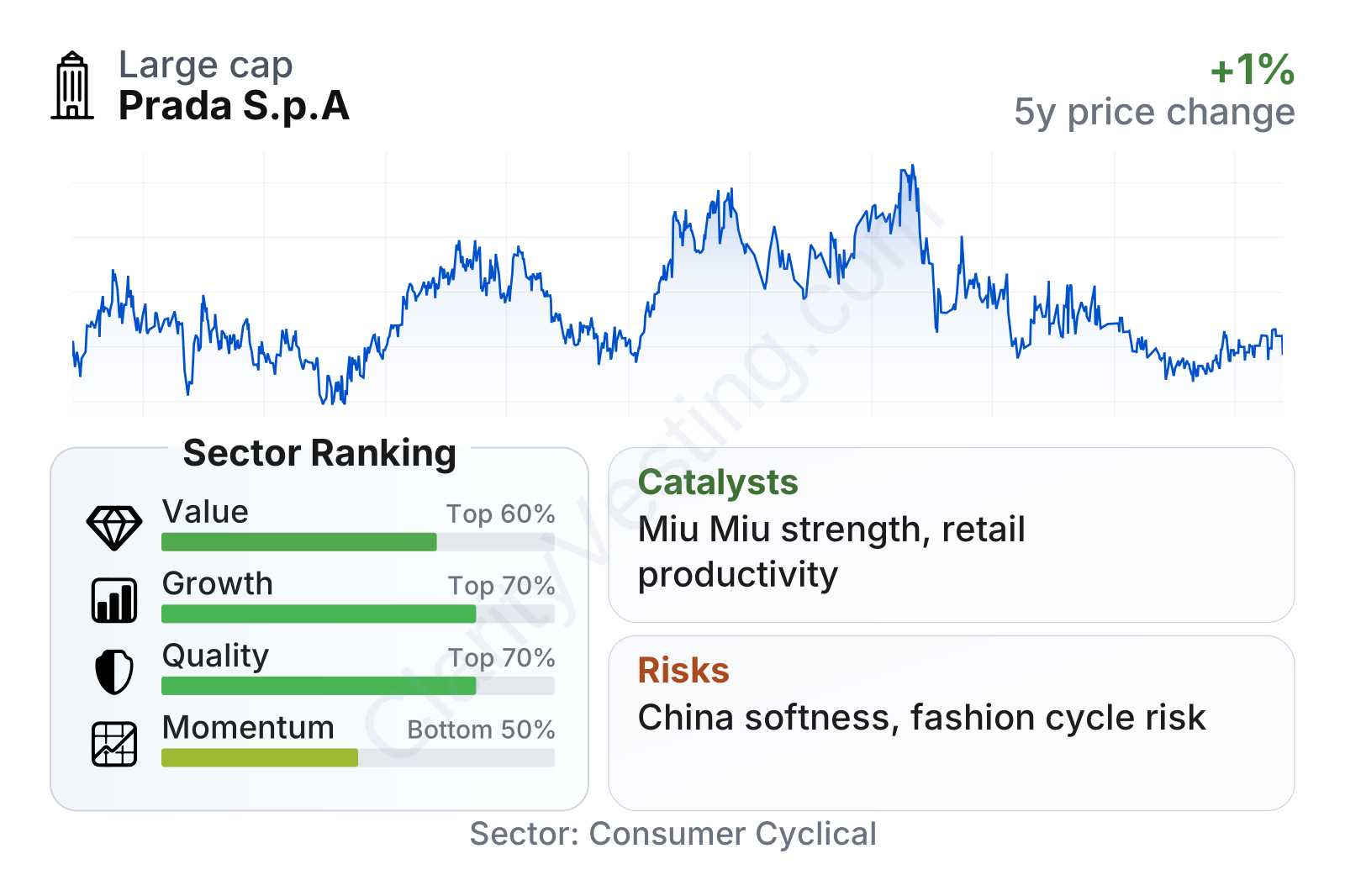
Prada stands out for profitability and cash generation more than for recent stock momentum. Margins are well above the sector median, free cash flow yield looks comparatively strong, and leverage against EBIT appears manageable. Growth metrics are mixed but generally solid, with revenue trends stronger than the sector even if cash flow growth has been less consistent. The weakest area is momentum: the share price has lagged much of the broader consumer discretionary group over the last one to three years.
In size terms, Prada is a large global luxury company, but still much smaller than the sector’s biggest conglomerates. Its beta below 1 suggests the stock has historically moved somewhat less aggressively than the broader market, although luxury names can still be volatile when consumer demand softens.
Growth
The luxury goods sector remains structurally attractive for long-term analysis because it is supported by global wealth creation, brand-driven pricing power, and high barriers to entry. Demand is not linear, and cyclical slowdowns can be sharp, but the strongest luxury houses often emerge with greater market share because consumers tend to concentrate spending on the most desirable labels.
Prada’s strategy appears coherent with that backdrop. The company continues to focus on direct retail, tighter control of distribution, selective store development, digital execution, and brand elevation. This matters because luxury growth is not only about selling more units; it is often about protecting exclusivity while increasing average selling prices and mix. Prada has executed that balancing act well in recent years, especially through the renewed strength of Miu Miu and the steadier positioning of the Prada brand.
Recent growth has been clearly better than the sector median on a year-over-year basis, and the five-year revenue-per-share trend is also ahead of many peers. Even more important, operating margin trends over the last five years have improved instead of deteriorating, which suggests the company has been growing without sacrificing business quality.
Cash generation adds another supportive element. Trailing free cash flow is strong in absolute terms and free cash flow yield compares favorably with the sector median. That gives the company room to fund store investments, marketing, manufacturing capabilities, and shareholder distributions without looking financially stretched.
A meaningful catalyst is the exceptional traction of Miu Miu, which has become one of the hottest brands in global luxury. Strong demand in this label can lift group growth faster than the mature core Prada brand alone would likely achieve. Another catalyst is continued penetration in Asia and travel retail normalization, areas where top luxury groups usually benefit when tourism and premium spending recover together.
Recent company communications have also highlighted ongoing investment in retail productivity and brand visibility rather than aggressive discount-led expansion. For a luxury company, that is usually a healthier sign than chasing volume at the expense of exclusivity.
Risks
This article is for informational purposes only and does not constitute financial advice. Some content is AI-generated. See Disclaimer


