Stock Analysis · Piraeus Bank S.A (PRBKY)
Overview
Piraeus Bank S.A. is one of the largest banking groups in Greece. It provides everyday banking services to households, small businesses, corporations, and public-sector clients. Its activities include taking deposits, making loans, payment services, cards, savings products, insurance distribution, asset management, and selected capital markets services. For U.S. readers, PRBKY represents the bank through an over-the-counter listing, while the core business remains centered in Greece.
Like most commercial banks, Piraeus generates revenue mainly from the spread between what it earns on loans and what it pays on deposits and other funding. Based on recent annual reporting, its revenue mix is still dominated by net interest income, with fees acting as the second pillar.
- Net interest income: about 75% to 80% of total core operating income. This is the income earned from mortgages, business loans, consumer lending, and other interest-bearing assets after funding costs.
- Net fee and commission income: about 15% to 20%. This includes payments, cards, asset management, bancassurance distribution, lending-related fees, and transaction services.
- Other income: about 5% to 10%. This can include trading and investment results, treasury activity, and other banking-related items that tend to be less predictable.
The business profile is relatively straightforward: a domestic bank with scale in Greece, a broad retail and corporate customer base, and a balance sheet that has been materially cleaned up compared with the crisis era. The recent earnings pattern also shows that revenue expanded from 2022 through 2024 before easing slightly in 2025, while profits stayed strong. A notable positive sign is that administrative costs rose much more slowly than revenue over that period, pointing to improved operating efficiency.
The multi-year flow between revenue, funding cost, overhead, and net income suggests a bank that has stabilized after restructuring. Revenue improved strongly through 2024, interest expense became less burdensome in 2025, and profit remained above the 2022 level despite a modest revenue pullback.
Key Figures
| Metric | Value | Sector ⓘ |
|---|---|---|
| Date | Nov 16, 2026 | |
| Context | ||
| Sector | Financial Services | |
| Industry | Banks - Regional | |
| Market Cap ⓘ | $13.51B | |
| Beta ⓘ | 0.90 | |
Value (Cheapness) | ||
| P/E Ratio ⓘ | 10.75 | 12.38 |
| P/B Ratio ⓘ | N/A | 1.54 |
| FCF Yield ⓘ | 20.79% | 8.67% |
| Dividend Yield ⓘ | 4.21% | 2.93% |
| EBIT / EV ⓘ | N/A | 8.26% |
| PEG ⓘ | N/A | |
Growth (Business expansion) | ||
| Revenue Growth ⓘ | 9.20% | 6.90% |
| RPS Growth (5Y CAGR) ⓘ | 6.03% | 12.30% |
| EPS Growth (5Y CAGR) ⓘ | N/A | -0.80% |
| BVPS Growth (5Y CAGR) ⓘ | 12.82% | 4.87% |
| Margin Growth (5Y Trend) ⓘ | N/A | -4.00% |
| FCF Growth (5Y CAGR) ⓘ | N/A | 4.68% |
| DPS Growth (5Y CAGR) ⓘ | N/A | 8.77% |
Quality (Business durability) | ||
| ROIC (Latest) ⓘ | N/A | 9.63% |
| ROE (Latest) ⓘ | 12.73% | 14.03% |
| ROA (Latest) ⓘ | 1.26% | 1.57% |
| ROIC (5Y Median) ⓘ | N/A | 7.80% |
| ROE (5Y Median) ⓘ | 12.31% | 12.05% |
| ROA (5Y Median) ⓘ | 1.25% | 1.28% |
| Net Debt / EBIT (Latest) ⓘ | N/A | 0.94 |
| Net Debt / EBIT (5Y Median) ⓘ | N/A | 0.73 |
| Net Debt / EBITDA (Latest) ⓘ | N/A | 0.75 |
| Operating Margin (Latest) ⓘ | N/A | 23.37% |
| Operating Margin (5Y Median) ⓘ | N/A | 24.30% |
| Debt to Equity (Latest) ⓘ | N/A | 58.72% |
| Profit Margin (Latest) ⓘ | 42.47% | 26.56% |
| Free Cash Flow (Latest) ⓘ | $2.81B | |
Momentum (Price trend) | ||
| 3Y Return ⓘ | +11.78% | +85.78% |
| 12M Return (excl. last month) ⓘ | N/A | +14.89% |
| 6M Return ⓘ | +6.51% | +8.17% |
| Price vs. 200-Day MA ⓘ | N/A | +5.53% |
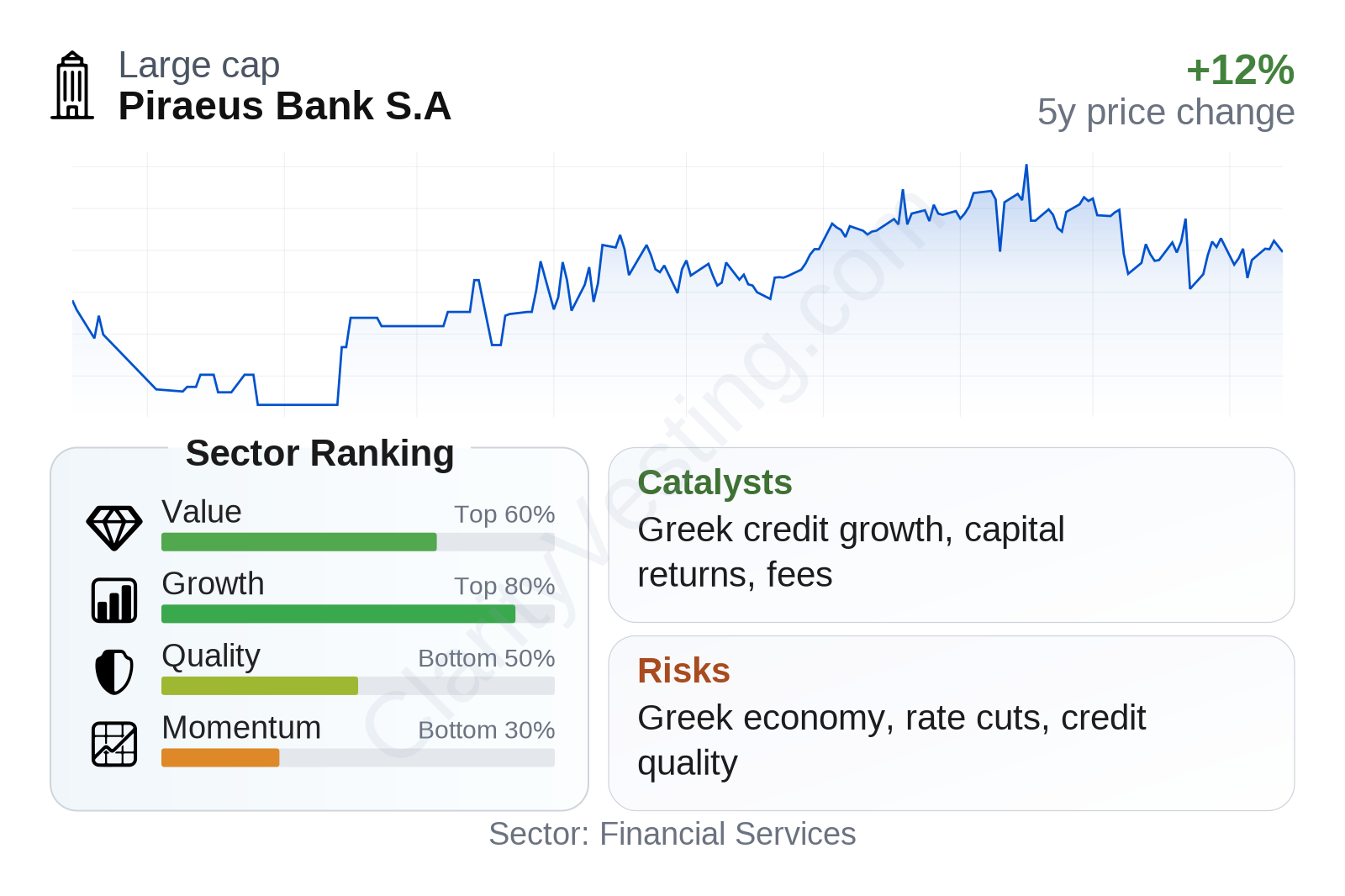
Piraeus sits in the mid-range on valuation relative to regional banking peers, with a price-to-earnings ratio below the sector median and a dividend yield above it. Free cash flow yield also screens unusually strong, although that metric can be less intuitive for banks than for industrial companies. Growth indicators are more favorable: recent revenue growth is ahead of the sector median, and book value per share has compounded at a notably faster pace than peers over five years. Profitability is mixed. The profit margin stands well above the sector median, but return on equity and return on assets are a little lower than median levels, which helps explain why the quality ranking is not stronger. Market performance has also been less impressive than many sector peers over the last few years, even though the stock moved higher during 2026.
Growth
Piraeus operates in a sector that is mature rather than fast-growing, but the Greek banking market still offers room for earnings normalization, credit expansion, and fee growth after a long restructuring cycle. That is an important distinction. This is not a high-growth technology business; its growth case depends more on improved banking penetration, healthier loan demand, digital efficiency, and a better quality balance sheet than on disruptive expansion.
The strategy appears coherent for that backdrop. Management has emphasized stronger capital generation, better asset quality, digital channels, cross-selling of fee-based products, and disciplined cost control. For a bank coming out of a difficult decade, these matter more than headline branch expansion. If loan growth in Greece remains healthy and interest rates do not fall too sharply, Piraeus has a reasonable path to maintaining solid earnings while continuing to build capital.
A useful sign of underlying progress is the steady rise in book value per share. For banks, book value is an important anchor because it reflects the net value of the balance sheet after liabilities. Piraeus has increased this measure meaningfully in recent years, which supports the view that earnings are not only accounting profits but are also adding to shareholder equity over time.
The upward trend here is stronger than the sector median over five years, which points to real balance-sheet rebuilding rather than a temporary earnings spike. That matters because long-term bank performance often depends on whether profits translate into durable capital growth.
Another catalyst is the operating environment in Greece itself. The country has seen better economic momentum, ongoing investment tied to European funding programs, and gradually improving credit conditions. That can support demand for corporate lending, project finance, mortgages, and payment services. In addition, the bank’s fee base has room to expand from cards, asset management, and insurance distribution as customer activity normalizes further.
Recent company communications have also highlighted continued capital strength, shareholder distributions, and a focus on returns. For the market, that combination can be meaningful because it signals that Piraeus is being evaluated less as a turnaround institution and more as a normalized bank with recurring earnings capacity.
Risks
This article is for informational purposes only and does not constitute financial advice. Some content is AI-generated. See Disclaimer