Stock Analysis · Kering SA (PPRUF)
Overview
Kering is a French luxury group that owns a portfolio of well-known fashion and jewelry houses. Its business is centered on designing, producing, marketing, and distributing high-end goods through directly operated stores, e-commerce, and selected wholesale partners. The group’s best-known brand is Gucci, but it also owns Yves Saint Laurent, Bottega Veneta, Balenciaga, Alexander McQueen, Brioni, Boucheron, Pomellato, Qeelin, and Kering Eyewear.
Its revenue base is still heavily tied to fashion and leather goods, with Gucci remaining the largest contributor by a wide margin. Based on recent annual disclosures, the business mix can be summarized approximately as follows:
- Gucci: roughly mid-40% of total revenue
- Yves Saint Laurent: around 15% to 20%
- Bottega Veneta: around 10% to 15%
- Other Houses: around 15% to 20%, including Balenciaga, Alexander McQueen, Brioni, and jewelry brands
- Kering Eyewear and Corporate: high-single-digit share, with eyewear becoming a more meaningful growth engine
Geographically, Kering is broadly diversified across Asia-Pacific, Western Europe, North America, and Japan, but demand from Chinese consumers remains especially important to the luxury sector as a whole, whether purchases happen in China or abroad. That gives the company global reach, but also makes results sensitive to consumer confidence, travel patterns, and regional slowdowns.
One useful way to think about Kering is as a collection of luxury brands with very high gross margins, where brand heat and execution matter more than volume. That creates strong upside when a house is culturally relevant and product strategy is working, but it can also lead to sharp setbacks when a major brand loses momentum. Recent years illustrate that clearly: revenue and operating profit peaked earlier in the cycle and then fell meaningfully, showing how dependent the group remains on restoring brand strength, especially at Gucci.
The long-term structure is still attractive because Kering keeps a large share of sales after production costs, but the recent trend is weaker: revenue has fallen from the 2022 peak, operating profit has compressed sharply, and net income has dropped much faster than sales. That suggests the current challenge is not just softer demand, but also a less favorable cost base and higher financial pressure.
Key Figures
| Metric | Value | Sector ⓘ |
|---|---|---|
| Date | Jul 18, 2026 | |
| Context | ||
| Sector | Consumer Cyclical | |
| Industry | Luxury Goods | |
| Market Cap ⓘ | $35.70B | |
| Beta ⓘ | 0.98 | |
Value (Cheapness) | ||
| P/E Ratio ⓘ | N/A | 18.58 |
| FCF Yield ⓘ | 9.37% | 7.99% |
| EBIT / EV ⓘ | N/A | 5.91% |
| PEG ⓘ | 1.16 | |
Growth (Business expansion) | ||
| Revenue Growth ⓘ | -15.90% | 5.50% |
| RPS Growth (5Y CAGR) ⓘ | -4.01% | 9.20% |
| EPS Growth (5Y CAGR) ⓘ | -10.63% | -26.43% |
| Margin Growth (5Y Trend) ⓘ | -21.10% | -0.18% |
| FCF Growth (5Y CAGR) ⓘ | -12.89% | 5.02% |
Quality (Business durability) | ||
| ROIC (Latest) ⓘ | 9.42% | 12.03% |
| ROIC (5Y Median) ⓘ | 13.30% | 10.82% |
| Net Debt / EBIT (Latest) ⓘ | 3.93 | 2.12 |
| Net Debt / EBIT (5Y Median) ⓘ | 3.90 | 2.25 |
| Operating Margin (Latest) ⓘ | 11.39% | 9.28% |
| Operating Margin (5Y Median) ⓘ | 24.26% | 9.64% |
| Debt to Equity (Latest) ⓘ | 126.23% | 75.23% |
| Profit Margin (Latest) ⓘ | 0.49% | 5.28% |
| Free Cash Flow (Latest) ⓘ | $3.35B | |
Momentum (Price trend) | ||
| 3Y Return ⓘ | -40.80% | +10.68% |
| 12M Return (excl. last month) ⓘ | +39.82% | +5.26% |
| 6M Return ⓘ | -14.97% | -2.41% |
| Price vs. 200-Day MA ⓘ | -8.03% | +1.55% |
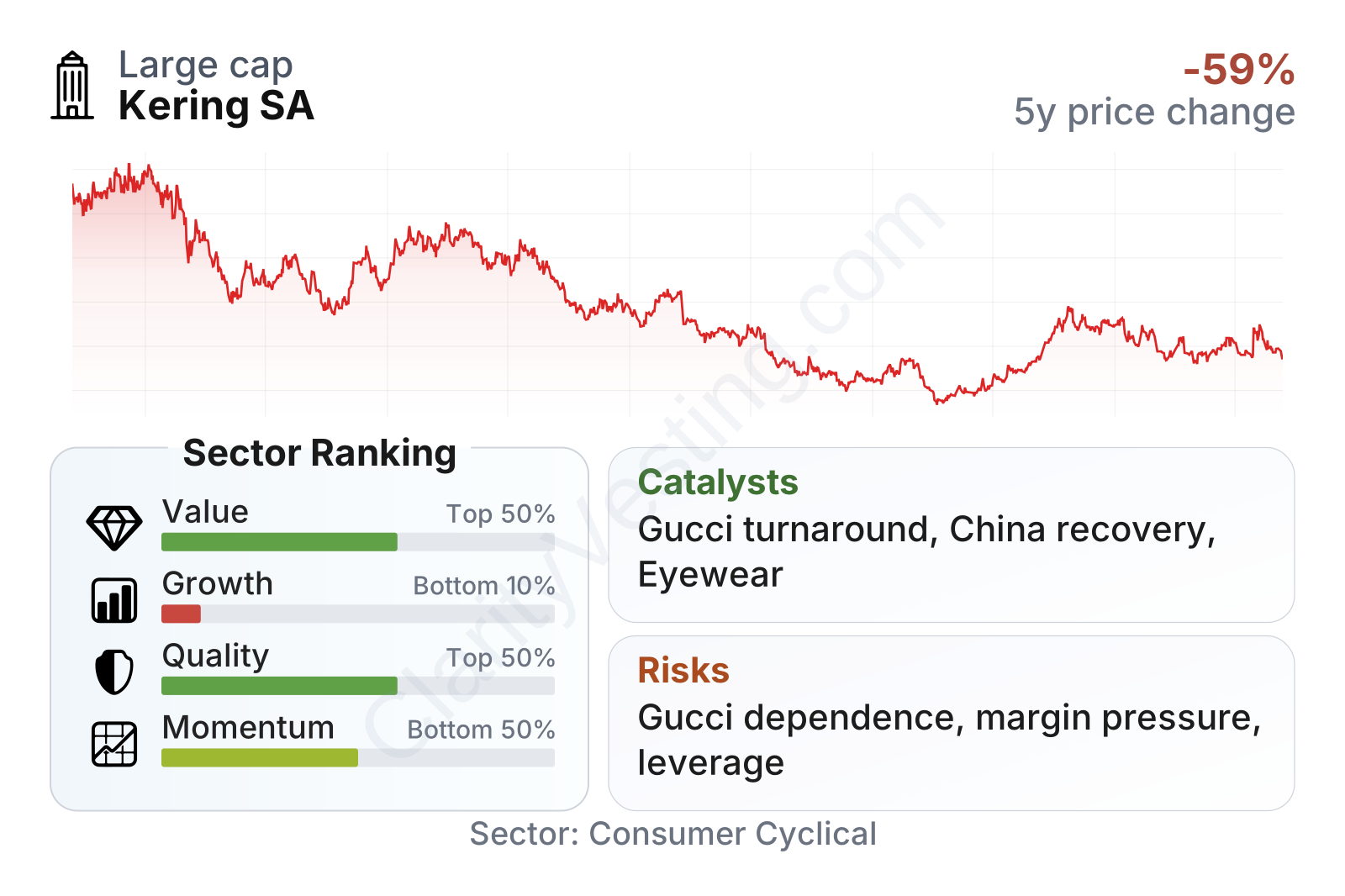
Kering currently sits in a mixed position. On valuation and cash generation, it screens better than many peers, with a free cash flow yield that is slightly stronger than the sector median and a market value of roughly $39 billion. On business quality, returns on invested capital and operating margins remain well above typical sector levels, which shows the group still owns valuable brands. The weak spot is growth: recent sales, margin, and cash flow trends rank near the bottom of the sector, reflecting the depth of the current downturn. Market behavior also shows this split picture, with a painful multiyear share-price decline followed by a partial rebound from very depressed levels.
Growth
The luxury goods industry remains attractive over the long run because it is driven by brand scarcity, pricing power, rising wealth creation, and growing demand from affluent consumers in Asia, the Middle East, and the United States. Even so, luxury is not a straight-line growth market. It is cyclical in the short term and highly dependent on execution at the brand level. Kering’s recent difficulties do not reflect a structurally declining sector as much as a company-specific challenge inside an industry that is still expected to expand over time.
Kering’s strategy for future growth is centered on reviving Gucci, continuing the steady development of Yves Saint Laurent and Bottega Veneta, and scaling newer platforms such as eyewear and high jewelry. That logic makes sense. Gucci is large enough that even a moderate recovery in product appeal, full-price sell-through, and store productivity could materially change group results. At the same time, the company has continued to invest in retail control, brand positioning, and creative renewal rather than chasing volume, which is consistent with how durable luxury franchises are usually rebuilt.
The challenge is that recent growth has been decisively negative. Revenue has been shrinking while many consumer companies have still managed modest expansion. That underperformance points to lost momentum rather than a simple macro pause. For long-term analysis, the key question is whether this is a temporary reset period for major maisons or evidence of a deeper erosion in brand desirability. The answer likely depends mostly on Gucci’s next collections, merchandising discipline, and customer response across key markets.
Cash flow offers a more encouraging signal than earnings alone. Even with weaker profits, Kering is still producing meaningful free cash flow in the multi-billion-dollar range. That matters because it gives the group financial room to keep investing in stores, marketing, and product development while navigating a softer cycle. It also indicates that the business has not lost its underlying ability to convert luxury sales into cash, even if near-term profitability has come under pressure.
Among the more important catalysts, Gucci’s repositioning is the clearest one. If newer collections gain traction and the brand reconnects with high-spending customers, the effect could be substantial given Gucci’s weight in the group. Another catalyst is the continued build-out of Kering Eyewear, which is strategically valuable because it expands the company into a category with recurring demand and broader brand licensing opportunities. Over a longer horizon, jewelry could also become more important, as that category tends to be structurally attractive and less fashion-sensitive than leather goods.
Recent company communications have also highlighted ongoing organizational and brand-management initiatives, including leadership adjustments and stronger focus on execution. Those actions do not guarantee a turnaround, but they do show that management is treating the slowdown as a strategic reset rather than waiting for the market to improve on its own.
Risks
The biggest risk is concentration around Gucci. While Kering owns several respected houses, Gucci remains so large that weakness there can outweigh progress elsewhere. This has been visible in recent results, where softer Gucci demand has pulled down group revenue, margins, and earnings. For a luxury group, concentration risk is especially important because brand desirability can shift quickly when fashion cycles change.
Balance-sheet risk is manageable but not trivial. Net debt relative to EBIT looks broadly reasonable compared with the sector, yet debt to equity is higher than the industry median. That does not automatically signal distress, especially for a cash-generative company, but it does reduce flexibility if the downturn lasts longer than expected or if recovery investments take more time to pay off.
Profitability is another area to watch closely. Kering’s operating margin is still strong by broad sector standards, which confirms the economic quality of luxury brands when they are run well. However, the bottom-line profit margin has dropped to a very low level recently, far below the sector median. That gap suggests the pressure is no longer limited to softer sales; it has also reached the net earnings level through a mix of lower operating leverage, restructuring effects, and higher financial costs.
Kering does have real competitive advantages. Luxury is one of the hardest industries to enter successfully because heritage, craftsmanship, distribution control, and consumer perception take decades to build. Kering owns brands with global recognition and premium pricing power, and it has experience managing creative houses across different categories. Those are genuine strengths. However, it is not the industry leader. LVMH is the clear heavyweight in global luxury, with far greater scale, category breadth, and diversification. Hermès is also in a particularly strong position because of its exceptional brand discipline, scarcity model, and resilience. Richemont is a key competitor in jewelry and watches, while Prada and Moncler are relevant comparables in fashion.
Compared with those peers, Kering currently looks more challenged. LVMH benefits from broader exposure and less dependence on one fashion label. Hermès has shown far more stable demand and profitability. Kering’s relative position is therefore weaker than the top-tier leaders at the moment, even though its brand portfolio still gives it the capacity to recover meaningfully if execution improves.
Reputation and execution risks also matter. Luxury groups depend heavily on creative direction, product timing, celebrity associations, and consumer mood. Missteps in design, pricing, or communication can damage momentum quickly. In Kering’s case, recent years have already shown that a strategic reset at a major house can take time and can be expensive. That is not a scandal-driven story as much as a brand-management risk: the group needs to prove that its houses can regain cultural relevance without diluting exclusivity.
Valuation
On earnings multiples, Kering appears notably cheaper than the sector. Its price-to-earnings ratio has moved down dramatically from the levels seen a few years ago and now stands well below the broader consumer discretionary median. On the surface, that makes the stock look inexpensive. The market is clearly pricing in weak growth, lower margins, and uncertainty around the pace of a Gucci recovery.
That discount is understandable. A low multiple alone does not mean the shares are mispriced when current earnings are under pressure and the business is in the middle of a brand reset. At the same time, the valuation is supported by some real fundamentals: Kering still generates substantial free cash flow, maintains above-average returns on capital, and owns assets that would be difficult to replicate. In other words, the market is not treating Kering like a broken mass-market retailer, but it is also no longer granting it the premium that stronger luxury peers command.
The current valuation therefore reflects a company with high-quality underlying brands but weak present-day momentum. If growth and margins stabilize, today’s multiple can look undemanding relative to the brand base. If the recovery remains slow, the discount can persist for a long time. The pricing context is best understood as skeptical rather than distressed.
Conclusion
Kering remains a high-quality luxury group on paper, but it is passing through one of the weakest periods in its recent history. The business still has meaningful strengths: globally recognized maisons, strong gross economics, solid cash generation, and returns on capital that remain above many peers. Those traits explain why the company still stands apart from ordinary apparel businesses even after a sharp earnings decline.
The problem is that the investment case is currently dominated by execution risk rather than by simple sector growth. Gucci’s slowdown has exposed how dependent the group is on one flagship brand, and recent margin compression shows that rebuilding momentum is costly. Against stronger luxury rivals such as LVMH and Hermès, Kering presently looks less resilient and less diversified.
Valuation is the part of the picture that has become more interesting. The stock is trading on a much lower earnings multiple than both its own history and the wider sector, which reflects deep skepticism. That discount appears grounded in real operational weakness, but it also leaves room for a different market view if Gucci stabilizes and the broader portfolio keeps progressing. The overall picture is that of a prestigious luxury owner with genuine recovery potential, but one that still needs to earn back confidence through better brand execution and more consistent financial results.
Sources:
- Kering Universal Registration Document 2025
- Kering Annual Results 2025 press release
- Kering First-Quarter 2026 Revenue press release
- Kering Investor Relations presentations, 2026 updates
- SEC EDGAR company information for Kering SA
- Wikipedia, “Kering”
This article is for informational purposes only and does not constitute financial advice. Some content is AI-generated. See Disclaimer