Stock Analysis · PGE Polska Grupa Energetyczna S.A (PPOEF)
Overview
PGE Polska Grupa Energetyczna S.A. is one of Poland’s largest electric utility groups. It operates across most of the power value chain: generating electricity, distributing it through regional networks, selling power and gas to end customers, and developing new low-carbon capacity. In practical terms, it is a national-scale energy company with a particularly strong position in Poland’s regulated electricity system.
The group’s business mix is broader than a pure power producer. Its largest and most stable activities usually come from electricity distribution and retail supply, while generation remains strategically important because PGE owns large conventional plants and is also expanding renewable energy. The company has historically been closely tied to Poland’s energy security, which gives it scale and relevance, but also exposes it to policy decisions more than many private-sector utilities.
Based on the group’s segment structure in recent company reporting, revenue is mainly generated from the following sources:
- Electricity distribution: approximately 35% to 45% of revenue in a typical recent mix. This includes regulated network services that deliver electricity to homes and businesses. It is usually the most predictable activity.
- Electricity sales to retail and business customers: approximately 25% to 35%. This covers power and, in some cases, gas sold to end users under supply contracts.
- Conventional electricity generation: approximately 20% to 30%. This includes lignite, hard coal, and other large-scale generation assets, with results influenced by wholesale electricity prices, fuel costs, and carbon allowance costs.
- Renewable energy and related activities: generally a smaller but growing share. This includes wind, solar, hydro, and support-system revenues tied to clean power production.
- Heat, ancillary services, and other operations: a minor share. These activities add diversification but are not the main earnings driver.
PGE’s financial profile in recent years shows how sensitive the company is to energy-market swings. Revenue rose sharply into 2023 and then eased back, while profitability moved much more dramatically because fuel, carbon, impairment charges, and regulation can have an outsized effect on bottom-line results. That makes this a utility with meaningful scale, but not a simple low-volatility earnings model.
The long-term pattern points to a business with very large operating costs relative to revenue, and profit conversion has been inconsistent. That is typical of capital-heavy utilities, but PGE’s swings have been larger than many regulated peers because of its legacy thermal fleet and exposure to Poland’s energy transition.
Key Figures
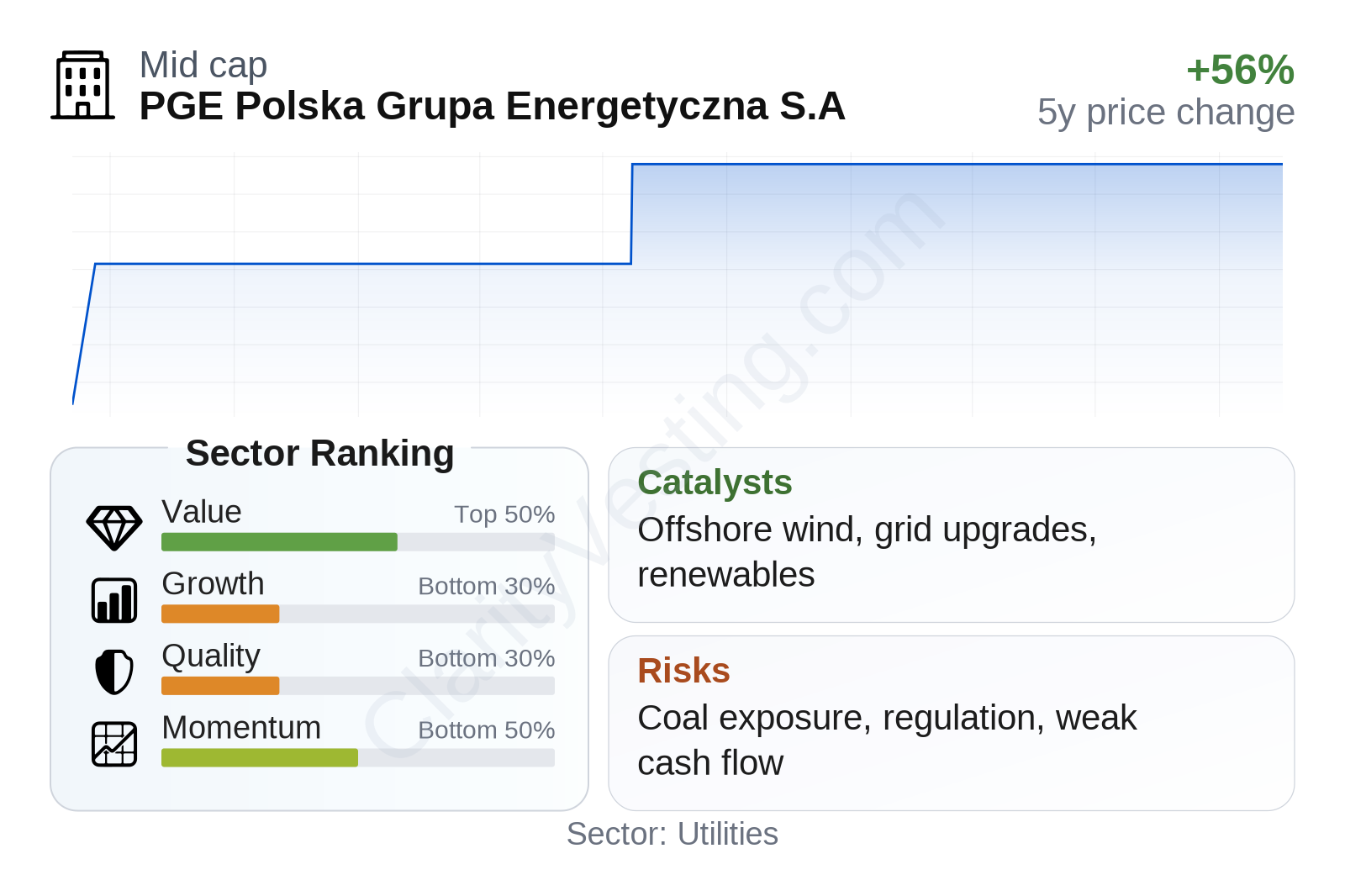
The stock moved up strongly from mid-2024 into 2025 and then largely flattened, suggesting that a significant part of the market’s re-rating has already happened while more recent momentum has cooled.
| Metric | Value | Sector ⓘ |
|---|---|---|
| Date | Nov 21, 2026 | |
| Context | ||
| Sector | Utilities | |
| Industry | Utilities - Regulated Electric | |
| Market Cap ⓘ | $7.99B | |
| Beta ⓘ | 0.67 | |
Value (Cheapness) | ||
| P/E Ratio ⓘ | N/A | 17.21 |
| P/B Ratio ⓘ | N/A | 1.97 |
| FCF Yield ⓘ | -4.22% | -0.81% |
| Dividend Yield ⓘ | N/A | 3.67% |
| EBIT / EV ⓘ | 19.45% | 5.78% |
| PEG ⓘ | N/A | |
Growth (Business expansion) | ||
| Revenue Growth ⓘ | 10.60% | 8.30% |
| RPS Growth (5Y CAGR) ⓘ | -0.76% | 3.61% |
| EPS Growth (5Y CAGR) ⓘ | N/A | -2.03% |
| BVPS Growth (5Y CAGR) ⓘ | -8.48% | 4.29% |
| Margin Growth (5Y Trend) ⓘ | N/A | 3.68% |
| FCF Growth (5Y CAGR) ⓘ | -8.38% | -8.99% |
| DPS Growth (5Y CAGR) ⓘ | 11.81% | 4.70% |
Quality (Business durability) | ||
| ROIC (Latest) ⓘ | 10.07% | 6.37% |
| ROA (Latest) ⓘ | 7.43% | 3.14% |
| ROIC (5Y Median) ⓘ | N/A | 5.97% |
| ROA (5Y Median) ⓘ | -2.48% | 2.74% |
| Net Debt / EBIT (Latest) ⓘ | 0.01 | 7.15 |
| Net Debt / EBIT (5Y Median) ⓘ | N/A | 7.25 |
| Net Debt / EBITDA (Latest) ⓘ | 0.00 | 4.42 |
| Net Debt / Assets ⓘ | 0.04% | 38.03% |
| EBITDA / Interest ⓘ | 6.55 | 4.57 |
| Operating Margin (Latest) ⓘ | 11.52% | 20.06% |
| Operating Margin (5Y Median) ⓘ | -0.68% | 19.99% |
| Debt to Equity (Latest) ⓘ | N/A | 137.61% |
| Profit Margin (Latest) ⓘ | 12.10% | 10.90% |
| Free Cash Flow (Latest) ⓘ | -$336.92M | |
Momentum (Price trend) | ||
| 3Y Return ⓘ | +56.14% | +47.60% |
| 12M Return (excl. last month) ⓘ | 0.00% | +6.07% |
| 6M Return ⓘ | 0.00% | 0.00% |
| Price vs. 200-Day MA ⓘ | 0.00% | +1.40% |
PGE looks mixed on headline metrics. On valuation, it screens around the middle of the utility sector overall, with a particularly strong EBIT-to-enterprise-value relationship, which can point to earnings power relative to the total business value. At the same time, free cash flow remains weak, and that matters because utilities ultimately need cash to fund grids, generation assets, and dividends. Quality indicators are also split: current returns on capital and assets look solid, and leverage appears unusually low versus sector norms, but longer-term profitability and margin consistency have been weaker than many peers. Growth metrics show why the market remains cautious: recent year-over-year revenue growth has been positive, yet the five-year record for revenue per share and book value per share has been negative, which means recent improvement still needs to prove durable.
Growth
PGE operates in a sector with clear long-term relevance. Electricity demand is supported by digital infrastructure, electrification of transport and heating, and the broader replacement of fossil fuels in the economy. In Poland specifically, the modernization of the power system is a structural theme for years ahead. That creates room for utilities that can expand networks, add cleaner generation, and help balance the grid.
PGE’s strategy broadly fits that direction. The strongest industrial logic is in regulated distribution and low-carbon generation. Distribution networks are essential assets, and grid investment tends to become more important as renewable power, electric vehicles, heat pumps, and industrial electrification grow. On the generation side, expanding offshore wind, onshore renewables, energy storage, and flexible capacity is more aligned with Europe’s policy and market direction than legacy coal exposure.
One of the main catalysts is the company’s role in Poland’s offshore wind development and broader power-system upgrade. Large-scale wind projects in the Baltic Sea, together with grid reinforcement and renewable additions, could gradually improve the quality of earnings by shifting the mix toward assets with stronger long-term strategic value. Another supportive factor is that PGE remains a major national operator, which can help it secure a central role in state-backed energy investment programs.
Revenue per share rose sharply through 2023 and then fell back in 2024 and 2025. That pattern suggests the business benefited from an exceptional energy-price period but has not yet converted that into a stable multi-year upward revenue trend. For long-term analysis, that means growth should be judged more by asset transformation and network expansion than by recent sales volatility.
Cash generation has also been uneven. Free cash flow swung from deeply negative to strongly positive and then back below zero. For a utility in heavy transition, this is not unusual, because large capital expenditure can depress cash flow before new assets begin contributing. Still, it means the growth plan is credible only if future regulated and renewable returns become visible enough to offset the upfront spending burden.
Recent company communication has continued to emphasize investment in renewables, distribution, and system transformation. The broader opportunity is clear: if Poland accelerates decarbonization and grid expansion, PGE is one of the few domestic groups large enough to participate at scale.
Risks
This article is for informational purposes only and does not constitute financial advice. Some content is AI-generated. See Disclaimer