Stock Analysis · People Incorporated (PPLI)
Stock Analysis · People Incorporated (PPLI)

Overview

People Incorporated, traded under the symbol PPLI, operates digital platforms centered on social networking and online dating. The company’s best-known brands are Tinder, Hinge, Match, Meetic, OkCupid, Plenty of Fish, and several smaller services. In simple terms, it runs apps and websites that help people meet, chat, and build relationships, with a strong focus on paid subscriptions and premium features.

The business model is fairly straightforward: users can join for free, but the company makes most of its money when users pay for subscriptions or buy extra features such as enhanced visibility, premium messaging tools, or other in-app benefits. Based on recent annual reporting, revenue is mainly concentrated in a few brands, with Tinder still the largest contributor and Hinge the main faster-growing asset.

  • Tinder: approximately 45% to 50% of revenue. This includes subscriptions and à la carte features sold through the Tinder app.
  • Hinge: approximately 15% to 20% of revenue. Hinge is positioned as a relationship-oriented app and has been one of the group’s key expansion engines.
  • Evergreen & Match Group brands: approximately 30% to 35% of revenue. This bucket includes Match, Meetic, OkCupid, Plenty of Fish, and other established brands, mostly monetized through subscriptions and premium add-ons.
  • Indirect and other revenue: a small residual share, generally under 5%, including smaller products and limited non-core sources.

The overall picture is that PPLI is not a diversified media company. It is largely a consumer internet platform business whose economics depend on keeping dating apps relevant, growing paying users, and improving monetization without damaging user experience.

The long-term operating trend has been uneven. Revenue climbed strongly through 2022, then moved lower over the following years, while profitability swung from solid profit to deep losses and then partial recovery. A notable positive is that cost discipline improved in 2025, with selling and administrative expenses and research spending both lower than earlier peaks, helping operating income turn positive again even as total revenue remained far below prior highs.

Key Figures

MetricValueSector
DateJul 20, 2026
Context
SectorCommunication Services
IndustryInternet Content & Information
Market Cap $3.31B
Beta 1.04
Value
(Cheapness)
P/E Ratio 27.3219.52
FCF Yield 1.70%12.63%
EBIT / EV 9.03%4.37%
PEG 12.91
Growth
(Business expansion)
Revenue Growth -12.20%6.10%
RPS Growth (5Y CAGR) -6.46%5.02%
EPS Growth (5Y CAGR) -51.22%-26.68%
Margin Growth (5Y Trend) -19.06%0.79%
FCF Growth (5Y CAGR) -2.60%5.18%
Quality
(Business durability)
ROIC (Latest) -10.58%8.74%
ROIC (5Y Median) N/A8.07%
Net Debt / EBIT (Latest) 0.942.09
Net Debt / EBIT (5Y Median) 1.383.02
Operating Margin (Latest) 14.56%15.46%
Operating Margin (5Y Median) 1.59%13.17%
Debt to Equity (Latest) 31.22%59.09%
Profit Margin (Latest) 1.75%9.11%
Free Cash Flow (Latest) $56.33M
Momentum
(Price trend)
3Y Return -20.59%+36.38%
12M Return (excl. last month) +13.92%+8.16%
6M Return +9.73%+2.31%
Price vs. 200-Day MA +14.32%+1.57%
Better than sector median
Slightly worse than sector median
More than 20% worse than sector median

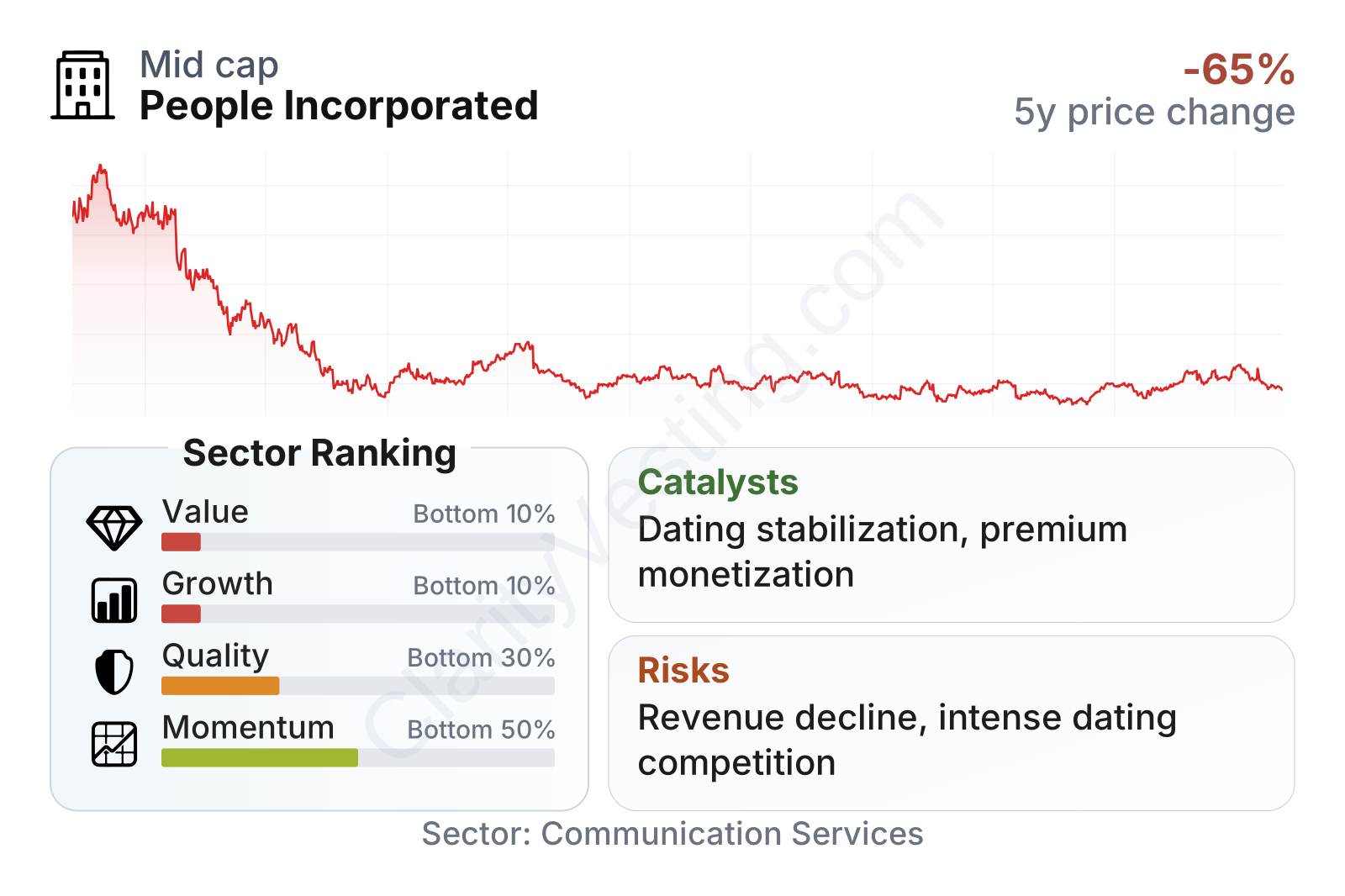
PPLI is a mid-sized internet platform company with market value in the low single-digit billions and a stock volatility close to the broader market. The most recent metrics show a mixed profile. Balance sheet leverage looks relatively restrained for the sector, but growth and overall business quality rank weakly versus peers. Profitability has improved from loss-making periods, yet margins remain below industry norms. On valuation, the shares trade at a higher earnings multiple than the sector median, while free cash flow yield is notably lower, suggesting the market is still giving credit for stabilization and possible recovery rather than current strength alone.

Growth

Online dating remains part of a large and durable digital category. The broader sector still benefits from smartphone penetration, app-based consumer behavior, and willingness to pay for convenience, visibility, and matching tools. That said, this is no longer an early-stage market. In many developed regions, the key challenge is less about category creation and more about product innovation, user retention, pricing, and winning attention in a crowded app environment.

For PPLI, the central growth question is whether Hinge can become large enough to offset slower performance at more mature brands, especially Tinder. That strategy makes sense on paper. Hinge has had stronger brand momentum, and management has been pushing product improvements, international rollout, and monetization expansion. If that continues, it could gradually reshape the revenue mix toward a newer platform with better engagement trends.

The problem is that recent top-line momentum has been weak. Year-over-year revenue growth turned negative after the post-pandemic surge and has stayed under pressure. The latest reading remains down by roughly the mid-20% range from the prior year, which places the company well below the sector median. Over a five-year view, revenue per share has also contracted rather than expanded. That does not remove the possibility of a turnaround, but it does mean the business currently needs recovery before it can be described as a clear growth platform.

Cash generation gives a slightly better signal than revenue. Free cash flow was deeply negative during the downturn, then rebounded sharply into positive territory and remains positive on a trailing basis. Even though the latest level is far below the 2025 peak, staying cash-positive matters because it suggests the company still has room to invest in products, marketing, and technology without relying heavily on external financing.

Recent company updates have focused on product execution, AI-assisted features, trust and safety tools, and better matching outcomes. Those initiatives can be meaningful because dating apps depend heavily on user satisfaction and engagement. Small changes in matching quality, retention, or conversion to paid plans can have a large effect on revenue over time. The strongest near-term catalyst appears to be successful monetization and scaling of Hinge, paired with renewed stability at Tinder.

Risks

PPLI’s biggest risk is business concentration. A large share of revenue still comes from Tinder, which means weak engagement, pricing friction, or brand fatigue in one product can affect the whole company. The second major risk is execution: in online dating, user preferences can shift quickly, and platform changes that are meant to improve monetization can also hurt retention if users feel the service is becoming less useful or too expensive.

Competition is intense. PPLI has scale and owns one of the broadest portfolios in the category, which is a real advantage. It also benefits from brand recognition, accumulated user data, and experience running subscription-based consumer apps. However, those strengths do not make it untouchable. The company is a major global player in dating apps, but leadership is more nuanced than it looks. Tinder remains one of the most recognizable brands in the world, yet category leadership does not automatically translate into the best growth or the strongest user sentiment.

Main competitors include Bumble, Grindr, Spark Networks in select niches, and a wider set of social platforms that compete indirectly for attention and discovery. Compared with Bumble, PPLI has greater scale and a broader portfolio. Compared with Grindr, it is far more diversified by audience. Its challenge is that larger scale has recently come with slower growth and less consistent profitability.

One area that looks healthier is leverage. Debt to equity is around 31%, materially below the sector median near 53%, and the trend has been fairly stable for several years. Net debt relative to EBIT is also lower than the sector norm. That reduces financial stress and gives the company more flexibility if operating conditions remain uneven.

Profitability is the more fragile part of the picture. Profit margin has recovered from negative territory to slightly positive, but it remains only around 2%, versus roughly 6% for the sector median. Operating margin is also slightly below peer levels today, and the five-year trend has deteriorated significantly. In practical terms, that means the company has not yet shown a durable return to the stronger earnings profile it once had.

There is also the usual set of platform risks for this type of business: app store economics, privacy rules, content moderation issues, reputation concerns around user safety, and the challenge of using AI features responsibly. No major scandal is needed for these issues to matter; a slow decline in trust or product relevance can be enough to weaken results over time.

Valuation

PPLI’s valuation looks demanding relative to its current fundamentals. The stock trades at an earnings multiple above the sector median, while revenue growth is negative, profit margins are thin, and the five-year growth record is poor. Free cash flow yield is also well below the sector median, which suggests the market is not pricing the company as a mature low-growth cash machine.

The valuation picture is also complicated by unstable earnings. The company’s P/E ratio has been inconsistent over time, disappearing during loss-making periods and recently spiking to very high levels as profits remained small. When earnings are this volatile, the headline P/E can make the stock look more expensive or cheaper than the underlying business really is. In this case, the market seems to be valuing PPLI on the expectation of normalization rather than on current earnings power.

That expectation is not baseless. The company still owns valuable digital brands, has positive free cash flow, and carries manageable leverage. But the current price appears to assume that margins improve further and that the revenue decline can be slowed or reversed. Without that operational recovery, the valuation leaves limited room for disappointment.

Conclusion

PPLI remains a meaningful player in online dating, with globally recognized brands, a lighter debt load than many peers, and enough cash generation to support a recovery effort. Those are real strengths, and Hinge gives the company a credible path toward rebuilding momentum.

Still, the current picture is more about repair than expansion. Revenue has been shrinking, margins remain subdued, and the business is still heavily reliant on Tinder at a time when execution matters more than scale alone. The market is giving the company some credit for stabilization, but the valuation already reflects a fair amount of optimism compared with the recent operating record.

The overall direction is that PPLI looks like a company with durable assets but an unfinished turnaround. Its long-term appeal depends less on the size of the category and more on whether management can restore consistent growth and stronger profitability across its core apps.

Sources:

  • Match Group, Inc. — Annual Report on Form 10-K for the fiscal year ended December 31, 2025
  • Match Group, Inc. — Quarterly Report on Form 10-Q for the quarter ended March 31, 2026
  • SEC EDGAR — Match Group, Inc. filings database
  • Match Group Investor Relations — Shareholder materials and earnings releases
  • Wikipedia — Match Group

This article is for informational purposes only and does not constitute financial advice. Some content is AI-generated. See Disclaimer


Sign up for exclusive research and insights.

Unsubscribe anytime.
