Stock Analysis · Power Integrations Inc (POWI)
Overview
Power Integrations is a semiconductor company that designs high-voltage power conversion chips and related components. In simple terms, its products help electronic devices take electricity from the wall or another power source and convert it into the form needed safely and efficiently. These chips are used in fast chargers, home appliances, industrial equipment, smart meters, renewable energy systems, and electric vehicles.
The company’s business is centered on power management rather than mainstream computing chips. That matters because demand is tied less to PC or smartphone processors and more to the broader trend toward energy efficiency, electrification, and stricter power standards. Power Integrations also sells gate-driver products used to control high-power switches made with silicon carbide and IGBT technologies, which places it in parts of the industrial and electric-vehicle supply chain.
Revenue is not usually reported by detailed product line percentages in the same way as some larger chip companies, but public filings indicate the business can be understood through its main end markets and product families. Based on company disclosures, the mix is best described approximately as follows:
- Consumer and appliance power supplies: the largest revenue source, estimated at 45% to 55% of sales in recent years. This includes chargers, adapters, TVs, major appliances, and many embedded offline power supplies.
- Industrial, metering, and infrastructure applications: estimated at 20% to 30%. This includes smart meters, industrial power supplies, lighting, and building or utility-related equipment.
- High-power products for renewable energy, motor drives, and electric vehicles: estimated at 15% to 25%. This is where gate drivers and higher-power conversion solutions fit, including solar inverters and parts of EV systems.
- Other and smaller application areas: typically a low-double-digit percentage or less, depending on the year and customer demand.
Geographically, the company has historically had meaningful exposure to Asia because a large share of electronics manufacturing is located there. It also relies on outsourced manufacturing partners rather than owning major fabrication plants itself, which keeps capital needs lower but adds some supply-chain dependence.
One notable business feature is gross margin resilience. Even as revenue fell sharply from the 2021-2022 peak, the company remained solidly profitable at the gross profit line, which suggests its products still carry technical value and pricing discipline. The weaker part of the picture has been below gross profit, where research spending stayed high while revenue compressed.
The long-term pattern shows a company that preserved a strong gross profit structure, but operating profit and net income have narrowed substantially since 2022 because revenue fell while research and administrative spending remained comparatively sticky. That points to a business with valuable technology, but one currently operating below its past scale efficiency.
Key Figures
| Metric | Value | Sector ⓘ |
|---|---|---|
| Date | Sep 12, 2026 | |
| Context | ||
| Sector | Technology | |
| Industry | Semiconductors | |
| Market Cap ⓘ | $2.78B | |
| Beta ⓘ | 1.53 | |
Value (Cheapness) | ||
| P/E Ratio ⓘ | 112.93 | 29.51 |
| FCF Yield ⓘ | 2.85% | 4.25% |
| EBIT / EV ⓘ | 0.80% | 2.85% |
| PEG ⓘ | 1.51 | |
Growth (Business expansion) | ||
| Revenue Growth ⓘ | 2.70% | 15.40% |
| RPS Growth (5Y CAGR) ⓘ | -8.92% | 8.56% |
| EPS Growth (5Y CAGR) ⓘ | -43.34% | -11.88% |
| Margin Growth (5Y Trend) ⓘ | -20.31% | 0.46% |
| FCF Growth (5Y CAGR) ⓘ | -17.00% | 9.80% |
Quality (Business durability) | ||
| ROIC (Latest) ⓘ | 3.15% | 9.44% |
| ROIC (5Y Median) ⓘ | 5.65% | 8.30% |
| Net Debt / EBIT (Latest) ⓘ | -3.49 | 0.54 |
| Net Debt / EBIT (5Y Median) ⓘ | -0.79 | 0.44 |
| Operating Margin (Latest) ⓘ | 4.50% | 9.58% |
| Operating Margin (5Y Median) ⓘ | 7.89% | 8.25% |
| Debt to Equity (Latest) ⓘ | N/A | 33.33% |
| Profit Margin (Latest) ⓘ | 5.58% | 7.14% |
| Free Cash Flow (Latest) ⓘ | $79.04M | |
Momentum (Price trend) | ||
| 3Y Return ⓘ | -29.39% | +45.48% |
| 12M Return (excl. last month) ⓘ | +40.59% | +23.48% |
| 6M Return ⓘ | +13.55% | +20.93% |
| Price vs. 200-Day MA ⓘ | -7.27% | +7.43% |
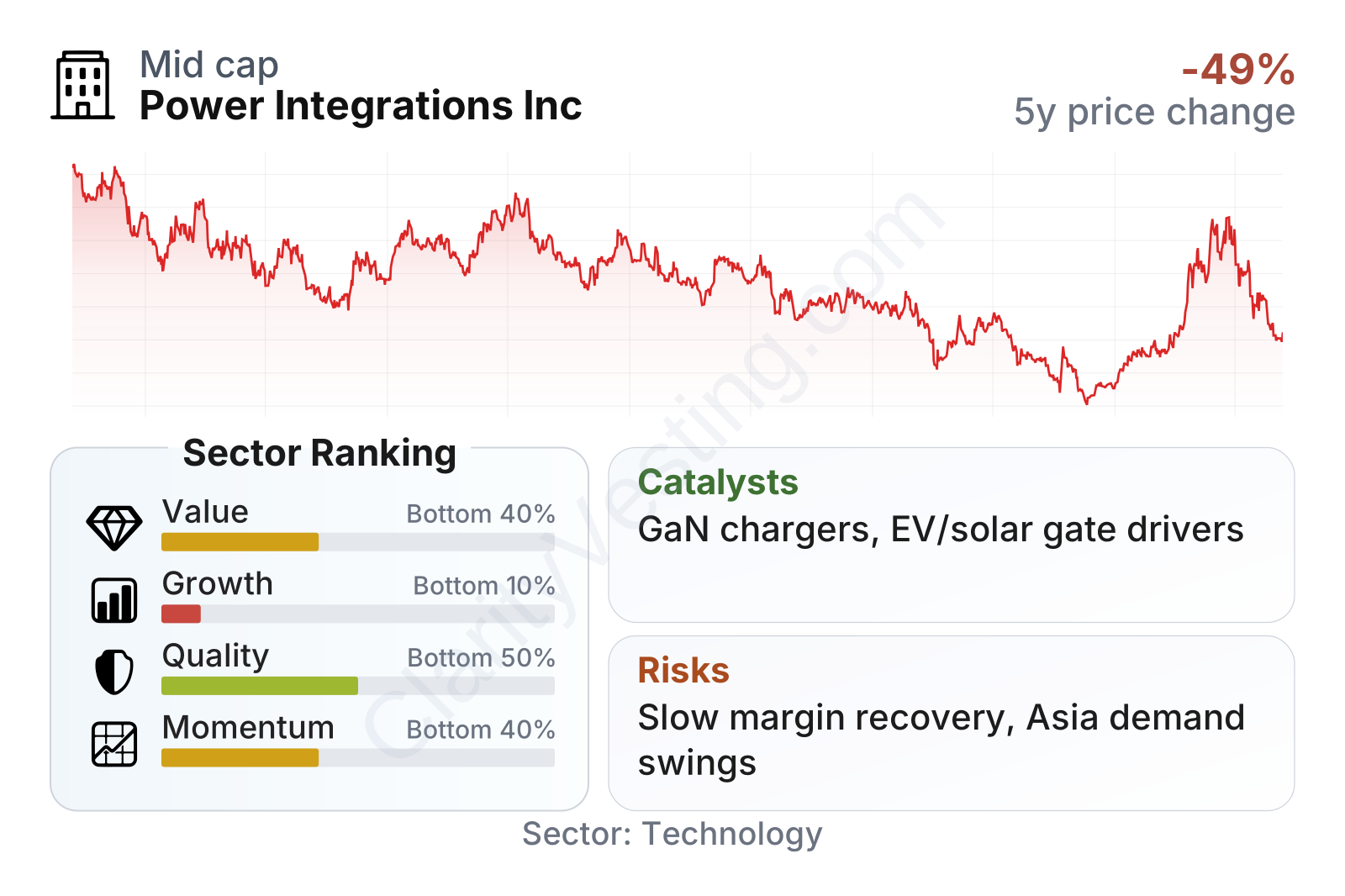
Power Integrations is a mid-sized semiconductor company with a stock that has been volatile over the last several years. The recent recovery in share price has been strong over the last six months, but the longer three-year record remains weaker than the broader semiconductor sector. In the latest factor snapshot, the company ranks poorly on growth and only around the middle to lower end on quality and momentum, while valuation metrics look demanding because earnings are currently depressed. One clear strength stands out: the balance sheet remains unusually conservative for the sector, with net cash rather than heavy debt.
Growth
Power Integrations operates in parts of the semiconductor market that benefit from durable structural themes: higher energy-efficiency standards, electrification of transport and industry, growth in renewable energy equipment, and the spread of fast charging and connected electrical devices. These are attractive markets for the long term because power conversion is a basic requirement in almost every electronic system.
The strategic logic is easy to understand. As devices become smaller, chargers become faster, and industrial systems become more energy efficient, customers need better power chips. Power Integrations has built expertise in high-voltage analog and mixed-signal design, plus software, packaging, and safety know-how. This gives it a role in applications where reliability and efficiency matter more than raw computing speed.
The biggest growth opportunity is likely in higher-power applications. The company has spent years expanding beyond low-power adapters into gate drivers and solutions tied to silicon carbide, motor drives, solar inverters, and electric vehicles. If these categories scale meaningfully, they could diversify the business away from the more cyclical consumer charger market.
Recent revenue growth shows a business emerging from a deep correction rather than one already in a strong expansion phase. After severe year-over-year declines through 2023 and much of 2024, growth turned positive again, but only at low-single-digit levels in the latest periods. That is an improvement in direction, not yet proof of a full demand rebound.
Cash generation has also stabilized after a major drop from earlier highs. Free cash flow remains positive and has improved from the trough, which is important because it shows the company is still producing cash even in a weaker profit environment. Still, the business is generating much less cash than it did at the cycle peak, so a stronger recovery in revenue would likely be needed to restore earlier earning power.
A meaningful catalyst is the company’s position in gallium nitride, or GaN, power semiconductors. GaN can improve charging speed, reduce power loss, and shrink adapter size. Power Integrations has highlighted this area in company materials, and broader adoption of GaN-based chargers and power supplies could support content growth per device. Another catalyst is the company’s gate-driver business for high-voltage applications, especially where electrification and renewable-energy installations continue expanding.
Recent company updates have also pointed to inventory normalization across parts of the supply chain. That matters because the prior downturn was not only about end demand; it was also tied to customers carrying too much inventory. If that overhang continues to fade, revenue can recover even before end markets become especially strong.
Risks
This article is for informational purposes only and does not constitute financial advice. Some content is AI-generated. See Disclaimer


